WATCHIT Eye introduces another layer of collision awareness
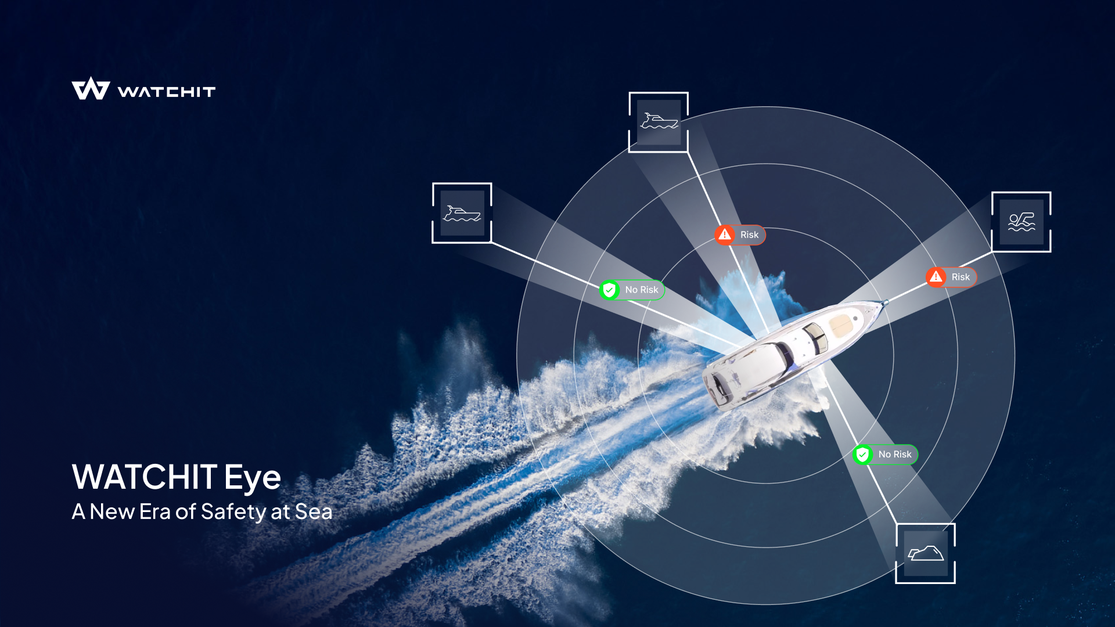
WATCHIT is presenting its Eye system in the 2026 METSTRADE catalogue as a marine collision-risk assistant combining a dedicated sensor with data already available aboard. The company's first-party description says the system uses proximity sensing and marine artificial intelligence to assess hazards, including nearby vessels, floating objects and partly submerged obstacles, then provides alerts intended to help the skipper respond. The announcement is about assistance, not an authorised replacement for the person in charge of navigation. On a recreational boat below twelve metres, any warning system must be considered alongside the realities of a limited helm, changing sea conditions and the obligation to maintain an effective lookout.
The marine environment defeats simple assumptions
At sea, a hazard does not always resemble a distinct object on a flat road. A floating log may sit almost entirely below the surface, while a small inflatable, paddleboard or fishing marker can be difficult to distinguish against waves. Vessels move in response to wind and current, and the viewing angle changes as a boat pitches or rolls. WATCHIT's proposed approach is to collect additional information about the area around a craft. That can be valuable, but the difficulty of the environment also means that any published claim about detection needs to be assessed under different conditions. A skipper cannot assume that an electronic sensor sees everything simply because the manufacturer has named several classes of hazard.
Dedicated sensing complements other boat data
The official exhibition entry describes combining measurements from an Eye-specific sensor with information from the vessel's existing systems. Such integration can help an algorithm place a potential hazard in context, rather than interpreting one measurement in isolation. For example, knowing the boat's speed and course may influence whether an object presents an immediate concern. However, the system will only be as useful as the quality and timeliness of its inputs. A faulty speed reading, incorrect calibration or interrupted data link could affect interpretation. The correct installation procedure should explain which instruments are required, which are optional and what happens when expected data are missing.
Artificial intelligence is not a navigational authority
Marine AI may help classify patterns and reduce the burden of watching multiple instruments, but it can generate false alarms or fail to recognise unfamiliar situations. The technology's actual performance depends on its hardware, software, training and operational conditions. A skipper remains responsible for following applicable navigation rules, including proper lookout and safe speed. WATCHIT Eye should be judged as an additional source of information, not as an instruction to maintain course or pass close to an object. Any assistance display ought to communicate uncertainty in a way a user can understand, particularly when the software's confidence is low.
Proximity and collision risk are not identical
An object can be close to a boat without presenting an imminent collision, and a more distant moving vessel can become a serious concern if the two paths converge. A useful warning system needs to distinguish between these situations. The manufacturer's description refers to assessing risk rather than merely showing distance, but the public catalogue does not specify all of the underlying calculations. Buyers should ask how the device defines a hazard, which information it considers and whether its settings can be matched to different boating environments. A constant stream of warnings that ignore context may be distracting, while overly permissive thresholds could create false reassurance.
An alert must arrive in time to matter
The practical value of a collision-warning product lies partly in when it brings a developing situation to attention. At higher speed, a small boat covers distance quickly, leaving little time for the crew to identify and respond to an obstacle. At low speed in a marina, by contrast, the system may need to handle many harmless nearby objects without overwhelming the operator. The exhibition page does not provide an independent universal alert distance or guaranteed reaction time. Owners should ask about tested detection ranges for representative objects at different speeds, and how those figures change with visibility, sea state or sensor mounting.
Floating debris presents a distinct challenge
Wood, plastic, lost fishing gear and other debris may be just above the surface or intermittently obscured by waves. Hitting a substantial object can damage the hull, propeller or steering equipment, particularly on a planing craft. WATCHIT identifies floating and semi-submerged obstacles among the hazards its system is intended to address. That is a useful design objective, but no sensor can be presumed to recognise every possible piece of debris. The owner should continue observing the water ahead and take account of local conditions. Information about actual test objects, size limits and false-alarm behaviour would be important when comparing WATCHIT Eye with alternative systems.
Small boats require straightforward displays
A nine-metre motorboat may have a multifunction display, engine gauges and communications equipment all within a compact helm area. Adding another alert source can be helpful if it communicates priority clearly. An alarm that requires detailed menu navigation or explanation during a manoeuvre may do more harm than good. Owners should ask whether WATCHIT Eye integrates with their existing displays, which alert formats are available and how the unit indicates a sensor fault. Its manufacturer's description promises clear, timely warnings, but real usability should be tested in the positions and lighting conditions of the intended boat.
A docking assistant is not the same as open-water awareness
WATCHIT Eye's risk-monitoring focus differs from products designed mainly to provide camera views around a boat during docking. Close-range visual assistance can help a helmsman judge a pontoon or neighbouring hull, while collision awareness may involve assessing objects and movements further ahead. The two categories can overlap but need not deliver identical information. An owner should identify the principal problem before selecting equipment: poor visibility around a high-sided cabin cruiser, close manoeuvring with limited crew or hazards encountered when travelling at speed. A comprehensive product comparison should match tested functions to that specific problem rather than treat all AI marine electronics as interchangeable.
Sensor location is an engineering decision
Mounting a new electronic sensor on a small boat may require a location free from obstruction by rails, cabin structures and other equipment. The unit should be protected from impact and able to operate within the environmental exposure described by the manufacturer. Cables or network connections may need to pass through deck or cabin surfaces, with proper watertight glands and strain relief. An installer must consider vibration, water ingress and access for cleaning or service. Poor installation can undermine the performance of capable hardware. Before ordering, owners should request the permitted mounting heights, field of view and any restrictions on nearby materials or other electronic devices.
Sea state and lighting can change behaviour
A sensor that identifies objects in calm water may face more challenging conditions in choppy seas, spray or strong sunlight. Changes in the boat's attitude can also alter what a sensor observes. The exact technology and detection limitations of WATCHIT Eye should be checked from current technical documentation; a short exhibition listing is not enough to establish operation in every weather condition. Users should know what warnings indicate that the system has become degraded. An assistance device that quietly displays old or unreliable information is particularly undesirable. Clear fault reporting matters as much as successful detection during a sales demonstration.
Compatibility needs to be verified before purchase
The manufacturer refers to existing onboard data, but recreational boats use a mixture of electronic standards and generations of equipment. A modern NMEA-connected network may support the proposed integration more easily than an older set of isolated instruments. The buyer should obtain an approved compatibility list, understand any additional interfaces and establish who will maintain software updates. If an existing navigation display is already close to its processing or power limits, new equipment may require a wider refit. The full installed cost should therefore include network work and commissioning, not merely the sensor and its retail price.
Alerts can change skipper behaviour
An electronic device may increase vigilance by identifying a hazard that would otherwise have been overlooked. It can also create a form of overreliance if the user begins to assume that no warning means the water ahead is clear. This risk deserves explicit treatment during training. Skippers should continue scanning the surroundings and using charts, depth information and other appropriate instruments. Crew members should understand that the equipment provides advice subject to limitations. If the sensor fails or becomes unavailable, the boat should remain safely operable using ordinary navigation procedures without disruption.
Collision regulations remain unchanged
The International Regulations for Preventing Collisions at Sea require vessels to maintain a proper lookout, proceed at a safe speed and take appropriate action to avoid collisions. A manufacturer's use of the phrase collision prevention does not confer a legal right to transfer those duties to software. An alert may assist in recognising a developing encounter, but deciding how to manoeuvre remains the skipper's responsibility. Automatic-looking graphics should not be mistaken for guaranteed right-of-way decisions. Buyers should ask exactly which operational claims are supported and distinguish them from general marketing language. Safe seamanship remains the primary defence.
Testing should include false positives and missed hazards
The most persuasive demonstration of WATCHIT Eye would include a variety of real marine objects, vessel movements and weather conditions, not only a short clip of a successful detection. Buyers can ask how often the system raises irrelevant alarms, which small objects it cannot reliably identify and what is done when a sensor is obscured. These are ordinary validation questions for safety-related equipment. The official product description does not publish a comprehensive independent performance table in the material used here. An owner should therefore resist drawing firm conclusions about reliability until test data relevant to the vessel's operating programme are available.
Software updates and service access matter
A sensor-based AI product combines hardware with software that may evolve after installation. Updates can bring useful refinements, but they should be delivered in a controlled manner with clear information about changes to behaviour. Owners should ask how the system handles an interrupted update and whether it remains usable without an internet connection. Service availability in the boat's cruising region is also important. A device installed to support navigation should not become unusable because a subscription, account or remote service has changed unexpectedly. The manufacturer should explain which functions are local and which, if any, depend on connectivity.
The system may be useful to different types of boaters
A small open motorboat operating in busy waterways encounters different hazards from a sailing yacht moving at lower speed offshore. Owners of fast craft may be particularly interested in early awareness of floating debris, while coastal cruisers may focus more on vessel encounters. Neither group should assume that WATCHIT Eye has been independently validated for every speed or hull type. The operating profile, installation position and available response time all influence potential value. A good dealer should ask how the boat is used before proposing a configuration or making claims about improved safety.
What the current exhibition listing confirms
The official METSTRADE entry confirms that WATCHIT Eye is being presented as a marine AI and proximity-sensing platform intended to evaluate hazards using its own sensor and existing vessel information. It specifically refers to floating objects, partly submerged obstacles and other vessels. It does not establish a universal detection guarantee, a fixed retail price, the exact hardware requirements for every boat or permission to abandon manual lookout. Those details should be verified in the current technical and installation documentation. The development is newsworthy because it attempts to make hazard-awareness information more accessible to ordinary recreational boaters.
A useful aid only when its limits are understood
WATCHIT Eye represents one direction in the growing market for intelligent marine assistance systems: gathering information from several sources and presenting risk assessments in a form that a skipper can act upon. The promise is practical, especially aboard boats with limited crew and busy helms. But the technology's value will depend on real detection performance, manageable alerts, reliable installation and honest guidance about failure conditions. Owners under twelve metres should ask for a demonstration on a comparable boat and make a purchasing decision based on the hazards they actually face. A better informed skipper is the goal; replacing the skipper's judgement is not.
Original industry sources and image credits
Reporting based on Official 2026 METSTRADE product and technical description supplied by WATCHIT.
Lead image: WATCHIT Eye Brings Proximity Sensing and Marine AI to Small Boats — manufacturer-supplied product publicity image. © WATCHIT. Original supplier image.