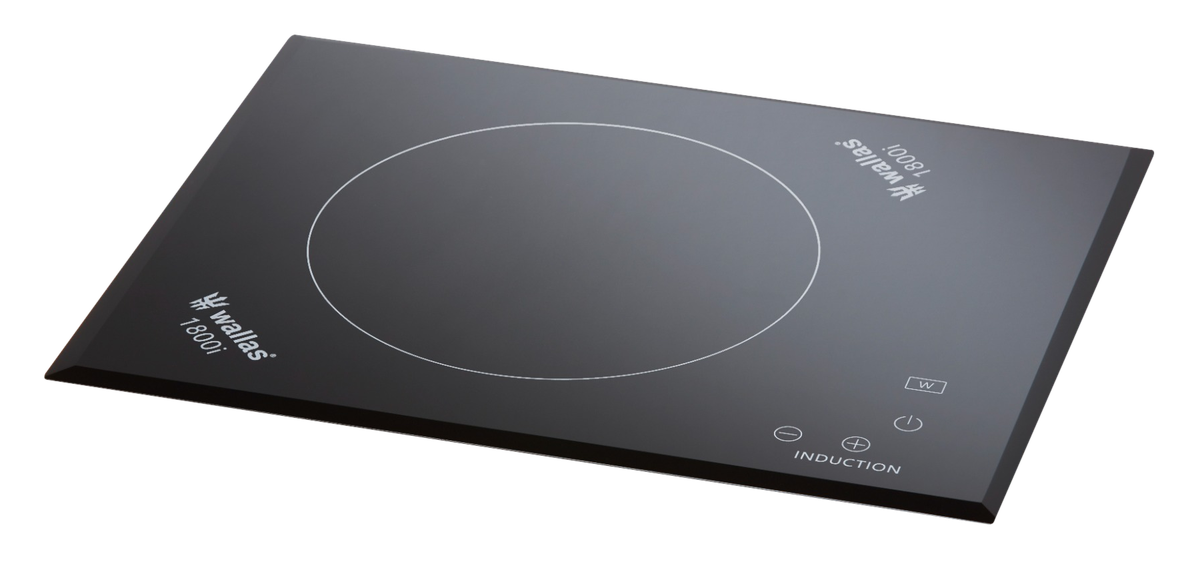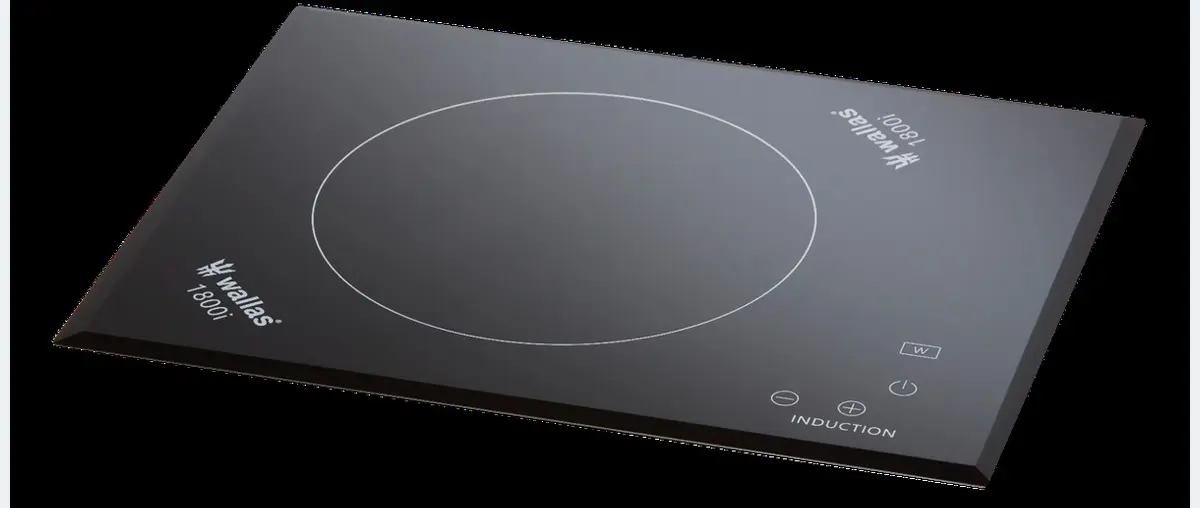
A compact induction hob with power-management options
Wallas has introduced the 1800i single-zone induction cooktop in its METSTRADE 2026 product catalogue, with the entry dated 17 November. The Finnish manufacturer describes a compact appliance that delivers up to 1,800 watts on a 230-volt supply and 1,200 watts on 110 volts, with automatic selection between the two. It also highlights an adjustable power limit and a low continuous-output mode intended to suit restricted shore-power supplies and inverters. The listing states that the hob needs only 76 millimetres of space beneath its ceramic top and can be fitted into a suitable countertop cut-out. For the owner of a small cruising boat, these are practical details rather than spectacular technology claims: they affect where cooking can be installed, how much electricity it consumes and how reliably it can operate aboard.
Small-boat galleys work within tight limits
A compact cabin cruiser may have only a short worktop and limited space beneath it, shared with storage, plumbing and electrical equipment. A cooking appliance needs to fit without interfering with drawers, structural components or nearby fittings. The Wallas 1800i's stated 76-millimetre under-counter requirement suggests the company has paid attention to this constraint, although an installer must still check the complete installation diagram. Ventilation, cable routing and service clearance may require more space than the visible depth of the appliance. Owners should measure the actual countertop and surrounding area before ordering, rather than assume that a compact product photograph proves it will fit any galley.
Induction cooking changes the heat source
An induction hob uses an electromagnetic field to generate heat in compatible cookware rather than heating a flame or conventional exposed electric element. This can provide convenient control and avoid a naked flame at the cooking surface, but it is not inherently risk-free. The cookware becomes hot, and nearby surfaces may still be affected. Induction also requires a suitable electrical supply and appropriate pots and pans. A buyer who is converting from gas or alcohol cooking should consider the whole galley arrangement, including ventilation, fire precautions and energy storage. A hob alone does not determine whether a boat can prepare meals safely during a passage.
The published power figures are supply-dependent
Wallas identifies a maximum of 1,800 watts at 230 volts and 1,200 watts at 110 volts. The distinction matters for boats that travel between regions with different shore-power standards or use compatible onboard inverters. A dual-voltage feature does not mean the appliance can be connected directly to a 12-volt battery. The boat still needs an appropriate AC supply, and any inverter must support the load as well as startup and continuous operating conditions. Owners should verify the exact input requirements, frequency and protective arrangements from the latest manual. The name 1800i is not a promise that every installation will always deliver its full rated output.
Shore-power connections may be limited
Some small marina berths have restricted electricity supplies, and a boat may share that connection between charging, refrigeration, heating and cooking. Turning on a high-power cooking appliance can exceed a supply's available capacity, causing a breaker to trip or forcing other equipment to shut down. Wallas promotes an adjustable power limit as a way to accommodate smaller shore-power fuses. That could be useful where energy use must be managed deliberately. But owners still need to know the actual rating of the shore connection and avoid using unsafe adapters or undersized cables. The appliance's control settings are only one part of a correctly protected shore-power system.
Inverter compatibility deserves particular scrutiny
A boat relying on batteries for AC electricity typically uses an inverter to supply appliances designed for mains voltage. Some cooking devices draw power in pulses or switch rapidly between high and low levels, which may challenge certain inverter arrangements. The Wallas listing says its continuous low-power output is intended to protect the inverter. Buyers should ask what behaviour is meant by that claim and which inverter types have been tested. Rated output, waveform quality, cooling and battery discharge limits all matter. An older inverter may not be suitable even if its headline wattage seems adequate. A qualified marine electrician should establish compatibility before anyone begins changing the galley's electrical distribution.
Electrical energy is not free at anchor
Induction cooking can be convenient, but it consumes stored energy when the boat is away from shore. An appliance operating near 1,000 watts for a quarter of an hour uses roughly 250 watt-hours before inverter and other losses. The actual amount depends on the power setting, cookware and cooking task. A small battery bank may struggle if the same period includes refrigeration, pumps and navigation equipment. Owners should prepare a realistic energy budget rather than treat the hob as merely a substitute for a small gas burner. Larger lithium banks and charging systems can make electric cooking more practical, but those upgrades have their own costs and engineering requirements.
A single zone imposes useful discipline
The 1800i is described as a single-zone cooktop, meaning that it is intended for one principal cooking vessel at a time. On a small boat, this may be entirely adequate for boiling water, reheating food or preparing a simple meal. It can also reduce the amount of countertop occupied by appliances. Owners accustomed to using two burners simultaneously will need to consider how meal preparation changes. A compact galley may benefit from a combined strategy involving one induction zone and other suitable cooking or food-preparation equipment, but that decision should follow how the boat is actually used. Space savings have value only if the resulting galley meets the crew's needs.
Cookware and stability matter at sea
Induction works only with compatible cookware that can interact with its magnetic field. A pan that works well at home may not be well suited to a moving vessel if it is too tall, heavy or difficult to secure. Boaters should also consider pot restraints and non-slip surfaces where appropriate. A stable bench installation at a marina is not the same as using a galley when the boat heels or encounters waves. The manufacturer's entry does not establish that a particular pot restraint is supplied or that cooking underway is recommended. The skipper should follow the appliance instructions and operate the galley only when conditions make it safe.
Ceramic surfaces still become hot
A common misconception is that induction means the cooktop never becomes hot. In reality, a heated pan can transfer energy back into the ceramic surface, leaving residual heat after cooking. Users should treat the area as hot until it has cooled sufficiently and should keep combustible materials clear. On a small boat, loose bags, towels and paper may be stored close to the galley, making discipline important. Children and guests may also be unfamiliar with how an induction surface behaves. Owners should establish simple routines for switching the unit off and checking the surface before placing anything on top. A compact hob cannot compensate for careless handling.
Mounting and securing the appliance
The manufacturer says the 1800i fits into a countertop cut-out and does not require a separate installation kit, but that does not eliminate the need to follow exact cutting and fixing instructions. A moving boat subjects equipment to vibration, heeling and impact loads. The appliance must be held securely without distorting its housing or damaging the countertop. Its position should also allow cleaning and future service. A competent installer needs to confirm whether heat-sensitive materials, storage lockers or wiring lie immediately beneath the proposed mounting location. The published 76-millimetre figure is useful, but the total design must satisfy all documented clearance requirements.
Weather and humidity affect the surroundings
Even if an induction unit is installed inside a cabin, the galley may experience condensation, salt-laden air and occasional spray from an open companionway. Electrical connections need appropriate protection, and the appliance should be isolated if water intrusion is suspected. Owners should not assume that a cooktop intended for boats can safely operate while submerged or with damaged seals. The correct location should keep it away from routine wet work and allow any spilled liquid to be managed. Cleaning must follow the supplier's instructions, particularly around control surfaces and joints. A watertight countertop does not make every electrical component beneath it immune to damage.
Replacing a fuel cooker involves more than swapping appliances
An owner removing an existing gas or alcohol hob may also need to consider how the old fuel installation is safely decommissioned. Gas bottles, lines, valves and lockers should be handled according to the relevant requirements rather than simply abandoned in place. The electrical supply for a new induction hob must then be designed around the intended load. This could involve a new inverter, increased battery capacity or an altered shore-power circuit. A retrofit quotation should show all of these elements. The low-profile appliance may be inexpensive relative to major electrical changes, so comparing only the cooker prices can be misleading.
Automatic voltage selection is not unlimited compatibility
The Wallas description says the hob automatically switches between its supported 230-volt and 110-volt operating modes. That may simplify use on vessels supplied by appropriate equipment in different markets. Nevertheless, the boat's wiring, plug, frequency and protective devices must be correctly specified, and owners should verify the precise voltage range. An appliance that can recognise two operating environments is not necessarily tolerant of any arbitrary voltage or unstable power source. Shore systems should be tested and connected with proper marine equipment. The convenience lies in correct recognition of compatible supplies, not in eliminating the need for safe electrical installation.
What the exhibition entry does and does not establish
The first-party METSTRADE listing dated 17 November 2026 confirms the Wallas 1800i as a compact induction cooktop with a single cooking zone, defined output at 230 and 110 volts, automatic supply selection, adjustable power limiting and a stated shallow installation depth. It does not establish an independent test of every inverter combination, a universal retail price or compatibility with every older boat. Those claims would require separate evidence. The announcement is relevant because it addresses a practical obstacle to electric cooking on smaller vessels: power availability can be as restrictive as countertop space.
The best choice depends on the boat's electrical system
For a craft that spends most nights connected to shore power, an induction hob may provide straightforward and convenient cooking. For an anchor-focused cruiser with limited battery capacity, even an adjustable-power appliance requires careful energy planning. There is no universal answer, and a product designed to manage low-power operation does not create energy. The Wallas 1800i is worth evaluating where its shallow profile and power-control features address a real installation problem. Owners should ask a qualified marine electrician to confirm the supply and an experienced installer to review the galley layout. A successful upgrade is one that cooks reliably without compromising safe electrical operation or the limited space aboard.
Original industry sources and image credits
Reporting based on Official METSTRADE 2026 exhibitor product information supplied by Wallas.
Lead image: Wallas 1800i Adds Power Limits to Compact Induction Cooking at Sea — official manufacturer product photograph. © Wallas. Original supplier image.