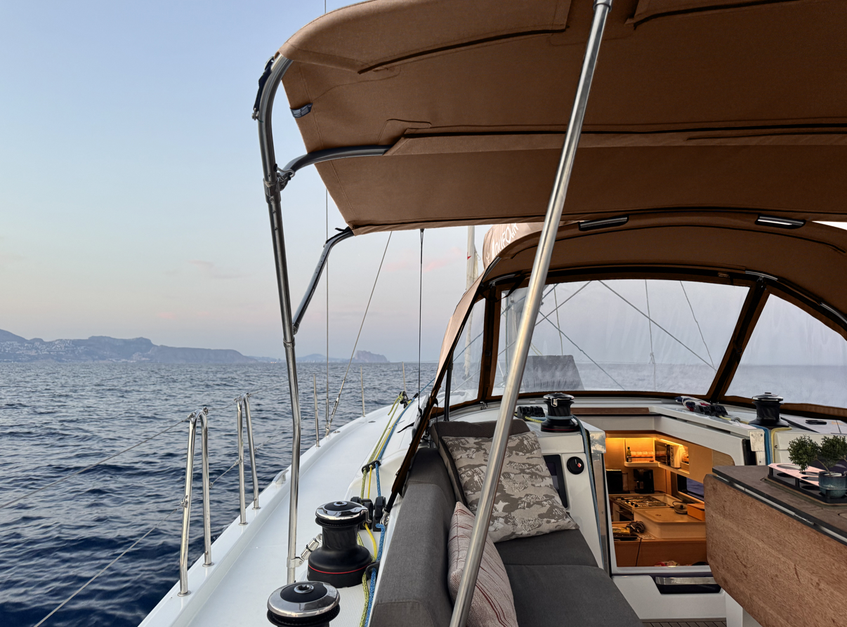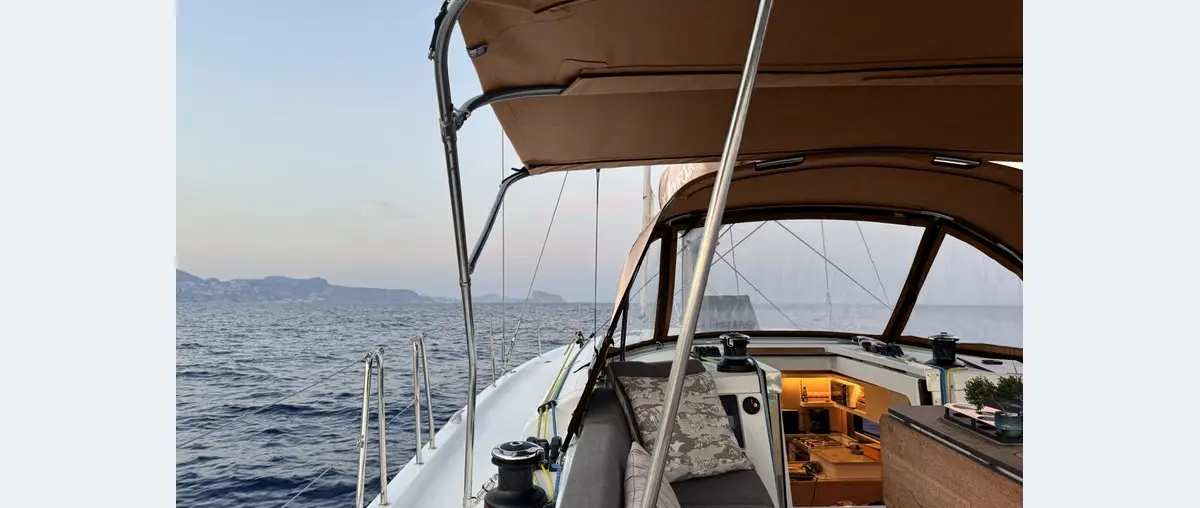
Recycled marine textile receives DAME recognition
Sunbrella Plus Recycled has been named among the Special Mentions at the 2026 DAME Design Awards, with the result announced at METSTRADE on 17 November. The fabric, produced by Sunbrella and Dickson Constant, is intended for marine covers and other exposed textile applications. Its manufacturer reports that recycled material represents 33 percent of the product and describes using manufacturing offcuts alongside high-tenacity yarn to achieve durability and shape retention. The underlying product was listed in late 2025, so the news is the November 2026 awards recognition rather than a claim that the textile has just been invented. For owners of smaller boats, the practical question is whether a recycled-content cover fabric can remain dependable through regular sun, rain and handling.
Boat covers work harder than they appear
A cockpit cover may spend much of its life outside, exposed to ultraviolet light, moisture, salt and wind. The fabric has to maintain its dimensions while being stretched over frames, clipped to fittings and folded repeatedly during use. If it sags excessively, water can pool rather than drain away; if it becomes brittle or tears, equipment beneath it may be exposed. A successful textile needs suitable yarn, weaving, finishing and installation, not merely an attractive colour. Sunbrella’s claim of improved dimensional stability is therefore relevant to real boat ownership. It should still be tested against the specific design and loads of a cover rather than assumed to make every installation trouble-free.
The thirty-three-percent figure needs context
The official product listing states that Sunbrella Plus Recycled incorporates 33 percent recycled materials. That is a meaningful composition claim, but it should not be transformed into the assertion that the whole fabric is recycled or that producing it has zero environmental impact. Recycled yarns may come from several sources, each with its own processing requirements. The company describes collecting and sorting manufacturing offcuts, giving a defined origin for at least part of the material. A customer who wants a full environmental comparison should look for verified lifecycle information, including energy use, transport, durability and end-of-life options. A simple percentage is a useful starting point, not a complete sustainability score.
Manufacturing offcuts return to the process
The manufacturer explains that its process uses textile offcuts generated during production. Recovering such material can reduce the amount discarded from manufacturing, provided the recovery is consistent and produces yarn of suitable quality. Sorting the offcuts is important because different colours or compositions may affect the result. The company notes slight variations and flecks in appearance, potentially making the recycled content visible rather than disguising it entirely. Buyers should ask whether those variations are part of the approved finish and whether colour matching across separate production batches has practical limits. A visible difference can have character, but it also matters when a boat owner needs to repair one panel several years later.
High-tenacity yarn provides structural support
Sunbrella’s catalogue describes the use of high-tenacity yarn in the weft to help control elongation and sag. The weft runs across the width of a woven fabric, while the warp runs lengthwise. Their interaction influences dimensional stability under load. That is particularly important when a cover is tensioned over a frame or fastened around a cockpit. Strong yarn alone does not determine the performance of the complete assembly: seams, edge reinforcement and the way fabric is cut also matter. An owner should ask the canvas maker how the chosen textile behaves under the expected tension rather than treating a single fibre specification as a guarantee against stretching.
Why shape retention affects rainwater drainage
A fitted boat cover often relies on a defined slope to direct rain towards the edges. If the material stretches and develops a low area, water may collect, increasing load and making the sag worse. Proper frame design and tension are essential, whatever fabric is used. A textile with improved resistance to elongation may help maintain the intended form, but it cannot rescue a badly designed support system. Owners should inspect cover geometry after installation and again following heavy rain or wind. The product’s DAME recognition is relevant to this practical challenge, yet every boat has a different combination of frame spacing, fastenings and exposed surfaces.
Sunlight, salt and abrasion are separate stresses
Marine textile durability should be evaluated across several dimensions. Ultraviolet radiation can affect colours and fibres, salt can accumulate along seams and hardware, and abrasion may damage areas that rub against rails or windshield edges. A fabric described as durable is not necessarily equally resistant to every form of damage. The Sunbrella listing does not provide independent results for every boat environment in this article. Owners should request current technical data and recommended cleaning methods. Protective patches at high-wear points may extend a cover’s life, while regular inspection can reveal an installation problem before a larger repair becomes necessary.
A cover is a custom assembly, not just a material
Even an excellent fabric can fail if poorly measured, stitched or installed. The canvas maker must consider how the boat moves, where the cover attaches and how it is removed for normal use. Snaps, zippers, seams and tensioning straps may wear at different rates from the textile itself. On a small motorboat, a cover might protect upholstered seating; on a sailing cruiser, it may shield the companionway and part of the cockpit. The material can be common to both applications while the finished construction differs substantially. Specifying Sunbrella Plus Recycled should therefore be a conversation with a competent fabricator about the complete assembly.
Repairability is central to the sustainability claim
A cover that lasts longer and can be repaired may reduce material replacement over time. But any environmental advantage depends on actual service life and how the owner maintains it. Replacing a small damaged section can be sensible when the rest remains sound, although matching fabric colour and stretch may become difficult after several seasons. Customers should ask whether the product will be available in the future and what stitching and repair methods the manufacturer recommends. A recycled-content textile that cannot be maintained would provide less practical benefit than its material percentage suggests. Longevity and the ability to repair are therefore important parts of a responsible purchasing decision.
Fit and ventilation can affect what lies beneath
An enclosure that keeps rain out may also trap moisture if ventilation is inadequate. Warm, humid air can condense on cooler surfaces, potentially affecting cushions or interior equipment. The correct amount of ventilation depends on the boat’s construction, location and storage conditions. Cover makers should consider how air moves beneath the fabric without allowing water to enter. Sunbrella Plus Recycled is a textile component, not a complete moisture-control system. Owners should avoid interpreting a water-resistant finish as a guarantee that the covered boat will remain dry in all circumstances. Proper cleaning and ventilation of the vessel remain essential.
The DAME Special Mention has a specific meaning
METSTRADE lists Sunbrella Plus Recycled under Special Mentions in Manufacturing and Support Products and Materials. It is not one of the three joint overall winners, nor the category winner, which was Sensiblue S4. This distinction does not make the recognition unimportant; it explains precisely what the organisers announced. Materials innovation can be less visible than a new navigation display or propulsion system, yet improvements in ordinary textile performance can affect many boats. The 2026 result highlights recycled-content fabric as a design issue worth attention, without proving any exact reduction in emissions or a fixed service-life advantage over every other cover fabric.
Appearance is a purchasing factor too
A boat cover is often one of the most visible parts of a vessel while it is stored or moored. Colour, surface texture and the way the material hangs can influence the owner’s satisfaction. The recycled-content manufacturing process described by Sunbrella may produce subtle flecks or variations, giving the surface a different character from an entirely uniform fabric. These effects may appeal to some owners more than others. A small sample should be examined in daylight, ideally beside the boat, because colours can look different under showroom lighting. The choice should balance appearance with the installation’s practical needs.
The owner’s local climate matters
A boat stored under strong summer sunlight may place different demands on a cover from one used through cool, damp winters. Wind exposure, nearby trees and the frequency of use also affect wear and cleaning. The same fabric may perform differently when installed as a taut winter storage cover, a flexible bimini or a small instrument cover. Owners should communicate the intended application to the supplier, including whether the textile will be folded daily or remain tensioned for months. The DAME listing establishes the product family and claimed composition but does not replace professional advice about the best material for each location.
Cleaning is part of a long service life
Accumulated dirt can make a cover look prematurely worn and may contribute to staining or biological growth in damp conditions. Following the supplier’s cleaning guidance helps protect finishes and avoid damaging the weave. Aggressive chemical treatments or pressure washing may be inappropriate for certain fabrics, while leaving a wet cover folded can also create problems. A boat owner should maintain drainage paths, remove debris and inspect fastenings as well as the textile surface. These measures are relatively inexpensive compared with replacing an entire enclosure. Responsible material selection is most effective when paired with a realistic maintenance routine.
Questions before commissioning a cover
A useful quotation should identify the exact textile, colour, warranty, expected application and any required supporting frame. Customers can ask for published technical data covering water resistance, dimensional stability, UV performance and cleaning. The 33-percent recycled-content statement should be attributed to the manufacturer, and environmental certificates should be examined separately if those claims influence the decision. Installation costs can exceed the apparent difference between fabrics, so evaluating only the per-metre material price may be misleading. Owners should also ask how repairs will be handled and whether replacements are readily available from the chosen canvas maker.
The wider lesson from a materials award
Sunbrella Plus Recycled illustrates how improvements to unglamorous parts of recreational boating can matter. A cover that retains its fit, sheds water effectively and remains serviceable may make ownership less demanding, while recycling manufacturing waste can be a constructive production choice when managed transparently. The first-party Sunbrella description supplies the material claims, and METSTRADE’s 17 November announcement confirms the Special Mention. Neither source establishes the exact environmental footprint or lifetime of an individual finished cover. For owners of craft under twelve metres, the sensible response is to discuss specification and construction with their canvas maker, looking for a product that combines practical durability, repairability and credible material information.
Original industry sources and image credits
Reporting based on Sunbrella first-party product / 2026 DAME entry.
Independent award result verification: METSTRADE official DAME Design Awards results, 17 November 2026.
Lead image: Sunbrella Plus Recycled Earns DAME Mention for Marine Cover Fabric — official supplier product image. © Sunbrella / Dickson Constant. Original supplier image.