
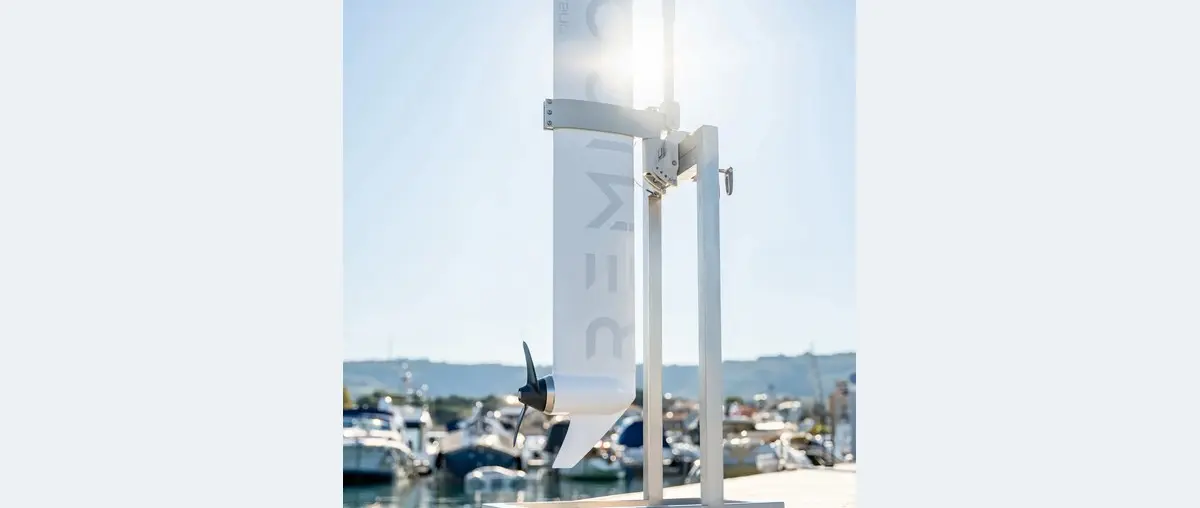
An all-in-one outboard with a stronger boost setting
Remigo's RemigoOne Go is a compact electric outboard built around a 1,154-watt-hour integrated battery and a motor with up to 1,500 watts of input power in its boost setting. The Slovenian manufacturer's current 2026 product page describes the Go as a 13-kilogram unit designed for dinghies, tenders and small recreational craft, with adjustable mounting and simple controls. The latest model differs from earlier RemigoOne and Neo versions in its battery, connector and boost behaviour. This report examines the current product rather than inventing a launch date or claiming that every boat will achieve a particular speed or range. For owners of small craft, the main attraction is an outboard that carries its battery within one portable assembly.
Integrated batteries change the installation
A conventional electric outboard may rely on a separate battery box connected by heavy cables. An integrated arrangement can reduce the number of items an owner has to carry and connect before leaving the dock. Remigo's Go combines the motor and energy store in a single body, making it potentially convenient for a tender that is launched and recovered frequently. Yet the entire unit still weighs approximately thirteen kilograms, which is substantial for some users lifting from a moving boat. Owners should try the handling position, not simply read the specification. The bracket, shaft and propeller must also be protected during lifting and transport.
What 1,154 watt-hours means in practice
Battery capacity is an amount of stored energy, not an automatic prediction of distance travelled. A motor drawing 500 watts would theoretically use about 500 watt-hours over an hour, but actual operating time also depends on losses, operating limits and environmental conditions. At higher power, stored energy is consumed faster. The Go's 1,154-watt-hour figure therefore helps owners estimate possible operating periods but does not establish a universal range in nautical miles. Wind, current, vessel displacement, hull shape and the chosen throttle setting all influence the result. A practical trial on the intended boat is more informative than a single optimistic range figure presented without test conditions.
Continuous boost is a key change from Neo
Remigo's current comparison chart distinguishes Go from the earlier Neo model. Both can deliver higher power in a boost setting, but the company states that Neo's boost ends automatically after approximately a minute, while Go's can remain active until the operator changes the setting. That difference can matter when a skipper needs extra thrust against wind or current, but it also means the battery can be depleted more rapidly if high power is used for an extended period. Continuous boost is an operating feature, not a guarantee of unlimited performance. Owners should learn how it affects range and motor temperature under the actual conditions in which they sail.
The horsepower comparison needs caution
The manufacturer describes the motor in terms familiar to buyers of small petrol outboards, including an approximate four-horsepower-class boost comparison. Electrical input measured in watts and mechanical horsepower produced at the propeller are not interchangeable marketing labels. Differences in propeller efficiency, torque delivery and the hull's resistance can influence how a motor performs. A boater should not assume that an electric unit labelled equivalent to a particular petrol horsepower will push every boat at the same speed. The safest comparison is a properly controlled demonstration on a similar hull with similar load. Static thrust may be relevant to low-speed manoeuvring, while sustained speed involves additional considerations.
Thrust matters when a tender is loaded
A lightly loaded dinghy can behave very differently from the same vessel carrying four people, bags and provisions. Remigo's model comparison gives static thrust information, but the value measured under a test condition does not establish safe passenger capacity or performance in rough water. The tender manufacturer sets maximum load and engine-power recommendations that must be respected. A motor suited to a small open dinghy might be underpowered for a larger inflatable with heavy equipment aboard. Owners should consider the maximum realistic load, not only the pleasant conditions in which a light demonstration takes place. The purpose of an auxiliary outboard is dependable control, especially near docks.
A portable motor should be easy to mount securely
The Go's compact design can make installation appear simple, but mounting height, transom shape and clamping security still matter. The propeller needs appropriate immersion in the water, and the motor must be aligned so that steering and tilting work without striking the hull. Owners should confirm the supported shaft-length adjustment and compare it with their tender's transom dimensions. A secure bracket should be checked before departure and periodically during use. The manufacturer supplies installation guidance; a short promotional video is not a substitute for following it. A motor that has been transferred between boats deserves a fresh check every time it is fitted.
The weight must be judged by the person carrying it
Thirteen kilograms may sound relatively light for a propulsion system that includes its battery, but the effort required to lift it depends on body position and where it must be carried. Moving a long, awkward object from a yacht's cockpit to a dinghy can be more demanding than lifting a compact bag of the same mass. The presence of waves, wet surfaces and restricted handholds adds difficulty. Crew should plan a safe transfer method rather than strain over a railing. The motor's integrated design reduces separate equipment but does not eliminate the need for secure storage, careful lifting and protection against impact.
Charging becomes part of the boat's energy plan
An electric tender outboard has to be recharged from a suitable supply. On a cruising boat, shore electricity may be available in port, but charging at anchor depends on the mothership's electrical system. Owners should understand which chargers and connection methods the Go supports, how long charging takes and how power demand will affect the main battery bank. A small solar array may contribute some energy but should not be assumed to recharge the motor rapidly without calculations. The manufacturer should be consulted before using any charging device that is not specifically supported. An integrated battery simplifies transport, yet it still participates in the wider energy budget of the boat.
The new connector matters to existing owners
Remigo's published model comparison shows different connector architectures for its older products, the Neo and the Go. The company also associates forthcoming range-extender compatibility with the Go's newer five-pin arrangement. That does not mean an older Neo can be upgraded simply by changing a cable. Owners with Remigo accessories should verify compatibility before ordering replacement chargers, remote controls or other equipment. A model name that differs by only one word can conceal important technical differences. Clear product identification is essential when purchasing parts. The current Go page and official support materials should take precedence over older promotional descriptions of the original RemigoOne.
A range extender is not standard equipment
The manufacturer's comparison refers to a range-extender accessory connected with the Go architecture, described as forthcoming in 2026. That should not be reported as already fitted to every motor or as an option definitely available at every retailer. Any accessory needs its own specifications, safety documentation and compatibility checks. Owners should decide whether the motor's integrated capacity is enough for their actual usage before planning a more complicated system. A tender that spends much of its time making short harbour journeys may not require extra energy storage, while another used for longer distances might need a different power arrangement entirely. The right solution depends on the mission, not the available accessory list.
Control should remain intuitive at close quarters
Small boats frequently operate near moored vessels, swimming areas and busy pontoons. The operator needs to select power and direction accurately without searching for hidden controls. Remigo promotes straightforward operation and an integrated user interface, with additional control arrangements available for compatible products. A buyer should ask for a demonstration of forward, reverse and neutral behaviour and confirm how accidental acceleration is prevented. The operator also needs to understand the emergency stop and what happens when the battery becomes depleted. A compact unit is attractive only if crew can control it confidently when the space for manoeuvring is tight.
Wind and current test the motor's reserve
An electric outboard that performs well on a quiet inland lake may face a harder task in a marina entrance with a crosswind or adverse current. More thrust can improve control, but the underlying question is whether the boat has enough power to remain safe within the intended operating area. A skipper should test the complete loaded craft in manageable conditions and establish a conservative return plan. High-power operation can consume a significant portion of stored energy in a short time. The Go's continuous boost should be understood as additional capability that must be managed, not a reason to extend a trip to the battery's last indicated percentage.
Battery management and water exposure
The Go contains a substantial battery within a unit exposed to spray and occasional wet handling. The manufacturer's documentation should specify allowable water exposure, charging conditions, safe storage and what to do after suspected damage. Owners should not assume that marine marketing means any connector may be submerged or used while wet. Lithium battery systems require correct charging and protection against mechanical damage, even in a compact integrated device. A dented casing, damaged charging port or unusual smell deserves careful attention and advice from the supplier. Safe handling is a normal ownership responsibility, not a reason to fear electric propulsion.
Noise and local emissions are only part of the story
An electric tender motor can operate quietly and without exhaust at the boat, potentially making short harbour movements more pleasant. But electricity still has to be generated and stored, and battery production has its own environmental effects. The overall comparison with a petrol outboard depends on electricity sources, durability, usage and eventual disposal. A responsible owner can appreciate the reduced local noise and lack of direct exhaust without claiming that the system has no lifecycle footprint. Quiet operation also creates a different safety concern: swimmers or other boaters may not hear the approaching craft. The skipper must maintain an effective lookout regardless of propulsion type.
Coastal use requires a conservative range policy
Owners should maintain enough reserve to return safely rather than planning around the absolute maximum range claimed in good weather. Currents and wind can change during a short outing, and a loaded tender may require more power than expected. The battery display should be observed, but its estimate may vary with throttle changes and the condition of the battery. It is sensible to identify a safe turning point before departure and avoid using the final reserve merely to complete a leisure trip. Small craft need proper flotation, communications and navigation arrangements appropriate to their waters, whatever motor they carry.
Maintenance is different, not absent
An electric outboard has no petrol fuel system or conventional small-engine oil changes, but it still includes a propeller, seals, mounts, controls and electrical connectors that require care. Salt should be removed according to the manufacturer's instructions, and the unit should be stored and charged under suitable conditions. Owners should inspect for damage to the propeller and lower unit after an encounter with debris or a hard grounding. A portable motor may be moved and bumped more often than one permanently fixed to a transom, making routine checks important. The absence of a combustion engine does not make the equipment immune to wear or neglect.
Which boats are suitable candidates?
The Go may appeal to owners of tender-sized inflatables, compact hard dinghies and other small craft whose weight and power requirements fit the product. It will be less suitable where the hull demands substantially higher propulsion power or where long high-speed runs are essential. The tender's permitted engine rating and load should be confirmed before purchase. A buyer should also consider secure storage aboard the parent vessel and whether charging can be managed between trips. No single motor is ideal for every tender, and the company's current comparison between RemigoOne, Neo and Go underscores the differences between use cases.
A useful development for small-boat owners
The RemigoOne Go shows how electric outboards are evolving around practical handling, simpler installation and a better understood choice of power modes. The increase in integrated battery capacity and the change to continuous boost offer reasons for owners to compare the new version with earlier Remigo models. Yet a feature list cannot establish a particular speed, endurance or fit on an individual boat. The official manufacturer page provides the current specifications, while the performance questions must be answered through the appropriate installation and realistic use. For Leisure Boat Guide readers, the Go is worth examining where quiet, portable propulsion suits the boat, the route and the crew rather than simply because it is new.
Original industry sources and image credits
Reporting based on Remigo official first-party product information, checked November 2026.
Lead image: RemigoOne Go Adds Continuous Boost to All-in-One Electric Outboard — official manufacturer product photo. © Remigo d.o.o.. Original supplier image.
