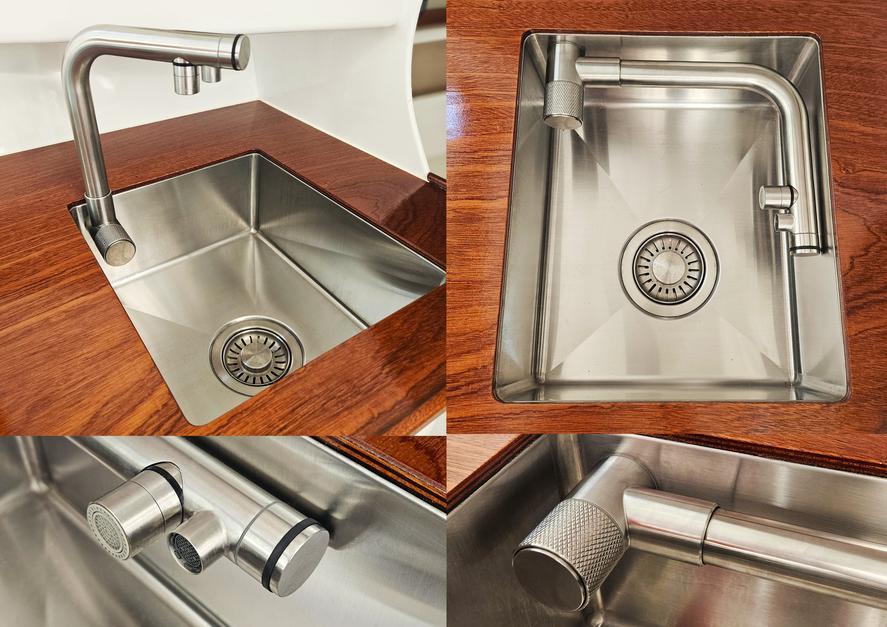
A small fitting draws attention to compact-galley design
Queensize Camper’s Deluxe Folding Faucet has received a Special Mention in the 2026 DAME Design Awards, according to the results published by METSTRADE on 17 November. The product is a folding, three-way tap made from 316 stainless steel, intended to combine normal hot and cold water service with a separate route that the installer can use for filtered drinking water or saltwater. The company originally listed the product in February 2026, so this article reports its later awards recognition rather than pretending the tap first appeared in November. For the owner of a small cabin cruiser, the interest is immediate: fixtures that save space without creating confusing plumbing can make a compact galley more practical.
Why folding matters aboard a small boat
A tap occupies more than the space taken by its base. A high spout may obstruct a sliding worktop, a cover over the sink or a cockpit arrangement that needs to be closed when underway. Folding the outlet down can allow an area to be used for other purposes when the sink is not needed. That is particularly relevant on boats below twelve metres, where the galley may share space with seating, navigation equipment or a passage through the cabin. The manufacturer promotes its fitting for marine and outdoor-kitchen applications. A prospective buyer should check the actual folded height and swing clearance rather than assume any folding faucet will fit an existing sink or locker.
Three water routes raise useful design possibilities
The product’s most distinctive published feature is a third flow path in addition to hot and cold service. The source suggests using this route either for filtered water or for saltwater, depending on the installation. Those are different configurations that require careful design. A filtered-water supply may offer convenient access to drinking water, while a separately managed seawater supply can reduce use of stored freshwater for some washing tasks. Neither should be assumed to be present automatically because the tap has three ways. The boat’s pumps, tanks, valves and lines still determine what reaches the outlet, and the intended flow path should be clear to every user.
Drinking-water service requires more than a labelled spout
A tap with a route dedicated to filtered water is only one part of a safe drinking-water system. The actual water quality depends on the supply, tank condition, filter type, maintenance and contamination risks downstream. Owners should use components approved for the intended potable-water application and avoid relying on marketing descriptions as proof that untreated tank water is safe. A separate filtered line must also be protected against unintended connections to other water services. The manufacturer’s description identifies an option for filtered water, not an independent microbiological test of any complete installation. A competent installer should explain how the chosen system is maintained and which parts require periodic replacement.
Saltwater is not simply another freshwater circuit
The alternative use of the third route for seawater can be practical aboard a cruising boat, but it introduces its own considerations. Seawater should not be allowed to enter drinking-water tanks or pipes, and the system needs clear separation, appropriate materials and protection against backflow. Marine growth, sediment and odour may affect parts that regularly carry untreated water. Owners should understand how the intake is controlled and where water can be discharged lawfully. A saltwater route might be useful for rinsing certain items, but it is not a substitute for potable water when hygiene requires it. The fitting’s availability does not remove the need for safe hydraulic design.
Why 316 stainless steel matters
Queensize describes the body as SUS316, an austenitic stainless steel grade often chosen for its resistance to corrosion in marine environments. That choice is relevant for a frequently wet fitting, but no stainless steel is completely immune to corrosion. Salt deposits, crevices and contact with dissimilar metals can still cause problems. Owners should confirm the material used in internal moving components, connections and fasteners as well as the visible body. Cleaning should follow the supplier’s guidance so that a polished surface does not become scratched or contaminated by an unsuitable product. A marine-grade label is useful only when installation and maintenance are considered together.
The folding joint deserves particular scrutiny
Every moving part introduces both convenience and a possible future maintenance requirement. The folding mechanism needs to remain smooth enough for daily use while maintaining seals and resisting wear. A tap that feels secure when new may be subjected to vibration, knocks and repeated movement over several seasons. An owner evaluating this product should ask how the joint is serviced, what replacement seals are available and whether folding is permitted while water is flowing. The official trade catalogue does not provide a full maintenance manual in its brief description. A dealer or installer should obtain the correct instructions rather than improvising lubrication or disassembly.
The DAME mention is a design distinction
The METSTRADE results list the Deluxe Folding Faucet under Special Mentions in the Onboard Facilities, Comfort and Entertainment category. That is an award recognition, but it is not the top category prize; the 2026 category winner was Blue-Airco’s Multizone Control Kit. It is also distinct from the three overall DAME winners. Clear reporting matters because a manufacturer’s legitimate recognition can be inflated when a small product is described generically as a top overall winner. The important point is that a jury recognised a relatively ordinary fitting as a noteworthy design contribution. Good innovation sometimes involves removing everyday friction rather than adding advanced electronics.
A cockpit galley has different needs from a cabin galley
A tap used in an open cockpit may experience direct sunlight, spray and temperature changes that a protected cabin fitting avoids. Its position also affects how people move around the boat and whether the faucet is exposed when the vessel accelerates or heels. The same fold-down feature could be valuable in both environments, but installation requirements will differ. On a small motorboat, the tap may need to sit below a seat or worktop lid; on a sailboat, it may need to remain secure during significant motion. Buyers should verify whether the proposed location has enough clearance for the faucet in both open and folded positions.
Space saving should not compromise safe operation
Compact equipment is attractive because it makes a small boat feel less cramped. Yet the resulting arrangement needs to remain easy to use when wet, tired or underway. A folding tap should not require someone to reach across a hot cooking surface or balance awkwardly to turn a handle. Access to the sink drain, shut-off valves and plumbing joints remains important for cleaning and emergency maintenance. The correct installation may save only a few centimetres, but those centimetres can be valuable in a small cabin. A careful designer should evaluate how the fixture interacts with the whole galley rather than treating it as an isolated object.
How an owner can assess the third-way control
A three-way fixture must communicate which water supply is active. If fresh and saltwater functions are easily confused, a feature intended as a convenience can become a problem. The product listing does not specify every available marking or control position, so no assumption should be made about how intuitive a particular installation will be. Owners can ask for an operating demonstration and confirm whether the third way is separated mechanically and hydraulically. Where several people use the boat, simple instructions near the galley may be useful. The best design is one a guest can operate correctly without a lengthy explanation.
Plumbing compatibility is boat specific
Marine water systems can use different pipe diameters, fittings, pump pressures and electrical controls. A new faucet should be assessed against those existing components, with adequate isolation valves for maintenance. It is important to consider access beneath the sink: a visually attractive tap may be difficult to service if installed directly over an inaccessible locker. Seals and hoses should be selected for their intended use, and a competent installer should check for leaks under real pump conditions. The exhibition description establishes the concept and material, not universal compatibility with every leisure boat. That distinction matters before an owner cuts a new opening into a countertop.
Freshwater capacity affects cruising comfort
Small boats often have limited stored freshwater, making consumption a practical concern even on short coastal trips. Some owners might welcome a separate saltwater supply for tasks that do not require fresh water, while others may prefer filtered drinking water without carrying as many disposable bottles. Both approaches involve trade-offs. The saltwater system needs an intake and appropriate plumbing; a filtered line requires effective treatment and regular cartridge care. Neither benefit arises simply because a fitting has an additional outlet. A useful purchase decision starts with the boat’s actual water-management routine, anticipated trip length and the people using the galley.
Pricing and availability require a direct check
The source lists a February 2026 product release and the later November DAME mention, but it does not establish a single price or guaranteed regional stock. Boat owners should request current technical drawings, fitting dimensions, installation requirements and warranty terms. They should also check which water configuration the supplier supports and whether accessories must be purchased separately. The product’s official photograph documents a real manufacturer-supplied fixture but does not prove that it fits a particular boat. An estimate should include plumbing work and any changes to the counter or sink. The total installed cost may matter more than the apparent price of the tap alone.
A modest change with potential everyday value
Queensize Camper’s design shows why the DAME Awards do not need to concentrate exclusively on large or expensive marine systems. Owners of small boats repeatedly handle ordinary fittings, and awkward details become more noticeable when space is scarce. A folding stainless-steel tap with a third water route can address several practical needs, provided the hydraulic separation, fit and maintenance arrangements are resolved correctly. The company’s first-party product listing supplies the technical outline, while METSTRADE’s 17 November results confirm the Special Mention. For a boat owner, the sensible next step is not to assume that an award guarantees a perfect retrofit, but to compare the proposed installation with the galley’s dimensions and the vessel’s existing water system.
Original industry sources and image credits
Reporting based on Queensize Camper first-party product / 2026 DAME entry.
Independent award result verification: METSTRADE official DAME Design Awards results, 17 November 2026.
Lead image: Queensize Folding Three-Way Faucet Gains DAME Design Recognition — official supplier product image. © Queensize Camper GmbH. Original supplier image.