Ocean Safety revisits the full man-overboard sequence
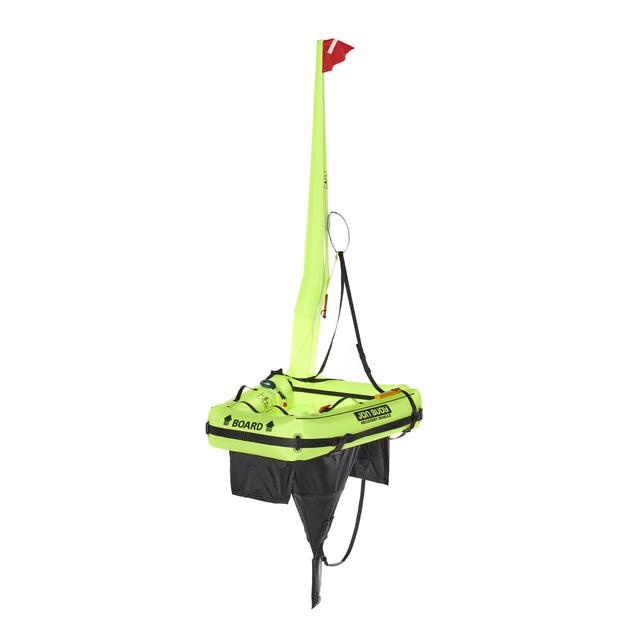
Ocean Safety's Recovery Module MK6, identified in its 2026 METSTRADE exhibitor catalogue as the JBRM6, brings several man-overboard functions into one deployable unit. The manufacturer's description says the system can help locate, support and recover a casualty, and that a single latch initiates its deployment from a container before inflation. The company also describes its acceptance in a specified context under World Sailing Offshore Special Regulations as a substitute for one conventional combination of rescue items. This is a particular product description and compliance claim, not proof that every recreational boat can replace its required equipment with one module. For a smaller cruising yacht, the more useful question is how the equipment fits into a realistic recovery plan.
Finding a person is only the first stage
When someone falls overboard, a crew faces several tasks in rapid succession. Someone must raise the alarm, maintain sight of the casualty and record or mark the position while the helmsman manoeuvres the boat safely. The person in the water then needs flotation or other support, and finally has to be brought aboard or helped by rescuers. A product that combines several of these functions can reduce the number of items a crew has to handle, but it cannot perform the entire operation without trained people. Ocean Safety's approach is worth examining precisely because the recovery sequence can break down at different stages, especially when only two people are aboard.
A deployable module seeks to simplify the first response
The JBRM6 entry describes a single latch that releases the unit from its housing. An uncomplicated action may be beneficial during an emergency, when panic, heavy motion or poor visibility can make complex instructions difficult to follow. However, ease of release needs to be balanced with secure storage: safety equipment must not deploy accidentally or become dislodged in ordinary operation. Owners should ask where the container may be mounted, how it is protected from weather and what checks confirm the release mechanism is ready. A product that can be deployed in one action must still be rehearsed in a safe setting with clear crew roles.
Inflation requires inspection and maintenance
The manufacturer says the module inflates automatically after deployment. Inflatable rescue equipment has several components that may need periodic servicing, including the fabric structure, inflation mechanism and any associated gas cylinder or activation system. A skipper should know the inspection dates and permitted storage conditions and keep records. An automatic mechanism can remove a task from the crew, but it also means users must trust that the device is correctly prepared. A maintenance label or service indicator should be checked as part of routine safety inspections. The fact that equipment is rarely used in anger is a reason for careful maintenance, not a reason to neglect it.
How a location marker can help
Keeping visual contact with a casualty is particularly difficult in a rough sea or when the vessel is manoeuvring. A deployed device may create a more obvious reference near the person in the water and help the crew identify an area to return to. Yet an inflated marker and the casualty can drift separately, especially in wind and current. A skipper should not confuse seeing the device with confirming the person's actual position. A dedicated lookout remains essential, along with appropriate use of plotter marks, communications or other equipment. Recovery modules are aids to an established procedure rather than guaranteed trackers that independently follow a person in every condition.
Support in the water matters
An overboard person may be cold, exhausted, injured or unable to swim effectively. Providing a suitable floating aid can help keep them above water while a recovery is organised. An inflated module may offer a structure to hold or enter, depending on the manufacturer's specific configuration and the casualty's condition. Owners should not assume that someone who is unconscious can make full use of a system designed for an active person. The crew's recovery plan must address several scenarios, including a casualty who cannot assist. A standard man-overboard drill is only a starting point if it assumes everyone can grip a line and climb a ladder without difficulty.
The hardest moment may be getting the casualty aboard
Recovering a person from the water can demand considerable force, especially when the casualty is wearing soaked clothing or cannot contribute to the lift. A small yacht may have a relatively low freeboard, but the available deck space and suitable attachment points can be limited. The JBRM6 is described as a recovery system, but the crew still needs an approved method of bringing the person aboard safely. That could involve suitable recovery tackle, a rescue platform or assistance from other vessels or emergency services. A rope, boom or winch should never be improvised as lifting equipment without understanding the loads and risks. Training must address the final recovery, not only the initial deployment.
An offshore racing regulation is not a universal exemption
Ocean Safety states that its module is accepted under a particular application of the World Sailing Offshore Special Regulations as an alternative to one specified combination of conventional items. The precise category, wording and current version of those rules matter. A skipper must not extrapolate that statement to every racing event, cruising region or national legal requirement. Coastguard, flag-state and event rules may prescribe different equipment, servicing or carriage conditions. Before replacing existing gear, owners should obtain written confirmation of the standard and scope of acceptance. A manufacturer's legitimate compliance claim deserves accurate explanation rather than being stretched into blanket approval.
Traditional equipment remains familiar for a reason
Many sailing boats carry a horseshoe buoy, danbuoy, drogue, light and whistle, sometimes in a combination suited to the relevant racing or cruising programme. Crew members may have trained to deploy those items individually and understand where they are located. A combined module could reduce the number of separate actions, but it introduces different handling and servicing requirements. Owners should compare the complete systems, including visibility, accessibility, replacement components and training demands. There is little benefit in swapping familiar working equipment for a more sophisticated device if the crew has not learned how to use it. Equipment choices should reinforce an effective response.
Small crews need clear jobs
A two-person cruising yacht can face a serious problem if one person falls overboard and only one remains to manoeuvre the boat. The remaining skipper must control the vessel, maintain lookout, communicate and potentially deploy recovery equipment alone. A combined module may help reduce workload, but this is one of the most demanding circumstances to plan for. Owners should practise single-handed responses, including how to put the boat into a safe manoeuvre and request assistance. They also need a plan for injury or loss of consciousness. A realistic drill should test the actions that the one remaining person can actually complete without putting themselves at further risk.
Safe approach and propeller hazards
The final approach to someone in the water needs careful boat handling. Propeller and thruster movements can endanger a person nearby, and lines or rescue gear may become entangled with propulsion equipment. The skipper should use an appropriate manoeuvre for the boat and sea conditions, following recognised training rather than relying on a single generic turn. A deployable module may have ropes or other components that need to be kept clear of the propeller. An owner should ask how those elements are controlled during recovery. Even the best-designed rescue aid cannot compensate for an unsafe approach or a crew that loses control of the boat.
Visibility changes after dark
A person in the water is much harder to identify in darkness, spray or waves. Rescue equipment may include markers, lights or reflective elements, but their performance depends on the configuration and conditions. The specific JBRM6 accessories and approved arrangements should be checked in the manufacturer's documentation; they should not be guessed from a small promotional image. Owners should verify how the deployed module can be seen from the helm and what happens if part of the system is obscured. Night-time drills in a controlled environment can improve understanding, but should not place a volunteer casualty in real danger merely to test the equipment.
The mounting position matters
A recovery module must remain accessible from the position where it is likely to be deployed, while not interfering with normal sailing or passenger movement. On a yacht with a narrow stern, a large container might obstruct access to a boarding ladder or emergency tiller. On a motor cruiser, a cockpit locker or rail mount may be more practical but still needs to allow rapid release. The manufacturer's dimensions and mounting instructions should be obtained before ordering. A neat installation should not compromise guardrails, visibility or watertight fittings. The crew should be able to reach the equipment without stepping into a dangerous area during a manoeuvre.
Servicing should be part of the boat's annual plan
The JBRM6 contains components that need attention according to their approved intervals. Owners should record the service history, identify authorised providers and ensure the device remains in date for any event or regulation that applies. The exterior container may also require cleaning and inspection for impact damage or deterioration from ultraviolet exposure. If the equipment is accidentally deployed, it may need qualified repacking and rearming before being returned to service. An unserviced automatic inflatable device can create a false sense of readiness. An annual safety-equipment audit should check actual functionality and documentation, not merely count the number of objects on deck.
Practice can expose unrealistic assumptions
A crew may discover during training that one person cannot reach the latch from the helm, that a recovery line becomes tangled, or that a standard ladder is unsuitable for an exhausted casualty. These are valuable findings before an emergency. A recovery module can be integrated into drills that also use a floating dummy and appropriate safety precautions. Each crew member should know how to alert others, deploy the equipment and support the subsequent recovery. The exact procedure should follow Ocean Safety's instructions and any applicable training standard. A product's claimed simplicity needs verification in the specific cockpit where it will be used.
The importance of not promising complete rescue
The exhibition entry describes JBRM6 as a full man-overboard solution. That is the manufacturer's positioning and should be understood in context. A successful rescue also depends on weather, boat handling, the casualty's condition, crew capability and timely assistance. No single item guarantees that someone will be recovered alive, nor can any product be presumed to eliminate all operational risk. Accurate information about the equipment's approved functions is more useful than a broad safety slogan. A skipper should build multiple layers into the plan: preventing a fall, recognising an incident immediately, marking the position, maintaining contact and executing a safe recovery.
How this fits small recreational boats
The value of an integrated rescue system will vary with the boat's freeboard, deck arrangement and cruising programme. A short-range dayboat may have different requirements from a sailing cruiser making overnight coastal passages. Some vessels cannot physically accommodate a large module without reducing usable space or interfering with other gear. Other yachts may find it a practical alternative within the rules that apply. An owner should identify mandatory equipment first and then ask how the system would improve their particular man-overboard procedure. The manufacturer's catalogue does not provide a universal retail price or a guarantee that every leisure boat below twelve metres can install the unit.
What is independently established in 2026
Ocean Safety's first-party METSTRADE listing identifies the Recovery Module MK6, describes the single-latch deployment and automatic inflation, and states its intended location, support and recovery functions. It also refers to a particular accepted role under World Sailing Offshore Special Regulations. The listing alone does not certify a complete vessel's compliance or prove that the device is newly launched this November. These distinctions are especially important when reporting safety equipment. The useful news is the current trade-show presentation of a combined recovery concept and an opportunity for owners to consider whether its functions match their procedures.
Equipment cannot replace a rehearsed recovery plan
Ocean Safety's Recovery Module MK6 illustrates a practical direction in marine safety design: bringing several emergency functions into one deployable package that the crew may be able to use quickly. That proposition deserves attention from owners and skippers, particularly those sailing with very small crews. Its actual value depends on maintenance, permitted use, safe installation and the ability to complete the full recovery sequence. An owner evaluating the system should consult the current manual, relevant regulations and a competent training provider. The right investment is one that makes a real man-overboard response more reliable, not merely one that adds another impressive container to the boat's rail.
Original industry sources and image credits
Reporting based on Official 2026 METSTRADE product and technical description supplied by Ocean Safety Ltd..
Lead image: Ocean Safety Recovery Module MK6 Sets Out Integrated Man-Overboard Procedure — manufacturer-supplied product publicity image. © Ocean Safety Ltd.. Original supplier image.