
Egis brings high-current battery switching onto a marine network
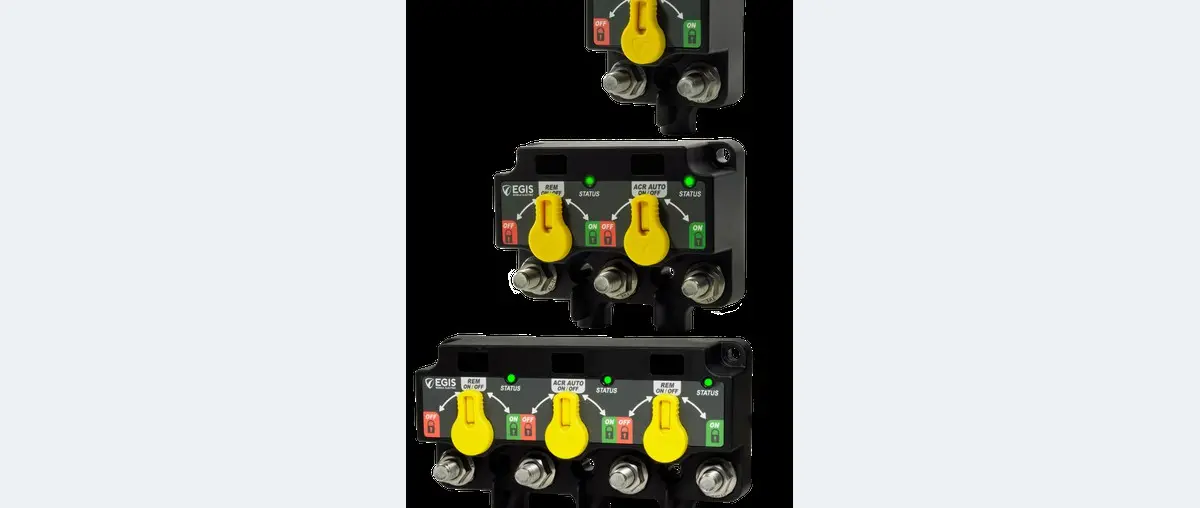
Egis Mobile Electric is presenting its XD Series of remote battery and load-management relays through the 2026 METSTRADE exhibitor catalogue. The manufacturer says the units can be operated from compatible NMEA 2000 multifunction displays and arranged in single-, dual- or triple-relay configurations. It also describes the ability to report relay status, manual override engagement and battery voltage back to the network. The stated purpose is to allow substantial electrical circuits to be switched or managed closer to their loads, potentially reducing long runs of heavy cable. For owners of leisure boats under twelve metres, this is a relevant development because electrical systems are becoming more complex even on compact vessels. It is also a reminder that network convenience must never compromise reliable manual isolation or correctly engineered circuit protection.
Electrical loads are expanding on smaller craft
A modest cruising boat may now carry navigation displays, communications, refrigeration, electric windlass equipment, water pumps and a collection of domestic accessories. Some of these loads draw relatively small currents, while others can demand considerably more during short periods. A traditional electrical panel may route substantial cabling back to central switches, depending on the installation. Remote relays offer a different arrangement: a switching component can be placed closer to the circuit it controls, while a networked display provides an interface for the operator. That can create practical advantages, but the effect on cost, weight and serviceability depends on the boat's actual layout rather than a general promise of simplification.
A relay is not the same as an ordinary screen control
A relay is an electrical component used to open or close a circuit. In a high-current marine application, it must be designed to carry the relevant load safely and operate under the expected conditions. An NMEA 2000 display may send commands, but the electrical work is performed by the relay and its associated circuitry. A skipper who taps a symbol on a multifunction display is therefore controlling a physical circuit elsewhere aboard. Owners need to understand exactly which loads can be controlled and what happens if the display or network fails. A sophisticated interface should make that relationship clearer, not obscure it behind an attractive graphic.
NMEA 2000 compatibility has precise limits
Egis describes the XD Series as controllable through compatible NMEA 2000 multifunction displays. This is not equivalent to a guarantee that every chartplotter made by every manufacturer supports every switching function. Network devices may use different software versions and recognised data messages, while displays can provide different levels of control. Buyers should obtain a current compatibility list and ask which commands and status indications are available for their particular electronics. An installer should verify backbone power, proper termination and the correct network layout. A component should never be connected by trial and error in the hope that the helm display will recognise it.
Distributed installation can reduce some cable runs
The manufacturer's description highlights placing high-current switching closer to where power is needed, rather than routing every circuit to a central panel. Shorter cable lengths may reduce copper weight, voltage drop and installation complexity in certain arrangements. But that outcome should be calculated, not assumed. A boat may require additional communication cables, local protective devices and accessible mounting spaces, offsetting some benefits. The total installation should be compared against the existing architecture, including how the system can be inspected and repaired. A distributed arrangement can be elegant when designed properly and confusing when its components are hidden without clear labels or drawings.
Single, dual and triple units provide different options
The XD Series includes individual units and multi-relay configurations, according to the exhibitor listing. That can give designers a choice between serving one substantial circuit or several circuits at a shared location. The right selection depends on current ratings, heat dissipation, fault protection and whether different loads should be electrically independent. Grouping equipment for convenience should not introduce a common failure point that disables several critical services. A competent marine electrician will assess which circuits belong together and which require separation. Owners should not choose the unit with the greatest number of relays merely because it appears to offer better value.
Manual override is an important design feature
Egis says the system reports when a manual override switch is engaged. The existence of a manual override can be useful if the operator needs direct access to the switching arrangement, but the precise behaviour should be understood before the boat is used. A manual switch could have particular limits or procedures depending on the product design. Owners should ask whether it works without network power, whether it can be used safely while a circuit is loaded and how it interacts with remote commands. Manual control is meaningful only when the crew can locate it and has been trained to use it. A status message is not itself a safe emergency procedure.
Battery charging needs careful coordination
The product page refers not only to load switching but also to battery charge management. In a modern boat, batteries may receive energy from shore power, an engine-driven alternator, solar panels or another charging source. A remote relay may help control connections within such a system, but charging equipment must operate within the battery manufacturer's limits. Disconnecting a battery while an alternator is supplying substantial current can create harmful electrical transients unless the system is designed to manage them. Owners should not assume a general battery relay can be inserted anywhere in an existing charging circuit. Every configuration needs suitable protective logic and equipment.
The battery voltage readout has a limited meaning
Egis advertises reporting the voltage of connected batteries to the NMEA 2000 network. Voltage is a useful diagnostic value, but it is not a comprehensive measure of remaining battery energy across all chemistries and operating conditions. A voltage reading may change with load, charging and temperature. For some battery types, state of charge is especially difficult to infer from voltage alone. Owners should understand whether a separate shunt or battery monitor is needed to track consumption accurately. A convenient dashboard number should support the electrical system's management, not be mistaken for an independent guarantee of how long essential equipment can run.
Circuit protection still has to be engineered
A relay opens and closes a circuit, but it does not automatically replace the fuses, breakers or other protective equipment necessary to prevent damage from overcurrent. The wiring must be sized for the maximum expected load and protected appropriately near the source. High-current circuits can generate considerable heat if connections are loose, corroded or improperly torqued. A marine electrician should specify the installation using current standards and the Egis manual. Owners should not use a remote switching upgrade as a reason to bypass an existing protective device. The most valuable smart electrical system is one that remains fundamentally safe when a fault occurs.
A lost network connection should not create uncertainty
If a chartplotter is turned off or the NMEA 2000 connection is interrupted, the crew needs to know what happens to the relays. Do they stay in their last state, change to a predetermined condition or require manual action? The short exhibition listing does not establish a universal failure response for every configuration. These questions should be answered during design and demonstrated at commissioning. Critical equipment such as navigation lights or essential pumps may require special treatment to avoid an unexpected loss of power. A good remote control installation is one whose failure behaviour is documented and predictable, not merely convenient when everything is working.
The helm display should show real circuit state
An operator might assume that a relay has switched because a button on the screen changes appearance. A well-designed system should instead communicate the actual reported state of the relevant hardware, including faults or manual override activity where supported. Egis identifies status reporting as part of the XD architecture. That can help diagnose a problem, but the display still depends on correct data transmission and the relay's own sensing. A commissioning test should compare screen indications with physical circuit behaviour. Owners should know how to identify stale or missing information so that a frozen interface is not interpreted as confirmation that equipment is safely isolated.
Installation access is often the decisive issue
A small cruiser may have limited room behind electrical panels and within machinery compartments. Placing remote relays close to loads could save long cable runs, but the equipment still needs to be mounted securely, kept within its temperature limits and protected against moisture. Technicians should be able to reach terminals for inspection without dismantling substantial parts of the interior. An installation should include clear labels and a wiring diagram showing every relay and the circuit it serves. Hidden sophistication can become expensive when a future owner or yard cannot identify which component controls a particular pump or charger.
Saltwater and vibration demand maintenance
Marine electrical equipment operates in an environment of humidity, vibration and possible salt contamination. High-current terminals can develop problems if seals or connections deteriorate. Owners should follow the supplier's inspection and service intervals, with particular attention to any exposed connectors and areas where condensation may form. Cleaning products should be suitable for electrical components, and power should be isolated before permitted maintenance. A relay that works correctly when new should not be presumed maintenance-free. The advantages of remote switching can be lost if it makes important hardware harder to inspect or encourages neglect of ordinary electrical care.
High-current ratings must be matched to loads
The product description refers to high-amperage switching, but a purchaser still needs the exact permitted current, voltage, operating temperature and duty cycle for the selected model. Different electrical loads can behave differently at start-up and during switching. Electric motors and certain electronic devices may create inrush currents that exceed normal operating values. A relay that appears adequately rated based on steady current might not be suitable without additional analysis. Owners should ask an electrician to verify every intended load using the manufacturer's actual ratings. The term high-current is a category description, not a substitute for engineering data.
Digital control may benefit some boats more than others
A basic dayboat with a small battery, a bilge pump and a few lights may be served perfectly well by a straightforward conventional switch panel. The added cost and complexity of a networked relay arrangement may offer little value. A more highly equipped cruiser with several battery banks and major electrical loads presents a different case. Remote monitoring could reduce wiring congestion and simplify operation when properly commissioned. The decision should begin with the real needs of the vessel and the maintenance capability of its owner. New electronics are worthwhile when they solve a recognised problem, not simply because they allow switches to appear on a chartplotter.
The 2026 supplier listing sets the verified scope
The official METSTRADE product entry identifies the Egis XD Series as remote high-current switching and battery charge-management equipment using NMEA 2000 control. It describes single-, dual- and triple-relay arrangements, status reporting, manual override indication and voltage information. It does not provide a universal price, guaranteed compatibility with every multifunction display or a complete approved wiring scheme for all boats. Those details must be obtained from Egis and the relevant installer. The current trade-show presentation is the verified subject of this article, without assuming an exact November 2026 product-launch date or unreported vessel installations.
Control convenience should never compromise safety
The Egis XD concept shows how the marine industry is moving towards distributed, digitally monitored electrical systems. That approach may reduce wiring complexity and provide useful status information in the right boat. But high-current switching remains a safety-critical part of the electrical installation, requiring correct ratings, circuit protection, documented failure responses and accessible manual procedures. Owners of leisure craft under twelve metres should ask a qualified marine electrician to assess whether the technology improves their particular system. A clear display is a benefit only when the underlying power architecture is dependable and can still be managed safely when the network is unavailable.
Original industry sources and image credits
Reporting based on Official 2026 METSTRADE first-party product description submitted by Egis Mobile Electric.
Lead image: Egis XD Brings NMEA 2000 Control to High-Current Battery Switches — official supplier product photograph. © Egis Mobile Electric. Original supplier image.
