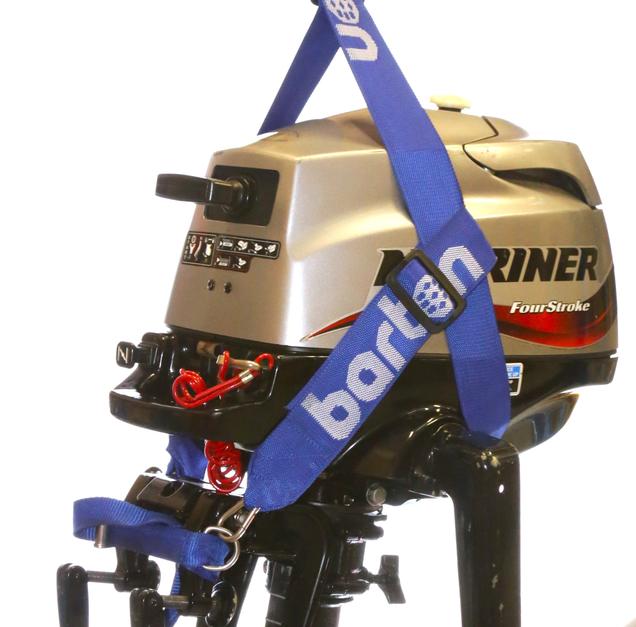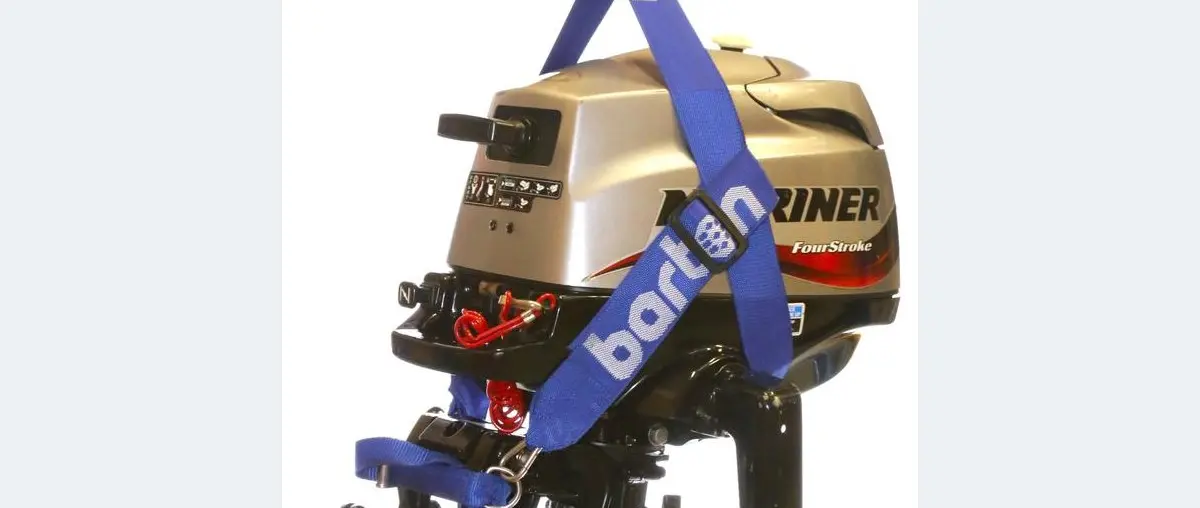
Barton focuses on handling small outboards more securely
Barton Marine Equipment is presenting its Outboard Motor Lifting Sling in the 2026 METSTRADE exhibitor catalogue, describing a webbing-based aid intended to hold small outboard engines during lifting and maintenance. The manufacturer says the sling is designed for motors up to 15 horsepower and recommends using it with Barton's SkyLock Block to raise and secure the lifting line. It identifies high-performance woven webbing and strong fastening components as features intended to provide balanced support without slipping around the engine. These are manufacturer claims, not a universal lifting certificate covering every engine of that horsepower. For owners of small cruisers and tenders, the development addresses a real operational problem: transferring a bulky, heavy outboard between a boat, a dinghy and safe storage without losing control of it.
The outboard is awkward even when it is relatively small
A portable outboard has a long, irregular shape with heavy components concentrated around the powerhead. Its propeller and lower unit extend well below the point a person naturally wants to hold. Lifting from a moving yacht to a tender can require bending over a rail while carrying substantial weight. Even a motor with a modest horsepower rating may be difficult for one person to manage safely. A dedicated sling may provide a more predictable place to connect a hoisting line, but the benefit depends on whether it can be attached correctly to the exact engine. A crew should establish a safe lifting arrangement before attempting a transfer, rather than improvise when the dinghy is already alongside.
Fifteen horsepower is a model limit, not a weight guarantee
Barton identifies compatibility with engines up to 15 hp, yet horsepower and engine weight are not interchangeable. Motors in the same power class may vary considerably in mass, shape and attached accessories. An owner should check the engine's actual weight and dimensions against the sling's detailed instructions and any specified maximum working load. The manufacturer's short exhibition entry does not state that every possible 15-horsepower model fits or can be safely raised from any lifting point. A safe arrangement needs to consider the motor, sling, hoisting tackle, mounting point and the person controlling the operation. All parts of the system must be suitable for the load.
Webbing can conform to an irregular engine body
Compared with a rigid metal lifting frame, a webbing sling may wrap around the contours of a small outboard and distribute contact over several areas. That can help stabilise the engine and reduce the risk of scraping its casing when the load is moved. Barton describes woven material and substantial fastening components, but the exact route around the motor matters. If the straps lie over fragile handles, fuel connections, steering parts or controls, the load may be badly distributed or damage equipment. Owners should follow the illustrated fitting instructions and verify that the sling remains secure before committing the motor's full weight to the hoist.
Balanced support can reduce unwanted swinging
A motor suspended from a single rope may rotate or swing as the vessel moves. The centre of gravity may not be directly beneath an improvised connection point, making the engine difficult to guide. The manufacturer's design objective is secure, balanced lifting without uncontrolled movement. Even if the sling works as intended, a suspended outboard can still swing when struck by a wave or when the hoisting point moves. Crew should plan a clear lifting path, stay out of the load's fall zone and use suitable means of controlling rotation without placing hands between the motor and hard surfaces. A sling is an aid to a planned lift, not an automatic stabiliser.
SkyLock is part of the proposed handling arrangement
The official product description mentions Barton's SkyLock Block as the recommended companion component, designed to lift and secure the line. That is important because a sling alone does not raise an engine or hold it at a chosen height. The load is carried through a series of components: the sling, connection, block, rope, attachment point and boat structure. Owners should establish which SkyLock configuration is approved and whether additional equipment is required. An unfamiliar locking block must be used according to its own instructions, particularly when lowering the motor. A lock that is convenient in ordinary service can create danger if the user misunderstands how to release a suspended load.
A strong attachment point is essential
A small cruising yacht may have a dedicated outboard crane, davit or lifting point, while another boat offers little more than a rail and cockpit fittings. Not every visible stainless-steel component is suitable for vertical lifting. Guardrails, stanchions and ordinary cleats may not be engineered for the combination of engine mass, boat movement and the changing angle of a hoisting line. Before buying a sling, owners should have the intended lifting point checked for capacity and secure attachment to the vessel. A quality sling cannot compensate for a weak support, and relying on an untested railing can put both equipment and crew at risk.
Transferring a motor to a dinghy requires planning
An outboard is often lowered towards a tender that moves independently of the parent yacht. Wind, current and passing wash can change the gap and relative height between the two craft in a moment. Crew should secure the tender appropriately, establish who controls the lifting line and decide where the motor will land. The receiving person should avoid reaching beneath a suspended engine or trying to grip its lower unit while the load is moving. Once the motor is positioned correctly, it needs to be clamped or otherwise secured according to the tender manufacturer's instructions before the sling is released. A successful transfer should be deliberate rather than hurried.
Maintenance lifting is a separate use case
A motor may need to be raised off its transom for winter storage, repair or access to the lower unit. A sling may simplify that movement, particularly if the owner lacks a dedicated workshop lifting eye. Nevertheless, any repair should begin with the engine isolated, fuel handling arrangements made safe and the motor supported securely on a suitable stand after lifting. A hoisting line is not automatically a substitute for a properly rated maintenance stand. Working beneath an engine suspended from a block can be dangerous, and a motor should not remain hanging for prolonged maintenance unless the entire arrangement is specifically approved for that purpose.
The engine's condition affects how it can be handled
A damaged cowling, loose mounting bracket or corroded component may alter the way a sling sits on the engine. Owners should inspect the motor before using it as the object to be lifted. A lifting arrangement should not rely on components that might detach or deform under load. Fuel hoses, electrical cables and control cables need to be disconnected safely where required. The propeller should be protected from accidental impact, and sharp edges that could damage webbing should be identified. Where the engine is unusually shaped or has accessories attached, the owner should seek confirmation from Barton about the intended sling arrangement.
Salt and sunlight can affect lifting equipment
Webbing used in the marine environment experiences ultraviolet light, salt crystals, abrasion and repeated wetting. These exposures can affect material condition even when the sling looks generally clean. Owners should follow the supplier's guidance on washing, drying, storage and inspection. Particular attention should be paid to stitched areas, webbing edges, fasteners and regions that rub against the engine. If the sling shows fraying, melting, cuts or other questionable damage, the safe response is to remove it from service pending proper assessment. A lifting aid should be treated as load-bearing equipment, not as an ordinary piece of decorative deck fabric.
Lifting should stop when the engine behaves unexpectedly
A motor that begins to slide within its sling, rotate sharply or catch on surrounding fittings presents a developing hazard. Continuing to pull harder on the line may make the situation worse. Crew should lower or secure the load when it is safe to do so, identify the cause and correct the arrangement before proceeding. A powered winch or a highly efficient tackle can generate forces that hide the operator's sense of resistance. A properly planned lift uses controlled movement and clear communication rather than reliance on power. The ability to stop safely is as important as the ability to raise the engine.
No lifting aid makes the crew expendable
Small craft sometimes operate with a single person or two inexperienced passengers aboard. It can be tempting to rely on a sling to make moving a heavy outboard seem like an easy one-person task. The number of people required depends on the motor's mass, the boat's movement and the design of the hoist. A second person may be needed to control the tender or guide the load, but nobody should stand where the motor could fall. Owners should practise the procedure in calm conditions with suitable assistance. If the task cannot be done safely with the available crew, postponing it or obtaining professional help is the right decision.
Storage is part of successful ownership
A portable outboard may be removed from a dinghy at the end of each outing and stored aboard the larger vessel. The storage position should prevent the engine moving under way and accommodate the manufacturer's instructions concerning orientation, fuel and lubrication. A lifting sling may help with a transfer into storage but should not be assumed suitable for securing the motor during a rough passage. Proper chocks, restraints and a dedicated bracket may still be needed. The aim is to keep an awkward item safely restrained when nobody is handling it, not simply make the moment of lifting more convenient.
Comparing a sling with built-in lifting handles
Some outboards have suitable carrying handles or dedicated lifting provisions specified by their manufacturers. Those may already provide a safe method for certain tasks. A separate sling could be useful where the motor's shape or weight makes those arrangements difficult, especially for lowering from a high deck. The decision should follow an assessment of the exact engine and hoisting environment. Adding a sling is not automatically better than using an approved factory lifting point. An owner should also ask whether the sling interferes with any fittings when the motor is mounted, since it may need to be removed after the transfer.
What the first-party 2026 catalogue confirms
Barton's METSTRADE product entry describes an Outboard Motor Lifting Sling intended for engines up to 15 hp, with woven webbing, substantial fasteners and compatibility with its SkyLock Block lifting arrangement. The supplier emphasises secure, balanced handling. The listing does not give a universal working-load figure for every model of engine or establish that any particular boat's rail is suitable for lifting. It also does not provide evidence of an exact November 2026 first launch date. This report concerns the current supplier product presentation and the practical questions it raises for owners of small boats and tenders.
A good lifting plan is more important than any accessory
The Barton sling addresses a task that many small-boat owners encounter, particularly when transporting a tender motor between vessels. A purpose-designed support may make that task more controlled when it is fitted correctly and used with suitable tackle. But safe handling still depends on knowing the load, providing a rated lifting point, selecting appropriate rope and keeping people clear of suspended equipment. An owner considering the product should obtain Barton's full technical instructions and check them against the engine and boat. A useful marine accessory reduces a known risk without creating the illusion that the underlying operation has become risk-free.
Original industry sources and image credits
Reporting based on Official 2026 METSTRADE first-party product description submitted by Barton Marine Equipment Ltd..
Lead image: Barton Outboard Lifting Sling Targets Safer Tender-Motor Handling — official supplier product photograph. © Barton Marine Equipment Ltd.. Original supplier image.