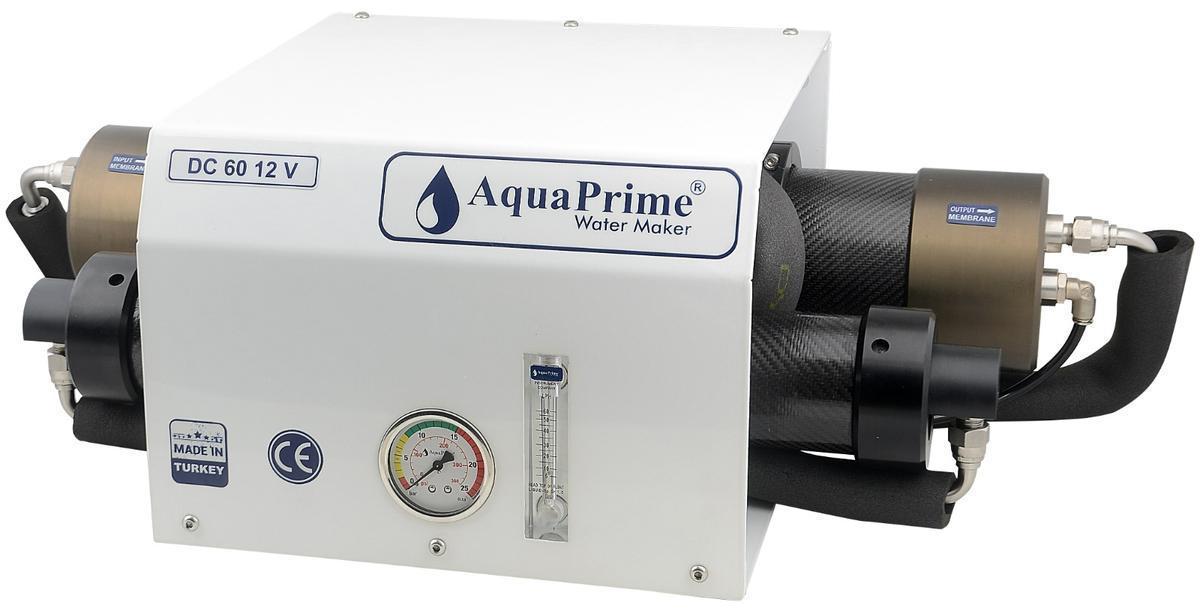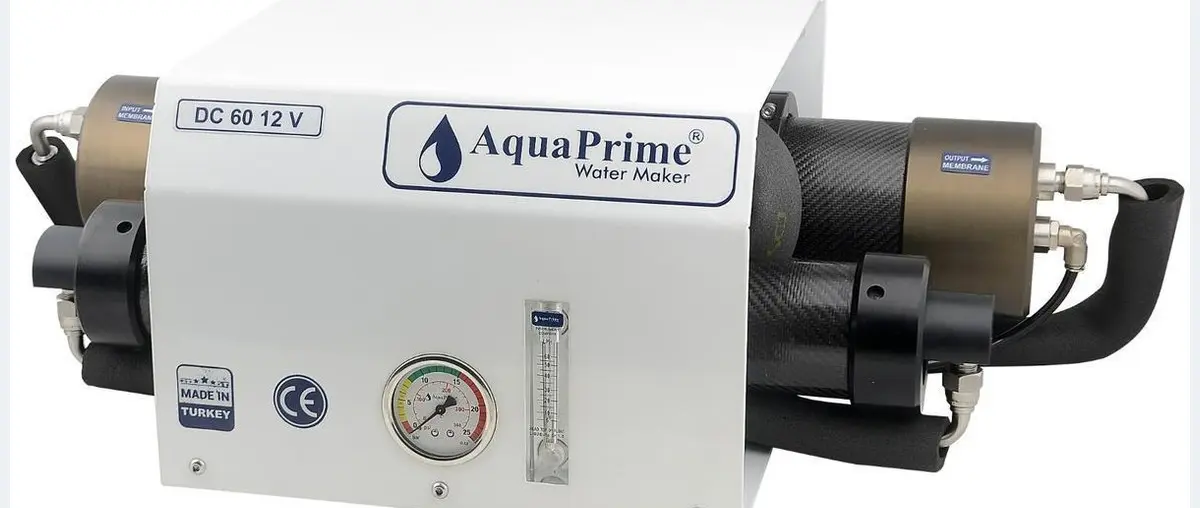
AquaPrime offers battery-powered freshwater production for smaller boats
AquaPrime Yachting is presenting the DC 60 12V or 24V watermaker through its 2026 METSTRADE supplier catalogue, describing a compact unit intended for small boats with limited space and electrical supply. The manufacturer says its DC range includes equipment producing around 30 or 60 litres of freshwater per hour, and the DC 60 is offered for 12- or 24-volt systems that can draw energy from a suitable onboard battery without requiring a generator. These are catalogue specifications, not a guarantee of the same output in every sea temperature and salinity. For owners of sailing and motorboats under twelve metres, the product highlights a common cruising problem: carrying enough safe freshwater for the crew without sacrificing every available locker to large tanks.
A watermaker changes the freshwater calculation
A small boat might carry sufficient water for day trips but have limited reserves for several days at anchor. Drinking, preparing food, washing and rinsing equipment can consume more than expected, particularly with guests aboard. A properly installed watermaker can replenish a portion of the supply while the vessel is away from shore, reducing dependence on marina taps. Yet it should not be considered a reason to sail without an adequate reserve. Mechanical or electrical equipment can fail, water conditions may prevent safe operation, and the crew still needs a plan for obtaining drinking water. The value of on-board production is added flexibility, not the disappearance of water management.
Sixty litres per hour is a rated figure
AquaPrime identifies the DC 60 by an output figure of approximately 60 litres per hour. Actual production from a marine water-treatment system can vary with feedwater quality, temperature, salinity, pressure, membrane condition and operating configuration. An owner should request the manufacturer's defined rating conditions and any published operating range. It would be misleading to calculate an entire voyage's freshwater supply by multiplying the advertised number by every hour that the boat is at sea. The correct estimate should allow for startup, flushing, maintenance and periods when the system should not be operated. A cautious production budget is more reliable than a maximum theoretical figure.
Battery operation does not mean energy is free
The supplier emphasises the ability to use a suitable 12- or 24-volt battery supply without a separate generator. That can be attractive for compact cruisers where a large generator would be expensive, noisy or physically impossible to fit. Nevertheless, freshwater treatment requires energy, so running the watermaker reduces the battery's available reserve. Owners should obtain the actual current draw and power requirements for the chosen voltage configuration. The boat's charging arrangements must then replenish the energy used. Solar panels, shore power or engine-driven charging may contribute depending on the vessel, but their output must be assessed realistically rather than assumed adequate.
Twelve- and twenty-four-volt boats need different installations
A small yacht may have a nominal twelve-volt domestic system, while another uses twenty-four volts for selected equipment. The product's stated availability at those voltages does not mean either version can be connected directly to any convenient electrical circuit. Cable sizing, overcurrent protection, switching and voltage drop matter, particularly when substantial current travels through a long cable run. A marine electrician should verify the permitted supply range and design a protected connection. Owners must also check which version they are ordering. A product name that references both voltages is not evidence of an automatically selectable input unless the manufacturer explicitly states that capability.
Compact packaging is only the beginning
AquaPrime describes the DC series as suitable for boats with limited space, but the complete installation may include intake filters, feedwater piping, a drain or brine discharge, product-water lines and access for maintenance. The main unit's dimensions are only part of the required volume. An owner should request a layout drawing that shows all connections and the clearance necessary for changing filters or accessing components. The equipment should remain accessible without removing substantial joinery. A small system fitted neatly behind a locker door can still create inconvenience if the owner cannot safely inspect or service it once the boat is fully loaded for cruising.
Feedwater quality matters to the system
Seawater near a busy marina, industrial discharge, shallow muddy harbour or polluted anchorage may contain contaminants that make it unsuitable for a recreational watermaker to process. Owners should follow the manufacturer's instructions on where the unit may be operated. A high-quality filter arrangement can reduce some particles, but it should not be assumed capable of making every possible contaminant harmless. The crew should know how to isolate the unit or postpone production when the surrounding water is questionable. Producing freshwater offshore in suitable conditions may be different from trying to operate the system alongside a fuel dock. Judgement about the source water remains essential.
Freshwater quality must be established
A watermaker is intended to produce water suitable for the specified use, but equipment performance, maintenance and storage conditions can influence whether the output remains safe. Owners should check the manufacturer's guidance on potable-water standards and any recommended testing or additional treatment. A low salt-content reading is not a complete examination of every possible contaminant. Even clean water can become compromised if it is introduced into an unmaintained tank or passes through unsuitable hoses. A boat carrying drinking water should have a complete hygiene plan covering production, transfer, storage and cleaning. The machine is one part of that chain, not a universal guarantee of potability.
The product water has to go somewhere
An installation needs a safe route for produced freshwater, often to a dedicated tank or through approved treatment and diversion arrangements. Owners should understand whether initial water should be rejected during startup or flushing and what checks are required before allowing water into the drinking-water supply. Plumbing that mixes untreated feedwater with the product side can compromise the system. The short exhibition entry does not establish the exact AquaPrime valve layout or any particular automatic diversion feature. A qualified installer should follow the current manual and explain the flow paths to the owner. Clear labels and accessible valves can help prevent mistakes when the system is used by occasional crew.
Brine discharge requires sensible routing
A seawater watermaker separates usable product water from a more concentrated reject stream. That reject water needs to be discharged or otherwise handled according to the approved design and local requirements. Pipes must be routed safely so that leaks cannot flood the vessel and discharge fittings do not create a hazard. An owner should verify the permitted flow and pressure arrangements from the manufacturer rather than attach a hose to a convenient existing outlet without analysis. The system's seawater intake and discharge may also require appropriate valves, filters and anti-siphon measures. Good plumbing work is as important as the electrical installation.
Intake arrangements need professional assessment
Bringing seawater into a hull creates obvious consequences if a hose or fitting fails. A new through-hull opening should not be drilled without examining the vessel's structure and the appropriate marine plumbing requirements. The intake needs protection from blockage, a suitable means of isolation and access for inspection. In some boats an existing seawater service may be usable only after a professional has confirmed its capacity and suitability. Owners should not assume a small watermaker can safely share any intake line. An installation that saves space but introduces an uncontrolled flooding route is not a successful upgrade.
Filters and membranes are consumable elements
Water-treatment systems generally depend on replaceable or serviceable components. Their life can depend heavily on source-water quality and use, while prolonged storage may introduce additional requirements. An owner should ask which filters and other components the DC 60 uses, the recommended service schedule and the availability of spares. The short METSTRADE description does not provide every part number or maintenance interval. A practical cruising kit should include the consumables appropriate to the planned route. A watermaker that cannot be maintained far from its original supplier may be of limited value even if its electrical and physical specifications are attractive.
Flushing and lay-up are part of ownership
A recreational boat may use its watermaker intensively for several weeks and then leave it unused for months. Many marine water-treatment systems require specific flushing, preservation or storage procedures to keep components in good condition. Those procedures vary between models and should not be improvised. Owners should obtain AquaPrime's current instructions and understand whether fresh water, approved preservative or a particular automated process is required. A unit that is compact and efficient during operation can still deteriorate if it is left full of untreated seawater for an extended period. Maintenance planning should begin before installation, not after the first long lay-up.
Noise and vibration affect cabin comfort
Pumps and pressure equipment can transmit vibration through a boat's structure. On a small cruiser, machinery located beneath a berth or close to seating can be noticeable even if its physical footprint is modest. A builder should consider mounting isolation, hose support and access before choosing the location. The DC 60 listing emphasises compact size and battery operation but does not provide a universal measured noise level. It would be misleading to promise silence simply because no combustion generator is required. Buyers can ask for verified sound data and, where possible, observe a comparable system operating aboard a boat.
Generator-free operation still depends on a charging strategy
AquaPrime's emphasis on powering the DC range from onboard batteries can reduce the need for a dedicated generator during water production. It does not remove the need to restore battery energy afterward. Owners should calculate the watermaker's electrical demand alongside refrigeration, navigation, lighting and other domestic loads. On a cloudy day or during a long period at anchor, a depleted battery bank may force the skipper to postpone freshwater production. A sensible operating schedule uses periods when charging is available and preserves a reserve for essential equipment. A generator-free watermaker can be a useful convenience, but it should be evaluated within the boat's entire energy budget.
Capacity should match the crew's habits
A six-metre dayboat with occasional passengers and a ten-metre liveaboard cruiser have very different water needs. The output rate required depends on crew size, tank capacity, daily consumption and how often suitable seawater will be available for production. Installing a large system merely because it has an impressive hourly output can add cost, mass and maintenance without corresponding benefit. An owner should prepare a daily water budget and include a contingency for equipment failure or bad conditions. The AquaPrime DC 60 may be appropriate for some smaller cruising boats, but suitability cannot be established from length alone.
Pricing should include the full refit
The watermaker unit is only one part of the total cost. An installation may require seawater plumbing, filters, electrical upgrades, monitoring, a new product-water connection and cabinet alterations. Labour can be significant where the boat has little room to work. A proper quotation should identify the model's current power draw, output limits, installation requirements and recurring service costs. Buyers should also consider how warranty service is arranged in their cruising area. The manufacturer catalogue does not establish a universal installed price, so it would be inappropriate to quote a single figure without the model and boat-specific work being assessed.
What AquaPrime's 2026 listing establishes
The official METSTRADE product page describes AquaPrime's DC 60 for small-scale boats, with 12- or 24-volt battery-powered operation and average production of around 60 litres per hour. It positions the equipment as compact and usable without a separate generator under suitable conditions. The entry does not provide independent potable-water test results, precise installed dimensions for every configuration or a guarantee of rated output in all seawater conditions. These limitations should be preserved in reporting. Its inclusion in the 2026 exhibition catalogue is the verified current product presentation, not proof of an exact first launch date this November.
More independence requires more responsibility
AquaPrime's DC 60 addresses a real concern for smaller cruising craft: the desire to replenish freshwater without installing bulky generating machinery. Its compact, DC-powered design may be attractive where storage and energy are limited. The value, however, depends on proper intake and discharge plumbing, safe electrical work, suitable water quality and regular service. Owners should confirm the manufacturer's exact technical requirements and decide whether the watermaker meaningfully improves their cruising plans. Producing freshwater aboard can extend flexibility, but it does not eliminate the need for reserves, hygiene or maintenance. The best small-boat installation is one that remains dependable and understandable long after the first demonstration.
Original industry sources and image credits
Reporting based on Official 2026 METSTRADE first-party product description submitted by AquaPrime Yachting.
Lead image: AquaPrime DC 60 Targets Battery-Powered Freshwater on Small Boats — official supplier product photograph. © AquaPrime Yachting. Original supplier image.