
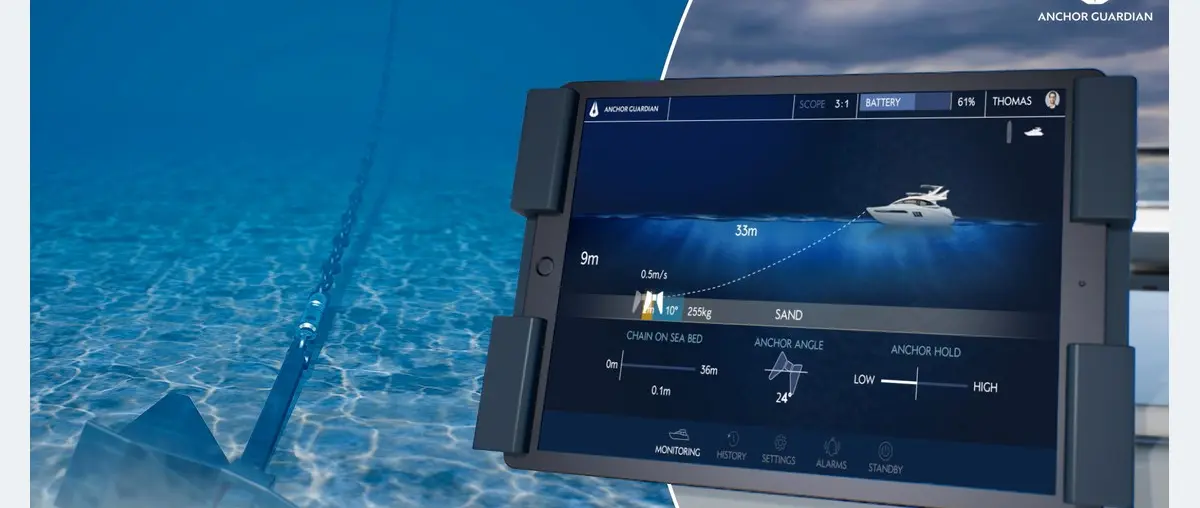
AnchorGuardian seeks to measure what happens at the anchor
Swiss Ocean Tech is presenting AnchorGuardian through the 2026 METSTRADE exhibitor catalogue as a system designed to monitor the movement and position of a vessel's anchor rather than infer everything from the boat's position. The manufacturer says its patented technology can deliver predictions and alerts about dragging, with claimed sub-metre positional accuracy. It also describes assisting the crew while lowering and recovering the anchor. These are supplier performance claims, not independently verified guarantees for every seabed, chain configuration or weather condition. For owners of small cruisers that anchor overnight, the product addresses a familiar anxiety: a GPS alarm can tell the skipper that the boat has moved, but it may not reveal exactly what has happened to the anchor on the seabed.
Why traditional anchor alarms can be ambiguous
Many chartplotters and mobile applications establish an area around the boat's recorded position and sound an alarm if the vessel moves outside it. That can be useful, but a boat at anchor naturally swings as the wind or current changes. Its GPS antenna may travel through a considerable arc even when the anchor has not shifted at all. Owners must therefore select an alarm radius that accommodates normal movement without giving so much clearance that meaningful dragging goes undetected. AnchorGuardian's manufacturer describes a different approach by focusing on the anchor itself. The distinction is interesting, although the public catalogue does not explain every measurement technique or installation detail.
The anchor and the boat occupy different positions
A vessel may lie downwind of its anchor with a length of chain or rope between them. As wind and tide change, the boat can turn around the anchor or move closer to it without an equipment failure. The anchor may remain in exactly the same place while the boat's GPS coordinates alter. Conversely, an anchor could begin creeping across the seabed before the vessel has moved far enough to trigger a widely set conventional alarm. A device that can track the anchor's position could, in principle, help distinguish those situations. Whether it does so reliably depends on actual sensor capability, calibration and operating conditions.
The manufacturer claims independence from vessel movement
Swiss Ocean Tech's official description says AnchorGuardian operates independently of movement of the ship. That is a central claim because it suggests information about the anchor is not simply derived from the vessel's track. But the phrase should not be stretched into a guarantee that the system works under every conceivable installation or communication fault. A customer needs the technical manual to learn where its hardware is mounted, how it identifies the anchor and what environmental conditions affect measurements. The relevant question is not how futuristic the display looks, but whether the underlying system provides a dependable indication of anchor displacement for the particular boat.
Sub-metre accuracy requires context
The exhibitor page refers to sub-metre accuracy. Such a claim deserves careful treatment because position uncertainty can depend on sensor type, calibration, interference and environmental conditions. It does not automatically mean that every reported movement smaller than one metre can be interpreted as dragging, or that every possible change is detected instantaneously. Owners should request the test method, stated confidence and conditions under which the advertised accuracy was obtained. A system operating near a steep seabed or unusual structure may face different challenges from one demonstrated in open water over a level bottom. Claims about accuracy are most useful when the measurement process is transparent.
Anchoring begins before the alarm is armed
Safe anchoring requires choosing an appropriate area, considering charted hazards, assessing wind and tide, inspecting the equipment and providing sufficient scope for conditions. The skipper should understand the holding characteristics of the chosen anchor and the seabed. An electronic monitor may offer information once the anchor is deployed, but it cannot make a poor anchorage safe or correct the use of an unsuitable anchor. The manufacturer says AnchorGuardian can support laying the anchor, which may be useful if the system can confirm aspects of its movement. That function still needs to be understood through the current operating manual, not inferred from a short marketing statement.
The type of seabed makes a difference
Sand, mud, weed, rock and mixed bottoms can influence how an anchor sets and holds. Some anchors need to dig into the seabed; others may have difficulty in particular conditions. A device intended to monitor position should not be confused with a universal direct measurement of holding force. Even if the anchor appears stationary, the skipper needs to consider whether conditions could change enough to overcome its holding capability. A safe anchorage includes room to swing and an escape plan if the anchor begins to move. Sensor data may add valuable information, but it cannot replace judgement about the bottom and forecast conditions.
Scope and chain geometry still matter
The ratio between deployed rode length and water depth affects the angle at which load is applied to the anchor. Wind, waves and current can change the shape of the chain or rope between the boat and the seabed. A monitoring system cannot correct insufficient scope or a rode that rubs against an obstacle. Owners should follow the appropriate anchoring procedure for their equipment and conditions, then use the device as an additional source of information. The public AnchorGuardian entry does not establish that its measurements can determine every element of chain geometry or recommend a universal scope ratio. Those are vessel-specific seamanship decisions.
Predictive alerts require realistic expectations
The manufacturer describes predictions and immediate alarms intended to reduce the risk of anchor drag. Predictive systems can potentially identify patterns before a larger problem becomes obvious, but their usefulness depends on sensitivity and false-alarm rates. Too many warnings can lead a crew to ignore the device, while an overly quiet system may create false reassurance. Buyers should ask how alert thresholds are determined, whether they can be configured safely and which warnings indicate reduced data quality. Any prediction should be regarded as additional decision support rather than certainty about what the anchor will do when an unexpected squall arrives.
A night at anchor is a demanding use case
When a crew sleeps aboard, the skipper may rely on several layers of warning in case the boat moves dangerously. A conventional GPS anchor alarm can provide one layer, while a correctly specified AnchorGuardian installation might offer another. Yet the devices could have common vulnerabilities, such as loss of battery power or a failure in the boat's electrical system. Owners should understand which alarms sound locally, whether an external connection is required and how the system indicates that it has stopped monitoring. A sleeping crew needs a dependable audible alert and a clear plan for responding promptly, not merely reassuring graphics on an unattended screen.
A small boat may have limited space for new hardware
Boats below twelve metres can have crowded bow lockers, narrow anchor wells and compact windlass arrangements. Any equipment associated with the anchor or chain must fit without fouling normal deployment and retrieval. A technical installation should preserve access for inspecting the rode and clearing a jam. If the product requires sensors, data connections or additional mechanical components, their placement must be approved for the particular arrangement. The METSTRADE summary does not provide universal mounting dimensions or a promise of easy installation on all small vessels. Buyers should request full diagrams before drilling or altering equipment near the stem.
Saltwater exposure is a serious engineering consideration
Anchoring equipment is exposed to spray, immersion, mud, sand and powerful mechanical impacts. Hardware that works on a clean demonstration stand may experience much harsher conditions when deployed repeatedly over rough seabeds. Owners should ask how AnchorGuardian components are protected and serviced, particularly any equipment located near moving chain or underwater elements. Corrosion, abrasion and fouling can affect sensors and mechanical parts. A well-designed monitor should remain inspectable and should report faults clearly. Its owner needs to understand what happens if components are damaged during retrieval or a heavy-weather anchoring incident.
Recovering the anchor brings another set of risks
A fouled anchor may resist retrieval, creating significant load on the windlass, bow roller and deck fittings. Swiss Ocean Tech's catalogue says the system supports the crew during lifting, but the exact form of assistance must be verified from the supplier. Even with additional information, a skipper should not use a windlass to pull the entire weight of the boat forward under high load. The engine and correct seamanship may be needed to relieve tension, and nobody should stand where a heavily loaded chain could cause injury. A monitoring device may inform the operation; it does not provide a reason to disregard ordinary deck safety.
Position information should be compared with other evidence
If AnchorGuardian reports movement, the skipper can assess conditions using visual bearings, depth, GPS track and the behaviour of neighbouring vessels. One unexpected sensor reading may indicate genuine dragging or a measurement issue. A useful procedure is to respond conservatively while checking independent evidence, rather than silence an alarm because the boat seems comfortable. The reverse also matters: if wind and waves worsen but the monitor remains quiet, the crew should not assume the anchorage is safe without observation. Good electronic aids increase awareness by adding evidence, not by becoming the only source of truth.
Cost and maintenance could determine uptake
An owner should include the complete installed cost, recurring service and any software or subscription requirements in a comparison with existing anchor-monitoring methods. The product's short exhibition page does not establish a universal retail price or a guaranteed maintenance schedule. On a small dayboat that rarely anchors overnight, the benefits may be limited. A coastal cruiser that spends many nights at anchor may place greater value on additional information. The decision should also consider whether the owner can obtain reliable support near their normal cruising waters. Advanced monitoring may be worthwhile when it addresses a real operational risk and remains maintainable.
Different anchor systems may require different solutions
A small sailing yacht might use a chain-and-rope rode, while a heavier cruiser may have all-chain ground tackle and an electric windlass. The motion of the equipment during deployment and recovery will differ, as will the available space for additional devices. An owner should establish which anchoring arrangements are approved for AnchorGuardian and how the equipment is calibrated. It would be misleading to assume that a system tested with one anchor type will provide identical performance on every other configuration. Matching the monitor to the actual ground tackle is part of achieving reliable information.
The official supplier description defines the claim
The first-party METSTRADE 2026 entry identifies AnchorGuardian as a patented monitoring and warning system concerned with the anchor's own movement and position, which Swiss Ocean Tech says can help reduce the risk of dragging. It claims predictive warnings, immediate alarms and sub-metre positional accuracy. The page does not provide an independent trial series, a complete compatibility list or an exact November launch date. Those facts should not be invented. The news is the manufacturer's present offering and the opportunity it creates to distinguish direct anchor monitoring from conventional alarms based mainly on the boat's GPS movement.
Electronics are a second layer, not the anchor itself
AnchorGuardian illustrates an appealing direction in boating electronics: trying to measure the state of an important piece of equipment rather than observing only its effect on the vessel. That may help owners interpret a difficult situation, particularly when a boat swings widely at anchor. But dependable anchoring remains a combination of suitable ground tackle, appropriate scope, weather judgement and a crew able to respond to changing conditions. A buyer should ask Swiss Ocean Tech for the verified installation requirements, test evidence and failure behaviour before relying on the system. Even the most informative alarm can only help if it alerts an attentive crew that knows what to do.
Original industry sources and image credits
Reporting based on Official 2026 METSTRADE first-party product description submitted by Swiss Ocean Tech Ltd. / AnchorGuardian.
Lead image: AnchorGuardian Monitors Anchor Movement Separately from the Boat — official supplier product photograph. © Swiss Ocean Tech Ltd. / AnchorGuardian. Original supplier image.
