
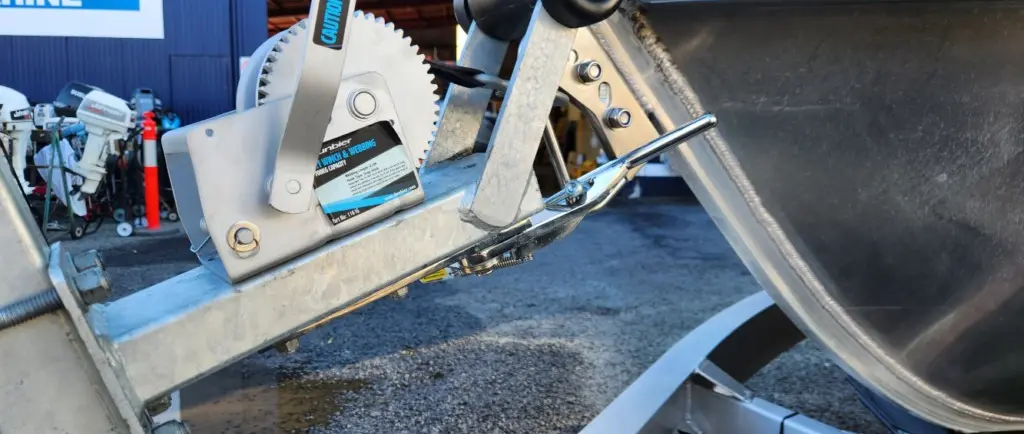
Boat ramp latch takes the trailer award at IBEX
The Launch & Retrieve Boat Latch has won the 2026 IBEX Innovation Award for trailers, parts and accessories, putting a familiar small-boating problem in the spotlight. The product uses a mechanical catch on the trailer to release and secure the boat at the bow during launching and recovery, with the aim of reducing the need for somebody to enter the water or handle the winch connection at the ramp.
The award was announced at the International BoatBuilders' Exhibition and Conference in Tampa on 6 October. Boating Writers International judge Steve Davis singled out the straightforward latch-and-snare arrangement and its suitability for a person operating a boat on their own. The award recognises the equipment's design, while safe use still depends on the condition and setup of the whole trailer.
How the latch and snare work together
The kit has a latch mounted at the trailer's bow-stop area and a compatible snare fitted at the boat's bow. Instead of relying on someone stepping into the water to catch the bow eye at the precise moment of retrieval, the two components meet as the vessel moves gently forward along the trailer guides. The latch then captures the snare mechanically.
A manually selected lever gives the device separate launch and retrieve positions. For launch, the catch is set to allow the boat to move clear as the trailer enters the water; for retrieval it is set to engage the snare. The manufacturer emphasises that the system works without electric power, wireless controls, wires or release strings.
The simplicity is attractive on a ramp where salt spray, trailer immersion and mechanical knocks are routine. Nevertheless, the latch must be fitted in the correct location relative to the bow and roller, and the snare must suit the vessel. Incorrect alignment can cause missed engagement or damage even when the basic mechanism is working properly.
Launching calls for controlled trailer depth
The maker's published procedure begins with the boat at the water's edge and the latch moved to its launch position. The driver then backs the trailer into the water until its rollers or supporting slides are approximately 50 millimetres below the surface, subject to the particular trailer and ramp. The boat can then be eased forward until the spring-loaded mechanism lets go.
This sequence does not remove the need for a line, attention to the tide or a safe plan to control the boat after release. Wind, current, a steep ramp and the position of other users may all affect how easily the vessel moves clear. An owner should practise in suitable conditions rather than relying on the latch to solve every difficulty encountered at a busy launch site.
The boat still needs a competent helm operator when moving away from the submerged trailer. The mechanism deals with the bow connection, not engine starting, steering, passengers or the risk of striking a propeller on a shallow ramp. Those parts of the launch procedure remain the responsibility of the people using the boat.
Retrieval is a two-stage approach
For retrieval, the lever is put in the capture position before the trailer is backed into an appropriate depth. The manufacturer advises approaching the trailer slowly and stopping roughly one metre from the catch, allowing the boat to settle before making the last controlled movement forward. The snare then meets the latch and is held in place.
Once the crew has confirmed that the latch is engaged, the engine should be stopped and the outboard or sterndrive lifted before the vehicle pulls forward. The manufacturer's manual then instructs the operator to move the trailer a short distance clear of the water before connecting the winch hook and securing the bow against the roller or V-block.
That last step is important because automatic engagement is not the same as fully preparing a boat for road travel. Winch tension, a bow security chain, transom restraints, trailer lights and other appropriate load-security arrangements still need to be checked. The latch makes the ramp operation more convenient but is not a replacement for the safety devices required to transport the vessel.
Material and kit choices
The product is made from marine-grade 316 stainless steel and the manufacturer states a tensile strength equivalent to 5.4 tonnes for the latch assembly. That advertised component rating should not be interpreted as a universal safe towing capacity; the trailer, snare, bow fittings and complete securing arrangement have separate ratings and installation requirements.
The company's standard snare version is recommended for boats below 7.5 metres, while a heavy-duty version is offered for vessels above that length or where the workload is more demanding. Boat owners should check hull material, bow geometry and actual trailer compatibility, not simply order on the basis of overall length. Some configurations need optional wedge plates or adjustments to ensure the system meets the bow correctly.
The manufacturer says installation need not involve cutting or drilling the boat itself, which can be appealing when preserving an existing hull finish. However, fitting a bracket to a particular trailer may still involve work best undertaken by a competent installer. Owners should inspect the final alignment and test the mechanism under controlled conditions before routine use.
Practical advantages for smaller trailer boats
A compact fishing boat, RIB or open dayboat often returns to a launch ramp with only one or two people available to assist. At an exposed slipway the traditional task of controlling the hull while reaching the winch post can be awkward, especially if the boat is rising and falling against the guides. A correctly fitted latch could reduce the number of separate movements needed while securing the bow.
The benefit will depend on how the trailer is set up. Bunk trailers, roller systems, differing bow shapes and ramp gradients can each change the way the boat approaches the catch. A product that works smoothly on one installation may require different adjustment on another, and the user should be willing to make a trial run rather than assume a universal fit.
Accessibility is another consideration. Being able to avoid repeatedly stepping into cold or slippery water could be particularly useful to a solo boater or someone with limited mobility. It remains important to establish how the boat will be secured if the catch does not engage or if the ramp conditions make a powered approach inappropriate.
What buyers should check after the IBEX win
The manufacturer's kit information describes the snare options and mechanical construction, while its operating guide sets out the launch and retrieve steps. The IBEX 2026 award notice independently confirms the product's recognition in the trailer category.
Before fitting a latch, owners should check the trailer's bow stop, winch post and the approach angle of their boat. The manufacturer or installer should confirm the appropriate kit and any extra mounting parts, then demonstrate a successful controlled engagement and release. Regular inspection of the stainless components, fastening points and any wear remains sensible.
The award does not make launching entirely automatic or eliminate the need for skilled boat handling. Its significance is more practical: a well-designed mechanical attachment can simplify a frequent task on the ramp, leaving the crew more time to attend to positioning, passenger safety and the other checks needed before and after a day on the water.