LALIZAS UK and Star International have been selected to supply lifejackets for Royal Navy use following a procurement and assessment programme lasting approximately two and a half years. The companies announced the arrangement in November 2026, with BAE Systems acting as the prime supplier and the two marine-safety businesses supporting the requirement together. According to their statements, the selected equipment covers different applications, including commercially available lifejackets for training and water-activity centres and purpose-developed solutions for personnel serving aboard naval vessels. For owners of smaller recreational boats, the award is an opportunity to consider the principles of lifejacket selection, servicing and crew familiarisation. It is not evidence that every LALIZAS product is approved for naval service or that military equipment is necessarily suitable for a family cruiser.
What the contract actually covers
The supplier announcement identifies LALIZAS UK and Star International as partners selected to provide lifesaving equipment after a lengthy evaluation process. BAE Systems is named as the prime supplier, and the companies have worked with personnel from the Royal Navy and Ministry of Defence. The release does not publish a contract value, a complete equipment list or specific quantities, so those figures should not be assumed. It also distinguishes between ordinary commercially available models and equipment developed for particular service applications. Reporting this distinction is important because naval vessels and their crews operate in conditions and roles that are different from those encountered on a weekend motorboat.
A long evaluation is a meaningful detail
The reported two-and-a-half-year programme suggests that the choice involved more than purchasing equipment directly from a catalogue. The companies describe assessment, selection and testing intended to establish suitability for a range of intended uses. Such programmes can examine durability, practical handling and compatibility with other equipment, although the November statement does not provide a full test protocol. A recreational boat owner can learn from the emphasis on evaluation without assuming that the same tests have been conducted for every retail lifejacket. A useful buying process should establish the correct approval, buoyancy category, wearer size and operating environment. Price and brand recognition are only part of the decision.
The equipment has different intended users
The release refers to commercially available models for training and water-activity centres as well as bespoke designs for operational personnel. This helps explain why a single lifejacket type is unlikely to satisfy every requirement. Someone using a small dinghy during a supervised training session may need a different garment from a crew member working in heavy clothing on the deck of a much larger ship. The wearer may also carry tools, a safety harness or other equipment that affects fit. A lifejacket should be chosen for a defined person and activity, rather than because it is associated with a demanding organisation. The responsibility remains with the operator to confirm that protective equipment fits the actual environment.
Buoyancy ratings need interpretation
Recreational lifejackets are sold with different buoyancy levels and approvals, including categories that are frequently described using newtons. Those ratings are relevant but should not be treated as a simple scale in which the highest number is always the best choice. A wearer who must move freely on a sheltered-water training boat may have different needs from someone travelling offshore in heavy clothing. Manufacturers' approval documentation explains the intended conditions and limitations. A lifejacket selected for one activity may be inappropriate for another, even when its headline buoyancy number looks reassuring. Owners should also consider whether the equipment is suitable for children, who cannot simply use an adult device adjusted to its smallest setting.
Fit is as important as the label
An incorrectly fitted lifejacket may not perform as designed. Shoulder straps, waist adjustment, crotch straps and the overall length of a garment should be appropriate for the wearer. On a small boat, people may spend time seated at a helm, leaning forward to handle ropes or climbing aboard from a low pontoon. Equipment that restricts basic movement is less likely to be worn properly throughout a voyage. A responsible skipper should provide everyone with an opportunity to try their lifejacket before departure, including while wearing the clothing they will use on the water. A fit check should be repeated when passengers or equipment change, not merely completed once when the boat is purchased.
Different lifejackets require different upkeep
Foam and inflatable products can both form part of a suitable safety arrangement, depending on the activity and the model's approval. Inflatable lifejackets require particular attention to the inflation mechanism, gas cylinder and any automatic activation components. Other designs require inspection of buoyant material, fastenings and the condition of fabric. The exact servicing interval is set by the manufacturer and, where applicable, by law or the organisation operating the boat. Owners should not infer from the naval award that a lifejacket has an unlimited service life. Damage, poor storage or incorrect replacement parts may compromise otherwise good equipment. Servicing records can be as important as the initial purchase receipt.
Training featured in the suppliers' programme
LALIZAS and Star International say their specialists worked with naval personnel to provide product familiarisation and training. This is a particularly useful aspect of the announcement for leisure boat owners because safety equipment is only effective when people know how to use it. A crew should understand how to put on and adjust the equipment, what an inflation mechanism does and what checks are required before use. Familiarisation should not rely on reading a label during an emergency. A brief demonstration at the start of a trip can reveal problems that might otherwise go unnoticed, such as an incorrectly fitted strap or a passenger who is uncomfortable wearing the equipment.
A demonstration can prevent small mistakes
Even experienced sailors may be unfamiliar with a particular lifejacket's inflation and release arrangements. A skipper who hires a boat, joins a club or invites guests aboard should not assume everyone has used the same equipment before. The crew can practise fitting the jacket while standing safely ashore, confirm that any integrated harness is used correctly and explain how to signal for help. That instruction does not require deploying an inflation cylinder during an ordinary pre-departure briefing, unless an appropriate training device and controlled programme are available. The key point is to build confidence before a stressful situation arises. Safety equipment should not become a mystery only when it is urgently needed.
Testing must reflect actual use
The Royal Navy programme reportedly involved demanding tests intended to assess the chosen models under a range of operational conditions. The announcement does not identify each test standard, environmental condition or acceptance threshold. It would be inappropriate to describe those tests as an independent consumer ranking of every lifejacket in the market. For recreational owners, the principle remains relevant: protective equipment should be judged against the activities it is expected to support. A lifejacket that is comfortable in a marina may feel very different when combined with cold-weather layers, a sprayhood or a tether. The boat owner should seek current manufacturer documentation and choose equipment suitable for those real conditions.
Professional service support has practical value
Star International supplies marine safety equipment and offers associated service support, making its role broader than simply distributing a garment. For owners of boats below twelve metres, finding a reliable service provider can help ensure that inflatable lifejackets and related equipment are examined at appropriate intervals. It is useful to know whether a supplier is authorised to service the particular model, what parts are available and how long the work may take. A jacket should not be regarded as fully serviceable simply because the outer fabric looks clean. An equipment record identifying the model, serial number and service history can reduce uncertainty when a boat is sold or transferred to another operator.
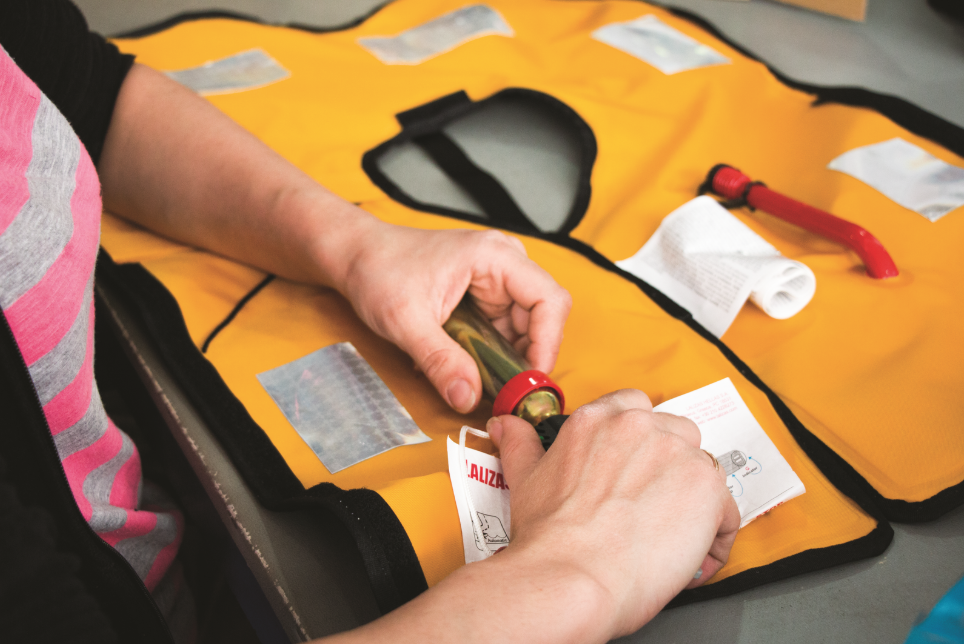
The official photograph illustrates safety-equipment work
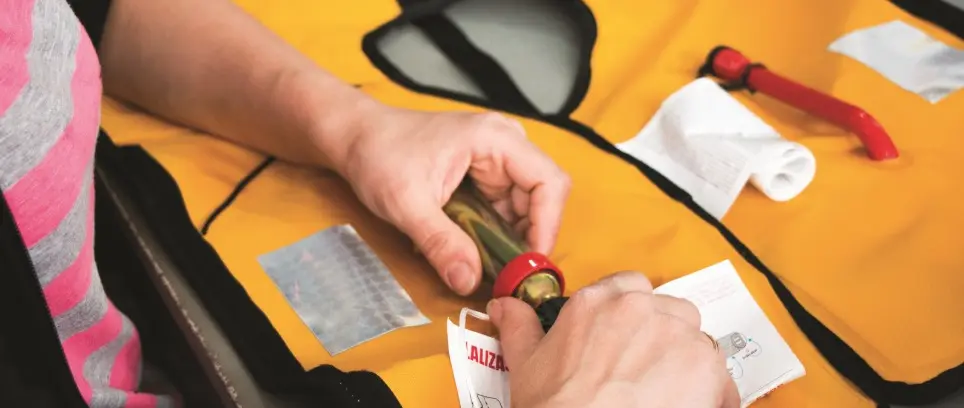
Star International's own news report includes a company press photograph showing hands working with lifejacket materials. It illustrates the testing and service context of the announcement, rather than identifying a particular Royal Navy-approved product model. That distinction matters because the source does not list every item purchased by the service. Publishers should not use an ordinary recreational lifejacket image to imply that it is the exact military-issued garment. The photograph is relevant to the supplier partnership and its handling of marine protective equipment. The rights and attribution of the original company image are preserved in the article's media record rather than treated as a generic stock illustration.
What small-boat owners should check first
Before buying a lifejacket, the owner should establish where the boat will operate, who is likely to be aboard and what clothing and other protective equipment will be worn. The product's intended buoyancy category and approval should be clear from the manufacturer. Adjustable size ranges must actually fit the user, and any optional harness or light should be compatible with the design. It is also worth asking whether replacement components, servicing and professional inspection are available locally. A lifejacket purchased for occasional calm-water use may not be the right choice for a longer coastal passage. Informed selection is more valuable than choosing equipment simply because it has a familiar logo.
Storage can influence reliability
Lifejackets are often stored beneath seats or in lockers where moisture and heat can build up. Prolonged exposure to poor conditions may damage materials or affect mechanisms. Inflatable devices should be kept in accordance with the manufacturer's instructions, and all products should remain accessible to the people who need them. A lifejacket buried beneath luggage is of little immediate use when a boat capsizes or a person falls overboard. Owners should also ensure that crew members know where spare equipment is stored. A routine inspection and sensible storage arrangement can improve safety without requiring complex new technology. The naval procurement story is a reminder that maintenance and operational procedures matter alongside equipment design.
The contract is not a universal endorsement
A procurement award to supply the Royal Navy is commercially significant for LALIZAS and Star International, but the details should be interpreted carefully. Some equipment is commercially available, while other solutions are designed for particular naval applications. The agreement does not imply that every model made by either company meets every military requirement. It is also not evidence that other respected safety-equipment manufacturers are unsuitable. Consumers should rely on applicable certification, correct fit and professional advice. A military procurement process may use selection criteria that differ substantially from those relevant to a small recreational craft. The useful lesson is the importance of matching equipment to task, not a reason to abandon careful comparison.
A wider industry focus on safer boating
Marine safety depends on equipment, training, maintenance and an understanding of risk. Suppliers may develop new products, but the people using them still need to practise basic responses to emergencies. Recreational crews should know how to alert assistance, recover a person from the water and respond if someone becomes incapacitated. Lifejackets are part of that system, not a substitute for the rest of it. The November 2026 contract announcement demonstrates how professional organisations combine product selection with testing and familiarisation. That integrated approach is relevant to leisure boating, even when the boats and operating circumstances are very different.
What the November decision signifies
LALIZAS UK and Star International's selection, supported by BAE Systems as prime supplier, represents a new supply arrangement following a lengthy reported evaluation. The companies have described different lifejacket applications and a training component, while leaving commercial quantities and the full technical specifications undisclosed. For small-boat owners, the announcement offers a useful reason to review the lifejackets already carried aboard: are they suitable for the people and voyage, correctly fitted and properly maintained? A prestigious supply contract can attract attention, but the real measure of safety is whether equipment is ready and crews know how to use it when the unexpected happens.
Official sources and photography
Reporting independently based on Official original press release, Secondary contract party official publication.
Official source product photograph: Star International staff working with LALIZAS lifejacket equipment, original partner official 2026 press photo; does not purport to show a specific Navy-issued model. Original image rights remain with the source publisher and photographer. Official press-image source.