
KVH reports a stronger third quarter
Marine communications provider KVH Industries reported third-quarter 2026 revenue of $38.4 million for the period ending 30 September, an increase of 35% from $28.5 million in the comparable quarter a year earlier. Revenue was also 14% higher than the $33.7 million recorded in the second quarter, according to results issued by the company on 5 November. Those comparisons make the announcement relevant to boat owners and marine businesses assessing the changing market for onboard connectivity.
The improvement is a company-wide result, not a measurement of spending by leisure boat owners alone. KVH serves commercial shipping, leisure vessels and other mobility and government markets, and the earnings release does not break the headline increase into a stand-alone recreational-boating figure. The distinction matters because changing patterns in shipping fleets and enterprise communications can move its overall results without precisely tracking the needs of an individual cruising yacht.
Low-Earth-orbit connectivity gains share
One of the most notable figures concerns low-Earth-orbit, or LEO, satellite services. KVH said those services represented 58% of its third-quarter service revenue, compared with 51% in the preceding quarter and 39% in the third quarter of 2025. This is a change in the composition of KVH's own service business, rather than a claim that 58% of all boats or all maritime communications use LEO networks.
The development nevertheless highlights a practical transition in onboard communications. Satellite links once commonly associated with geostationary VSAT services now sit alongside increasingly prominent LEO offerings, potentially changing the combinations of speed, latency, coverage and cost that operators consider. Whether a particular boat benefits depends on where it cruises, its existing equipment, service terms, power budget and actual bandwidth requirements.
Service revenue provides the main signal
KVH reported $33.0 million of service revenue, up approximately 30% year on year and 11% against the previous quarter. That category is particularly important for customers because it reflects ongoing connectivity and associated services rather than simply counting terminals sold. The company also reported $11.1 million of service gross profit, around 28% above the figure for the same period in 2025.
The figures should not be read as a promise that subscription prices or connection quality will improve in tandem with sales growth. A rise in recurring revenue may reflect a mix of new customers, changing packages, higher consumption and revised pricing. For marine operators, it is the details in their own agreements, including data allowances, geographical limitations and technical support, that determine the day-to-day value of a service.
Margins tell a more nuanced story
Service gross margin was 34% in the third quarter, compared with 36% in the second quarter and 34% a year earlier. The margin indicates how much service revenue remains after the direct costs of providing it, before general corporate expenses are considered. The two-percentage-point sequential decline therefore deserves attention alongside the strong increase in service sales.
A business can expand revenue while experiencing pressure on the percentage it earns from each dollar of sales, especially as its products and network suppliers change. The precise relationship between revenue and gross profit is also relevant to resellers and installers who must plan support work and customer expectations. KVH's report supports an observation about its own service economics, but cannot establish the profit margins of an unrelated marine electronics dealer.
Net loss narrows, with qualifications
The company recorded a net loss of approximately $0.6 million in the latest quarter, compared with a $6.9 million net loss in the third quarter of 2025. Reported loss per share narrowed from $0.36 to $0.03 over the same comparison. At first sight this is a substantial improvement, but the reported periods included inventory-related write-downs that complicate an unqualified comparison.
KVH identified inventory write-downs of about $2.3 million in the 2026 quarter and $5.5 million in the year-earlier quarter. Adjusted EBITDA, a non-GAAP measure that should not be equated with net profit or cash flow, was $3.9 million, against $3.0 million in the second quarter and $1.4 million a year earlier. Taken together, these figures suggest improved operating performance while underscoring why readers should distinguish statutory results from adjusted management measures.
Starlink pricing plans for December
The company's release also discussed expected changes affecting Starlink services. KVH said Starlink had announced price increases for resellers and maritime customers, and stated that KVH expected to adjust its own customer Starlink plan prices from 1 December 2026. This was a forward-looking intention in the 5 November announcement, not proof that every customer has already received a revised bill.
KVH indicated that the expected pricing change could increase its service revenue while reducing its service gross-margin percentage, with little expected effect on service gross profit. Boat owners comparing offers should therefore check the exact plan, whether any changes apply to an existing contract, and the conditions for roaming or seasonal suspension. It would be misleading to treat a provider-level forecast as a universal price change for every vessel or every subscription.
Managed technology extends beyond the satellite link
During the quarter KVH began adding subscribers to its managed information-technology services, according to the company. It also expanded the cybersecurity capabilities of its CommBox Edge Pro platform in September. Both developments demonstrate the industry's interest in services extending beyond the original act of receiving a satellite signal, although the release does not specify how many recreational boats adopted the offerings.
On a modern vessel, connectivity becomes part of a wider network of crew devices, chart and monitoring systems, remote support and guest internet access. Security and system management deserve distinct consideration because a fast connection alone does not establish that an onboard network is well configured or protected. An owner commissioning an upgrade should ask suppliers how devices are segregated, software is updated and access is administered, without assuming that a branded service resolves all cybersecurity risks.
Crew content enters the offering
KVH also referred to a September launch of Link Live, a streaming-content offering aimed at crew. This points to a different requirement from navigation, machinery reporting or shore-side business communications: crew welfare and entertainment on longer journeys. The company did not present Link Live as a substitute for the underlying communications link, and its broader earnings figures cannot reveal the specific contribution from the newly launched service.
For operators, separating essential shipboard communication from discretionary streaming traffic can be useful when judging a subscription. Actual bandwidth priorities, equipment compatibility and rights to access particular content can vary by vessel and location. A connectivity purchase is therefore better evaluated against a realistic operating profile than against a single advertised peak-speed figure.
Cash position and outlook
At the end of September, KVH reported approximately $50.7 million in cash and cash equivalents and said it had no debt. It also said that third-quarter repurchases of shares amounted to $10.7 million, completing a $15 million buyback programme. These balance-sheet and capital-allocation details help explain the company's financial position but do not, by themselves, indicate future connectivity prices or guarantees about service availability.
Management revised its forecast for full-year 2026 revenue to a range of $137 million to $143 million, from an earlier $130 million to $145 million. The adjusted EBITDA outlook moved to $13 million to $15 million, compared with the earlier $11 million to $16 million range. Both are company expectations rather than finished-year results, and their narrower ranges should be treated as forecasts subject to business and market risks.
What leisure boat owners should take away
The immediate relevance of the announcement lies less in the earnings-per-share calculation than in the rapid shift of KVH's recurring service business toward LEO connectivity. The 58% service-revenue share is a measurable indication of changing demand within this provider's customer base. It supports a decision to review onboard communications arrangements, but it does not establish that a particular boat should abandon its present equipment or provider.
Before changing service, owners should compare cruising grounds, emergency and operational requirements, hardware and installation costs, advertised versus expected speeds, ongoing fees, support arrangements and the resilience of the complete onboard system. Those questions remain as important for a small motor cruiser as for a larger vessel carrying a professional crew. KVH's third-quarter release provides fresh evidence of the commercial transition; it is not a substitute for vessel-specific technical advice.
Source: KVH Industries' official third-quarter 2026 results announcement, 5 November 2026.
Primary release and photograph credit
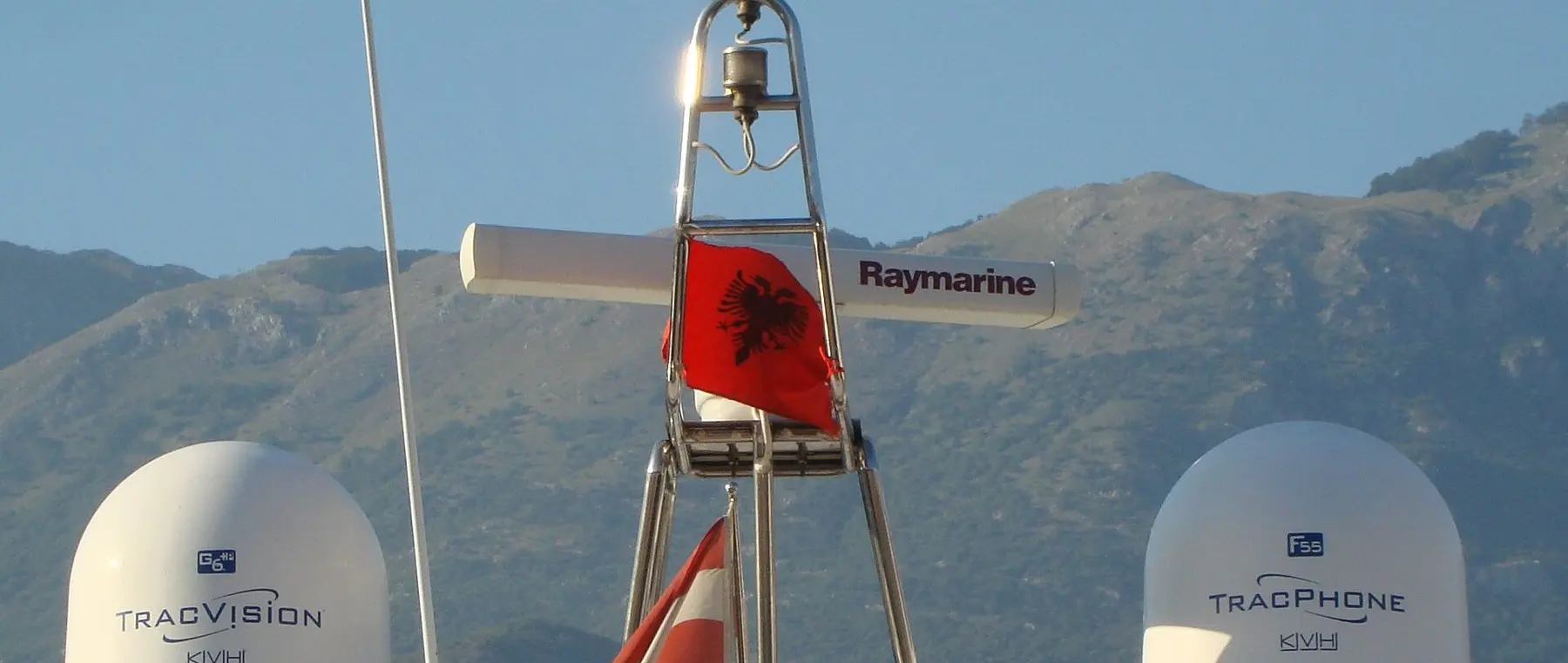
Original issuing organisation. A photographed KVH TracVision/TracPhone satellite-dome installation. It is an archival image, not a photograph from the Q3 results announcement. Photograph: Aleksey Churushkin, Wikimedia Commons, CC BY-SA 4.0; resized without cropping.
