
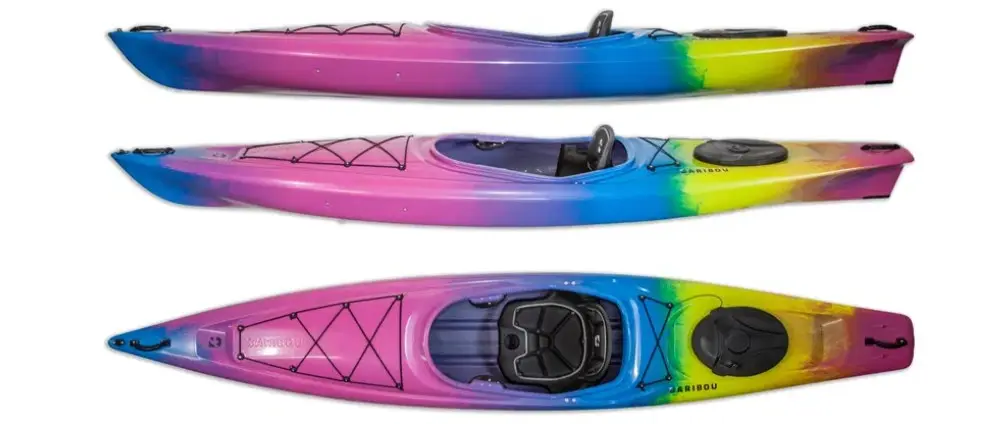
A third design expands the Caribou family
Polish kayak manufacturer KayakZone has presented the Caribou Nuna as the third model in its Caribou family, focusing on beginning and intermediate paddlers who want a comfortable river and touring craft. The submission to the Paddle Sports Show's 2027 recreational selection places particular emphasis on cockpit ergonomics and the way hull geometry can combine stable handling with efficient paddling.
The company says the design was developed in cooperation with 2s.design, a specialist design studio, and informed by usability testing with paddlers. That process is relevant because a boat intended for a rental centre or a newcomer must work across different body sizes and experience levels. A model can look well balanced in a showroom but still prove awkward when the paddler tries to reach the water or adjust the footrests.
A 3.96-metre hull with defined capacity
The Nuna's published length is 396 centimetres and its width 69 centimetres. KayakZone lists a hull weight of 27 kilograms, with an optimal carrying capacity of up to 200 kilograms and an overall volume of approximately 350 litres. These figures offer an initial basis for comparing the model with smaller, narrower touring kayaks, but weight and load should always be considered together.
A published carrying limit is not a recommendation to load every expedition to that figure. The paddler's own weight, clothing, food, dry bags and safety equipment all contribute to the total. The correct trim can also be affected by where equipment is placed. Buyers should check the manufacturer's usage guidance, particularly if the craft will be used on rivers with stronger currents or shallow obstacles.
Why the cockpit dimensions matter
The maker specifies an internal cockpit rim of approximately 96 by 52 centimetres, with external dimensions around 103 by 57.5 centimetres. The seating arrangement uses a fixed seat with thick cushions and a folding ergonomic backrest, while adjustable footrests and padded thigh braces are intended to help the user maintain control. Such details can influence how natural a paddling stroke feels over several hours.
The company says it studied the space available for the hands and paddle, aiming to reduce the restrictions sometimes created by a broad, high-deck recreational kayak. A generous cockpit is helpful for boarding, but it must still allow the paddler to control the boat without sliding unexpectedly. A test fitting is particularly important for people who intend to use a spraydeck or paddle in more demanding conditions.
Polyethylene for frequent river use
The Nuna uses a polyethylene hull, a common choice for recreational kayaks where impact resistance and relatively straightforward maintenance matter. It may appeal to rental companies whose boats are repeatedly loaded, launched and handled by different customers. The official submission describes durability as one of the priorities, although it does not remove the need for regular checks of fittings and the hull surface.
Polyethylene responds differently from composite constructions to temperature, abrasion and long-term storage. A craft left unsupported in strong heat can experience deformation, and a hull dragged across rough ground may suffer wear. Rental operators should maintain suitable racks, inspect the underside and follow the manufacturer's advice on repair or replacement of affected components.
Storage for day touring and longer routes
The maker specifies a stern compartment of approximately 125 litres within the overall hull volume, accessed through an oval hatch. A bulkhead separates this space from the cockpit, providing a more organised way to carry dry bags and supplies. The boat also includes a bow drain plug and a replaceable protector at the stern keel, features that may prove useful when the craft is handled frequently.
A hatch cannot be assumed perfectly watertight without testing and maintenance, so essential electronics or spare clothing still deserve appropriate waterproof packaging. Heavier cargo should be secured so it cannot slide in the compartment. The layout may suit an extended day excursion, but safe overnight use would require careful evaluation of the total load and the intended route.
Flat bottom with additional directional features
KayakZone describes the bottom profile as relatively flat with two internal keel lines, intended to provide a blend of stability and tracking. A rudder can be selected as an optional feature, potentially assisting directional control on open or windy stretches. The degree of benefit will depend on the paddler's technique, water depth and the way the boat is loaded.
An optional rudder may complicate launching from shallow banks or moving through snag-filled rivers. Paddlers should learn to control the hull with ordinary strokes first and understand how the system is protected when it is not in use. A broad river kayak should not be assumed safe for technical whitewater simply because its materials are robust.
Designed with rental fleets in mind
The manufacturer explicitly identifies kayak rental businesses as an intended customer group, where comfort and adaptability can matter as much as outright speed. Operators may need a boat that suits a wide range of recreational paddlers and can withstand frequent entry, exit and transportation. A welcoming cockpit and replaceable areas of wear can help reduce everyday operating difficulties.
However, the commercial value depends on practical service arrangements. Rental operators should confirm access to replacement footrests, hatch covers, seats and other parts, together with the supplier's approach to repairs. Documentation and training for staff remain essential when customers have little or no kayaking experience.
The meaning of the 2027 presentation
The Caribou Nuna has been presented for consideration in the Paddle Sports Show's recreational product selection, which should not be confused with winning the final award. The official product image depicts the kayak itself in several views, allowing readers to assess its outline and cockpit arrangement rather than an unrelated illustration.
For leisure boaters, the design offers an example of how manufacturers continue to refine small-craft ergonomics. The most useful comparison is not a headline number but how efficiently the craft can be paddled, launched and maintained by its actual user. Buyers should confirm final dimensions, recommended capacities and options with KayakZone before ordering.