
A manufacturing acquisition presented to the leisure marine trade
Jubilee Clips is highlighting an acquisition of manufacturing assets through the exhibitor news service at METSTRADE. The British hose clamp producer disclosed on 10 September 2026 that it had acquired assets of NewTech Tools Limited, a business that had made press tools and pressed components since 2001. The purchaser states that the transaction was financed from positive operating cash flow. Additional manufacturing processes are expected to be absorbed at its two Gillingham sites.
The announcement concerns an acquisition of assets rather than the launch of a particular clamp. The company has not disclosed a transaction price, the book value of the equipment involved or a schedule for integrating every acquired process. It is an example of consolidation within the manufacturing supply chain behind familiar products that may occupy very little space aboard a boat but perform important functions.
For Leisure Boat Guide, the connection with recreational boating is the continued availability of appropriate hose-retention hardware and the capability of suppliers to develop and manufacture it. The announcement is relevant to the marine trade as it meets in Amsterdam from 17 to 19 November, even though the original transaction disclosure predates the exhibition.
An established relationship between two manufacturers
According to Jubilee Clips managing director Ian Jennings, the association with NewTech Tools began in 2018. At the time, Jubilee was moving the operations of its earlier acquisition, Elms Lightning Fasteners, from Birmingham to its Kent base and needed extra toolroom capacity. NewTech subsequently provided tooling for the expansion of several product ranges.
The experience appears to have contributed to the decision to acquire the assets when NewTech owner Dick Cordery chose to retire and close his business. This is a different commercial development from the purchase of an unfamiliar supplier on the expectation that the two organisations might establish a productive relationship. The businesses had already worked together for approximately eight years.
However, the announcement does not specify whether any employees have transferred, which individual tools are included or what the acquisition means for NewTech's other customers. Nor does it establish that Jubilee has taken over the entire legal entity, its liabilities or every existing contract. The confirmed development is the purchase of assets and the intended transfer of further manufacturing activities to Gillingham.
Why the toolroom matters to a clamp supplier
A press tool gives a piece of material a defined form through a manufacturing operation. The accuracy and condition of the tooling can influence the consistency of the resulting parts. A manufacturer that needs to modify a product may therefore need to address tooling as well as the design of the intended component.
Hose clamps can incorporate several separate formed parts. A band must fit the intended range of hose diameters, and the tightening mechanism must engage appropriately with the band and its housing. The way those parts are made and assembled is distinct from the eventual specification of the finished clamp. The presence of additional manufacturing capacity is not itself a guarantee of a particular performance rating.
The significance of bringing processes into two existing sites is that it may change the way the manufacturer organises tooling support and production development. Jubilee's own account attributes faster introduction of certain new product lines to its previous relationship with NewTech. It has not provided comparative production times or quantified a future improvement following the acquisition.
Marine equipment distributors should distinguish these manufacturing developments from any subsequent changes to product certification, prices or delivery lead times. Those particulars would require their own evidence.
The importance of the complete hose connection
A recreational boat can contain hoses belonging to freshwater installations, drainage arrangements, engine cooling systems and other equipment. Some connections have comparatively limited consequences if a leak develops, while others form part of systems whose failure can cause serious damage or introduce water into the vessel. Selecting the hardware should start with the service for which the connection is intended.
A clamp works as part of an assembly that also includes the hose and the surface onto which it fits. Nominal hose size alone does not settle every question of compatibility. The product's clamping range, the actual dimensions of the connection, its material and the manufacturer's specified installation requirements all matter.
A clamp that is appropriate for one hose system cannot automatically be assumed appropriate for another. Owners replacing equipment should refer to the vessel and equipment manufacturers' requirements and seek competent marine engineering support for critical connections. The acquisition announced by Jubilee does not change those existing responsibilities or establish universal suitability for marine installations.
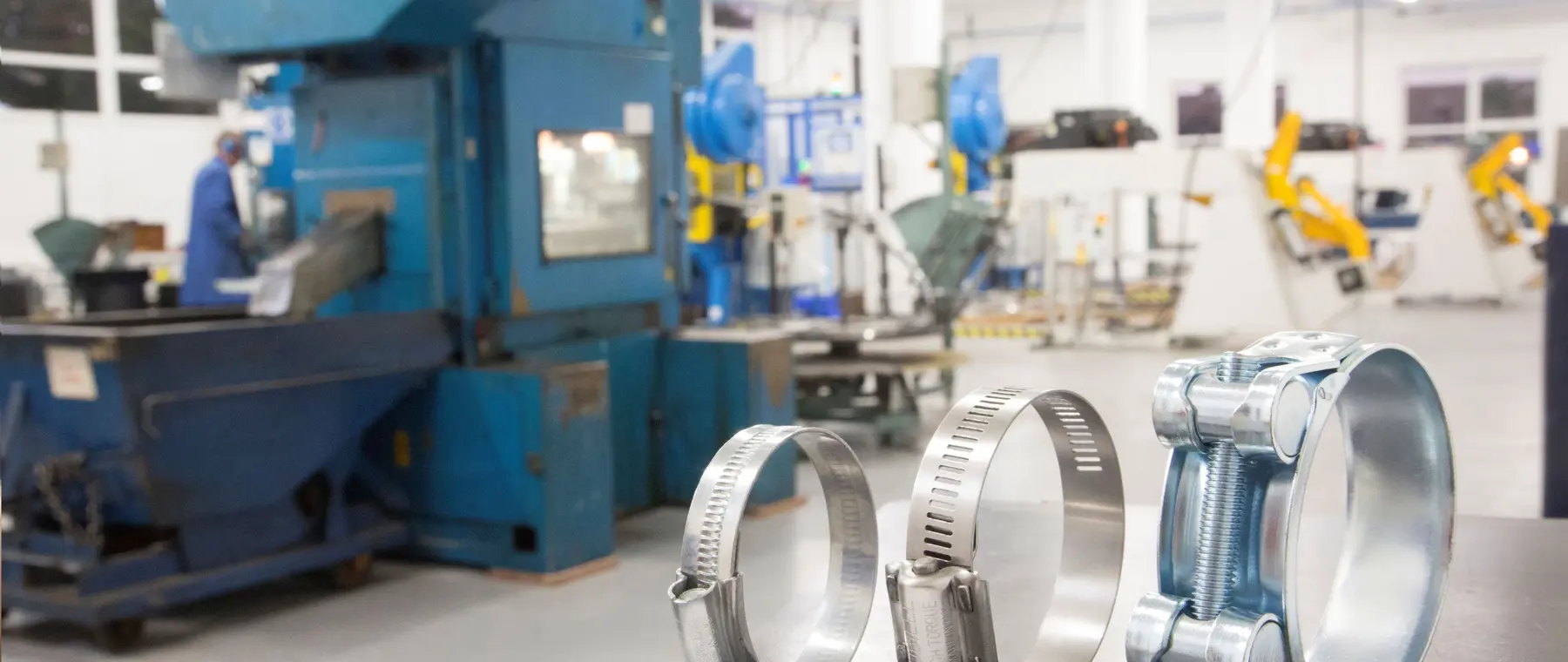
The company's official photograph shows several clamps at a manufacturing facility. It illustrates the kind of product involved in the business rather than providing instructions for attaching those clamps to a specific hose.
Material selection in different onboard environments
A boat's interior can contain quite different local environments. A dry locker may expose equipment to relatively little moisture, while certain machinery spaces can be subject to heat, condensation and vibration. Fittings in exposed locations may encounter seawater and cleaning agents. Their suitability cannot be determined from visual appearance alone.
There may also be more than one metal within a clamp assembly. A description of the band material does not necessarily establish the metallurgy of its screw or housing. A purchaser for whom corrosion resistance is important should therefore consult the specification for the complete product instead of relying on a general description of a shiny metal surface.
The September business announcement gives no new material specifications or independent corrosion test data. It should not be interpreted as confirmation that every clamp sold by the manufacturer will have the same resistance to the environment found aboard a boat. The appropriate product must be identified through its individual documentation.
For a marine service business, keeping accurate records of the hardware specified for a job can make subsequent maintenance more straightforward. That is particularly useful when an owner returns several years later and the original installation needs to be assessed or renewed.
A supply chain perspective for smaller boatbuilders
A boatbuilder may purchase a substantial number of relatively modest components in the course of producing a single model. The continuity of specifications and supplies can consequently matter even when each individual item represents a small proportion of the cost of the finished boat.
When a manufacturer acquires tooling assets, a customer may reasonably want to know whether the production arrangements for an established component will change. If they do, the purchaser needs to understand whether those changes affect the specification, testing or identification of the product supplied. The announcement does not report an alteration to existing clamp specifications or identify a particular part whose production is being transferred.
For refit yards the purchasing pattern can be quite different from that of a boatbuilder. A yard may need small quantities of several products at short notice and must identify replacements for equipment made at different times. Technical support and accessible documentation can be as valuable as the breadth of a catalogue.
The expected integration of additional processes at Jubilee's existing premises is therefore worth following, but it would be premature to promise that a particular component will become easier to obtain as a consequence.
A long manufacturing history and a measured interpretation of the deal
Jubilee describes its business as having more than a century of history in hose clips and clamps. The company has presented the acquisition as a continuation of a relationship that provided useful manufacturing expertise. Its financing explanation indicates that the purchase was made using internally generated cash, according to its own account.
That is not sufficient evidence to assess the company's wider financial position or the profitability of the acquired assets. No financial statements or valuation details accompany the exhibitor announcement. Nor can the return on the transaction be calculated from the information disclosed.
The relevant development for recreational marine customers is the intended consolidation of tooling and production capabilities. The benefits will depend upon the actual transfer and continued operation of those processes. The announcement provides a clear account of the history leading to the transaction but limited detail about the integration itself.
METSTRADE provides an opportunity for distributors and technical purchasing staff to discuss those questions directly with suppliers. Owners and service businesses should continue to select hose clamps according to the documented requirements of their installations. The commercial news is significant because the reliability of familiar boat equipment depends partly on manufacturing capabilities that are rarely visible to the end user.
Source and lead photograph
Official source: Jubilee Clips exhibitor announcement, 10 September 2026. Lead photograph: Jubilee Clips, official exhibitor photograph of hose clamps and manufacturing equipment at its factory. Original issuer press asset distributed through the official METSTRADE virtual press room; copyright remains with its owner.