
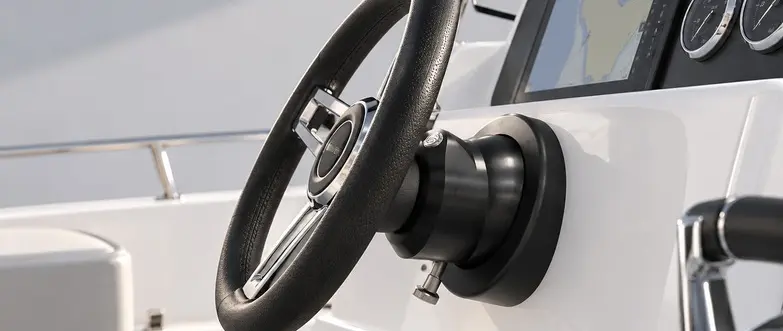
Jefa Steering has introduced a tilting helm-head option for its ES150 electric steering system, placing the driver's position rather than merely steering response at the centre of its METSTRADE 2026 update. The company says the adjustment gives builders more freedom in console design and allows the operator to find a more comfortable wheel position. For owners of smaller motorboats, where seats, windscreens, chartplotters and walkways compete for limited space, an adjustable helm may be a more tangible improvement than a specification-sheet upgrade. The change deserves attention, but it is not a substitute for checking installation fit, electronic integration and how a particular boat handles on the water.
The development announced in Amsterdam
The announcement was issued through the BSI Marine Equipment Group's METSTRADE exhibitor news channel ahead of the event held in Amsterdam on 17–19 November 2026. Jefa describes the new Tilt Helm as an option on its existing ES150 electric steering system rather than an entirely new propulsion or steering platform. That distinction is important for buyers: the headline development concerns the physical helm position, while familiar ES150 electronics and steering performance remain the framework. Jefa's release presents it as a choice for boatbuilders configuring different driving positions, not as evidence that every existing ES150 installation can be upgraded without further hardware or engineering work.
Why small motorboat cockpits make this meaningful
A boat below twelve metres may carry many of the same electronic displays and controls found on larger craft, but its console often sits much closer to the seats, accessway and companion seating. The ability to adjust a wheel's angle could help someone standing at the helm while navigating close quarters, or seated when travelling farther. It might also improve knee clearance and access past the driving position. Those are potential ergonomic benefits, not outcomes guaranteed for every hull. The dimensions and adjustment range of the optional assembly, and whether the helm remains comfortable with a particular dashboard and seat, need checking against the actual installation.
The ES150 platform beneath the new option
Jefa says the ES150, formerly marketed as Electric Steer, was nominated for a DAME award in 2024 and became its first motorboat product after a long involvement in sailing-yacht steering. The system is offered for outboard engines up to 200 horsepower, with the manufacturer listing compatibility with Garmin autopilot and multi-engine arrangements. Those details help define its intended market: it is relevant to certain recreational outboard installations, not a universal steering product for every engine or helm load. An owner considering a refit should have the exact engine, boat, steering loads and existing controls checked rather than infer compatibility from horsepower alone.
Electric assistance and the steering experience
Jefa quotes a steering response time of 0.2 seconds and approximately three seconds from lock to lock for the ES150. These are manufacturer-reported figures, not independent measurements by Leisure Boat Guide, and they should not be translated directly into real-world turning-circle or evasive-manoeuvre performance. Boat response is determined by hull shape, speed, propeller thrust and sea conditions as well as the steering apparatus. Nevertheless, the figures explain the company's emphasis on agility. The meaningful sea-trial question is whether the wheel feels predictable through a range of speeds, with sufficient feedback and no abrupt or unintuitive response while a skipper is manoeuvring.
A different arrangement from hydraulic hoses and pumps
The ES150's electric-steering approach does not require hydraulic hoses and pumps, according to Jefa's release. On a small craft that could simplify one portion of installation and reduce exposure to some common hydraulic-service tasks, such as leak inspection or fluid-related maintenance. It does not make the steering system maintenance-free, nor does it eliminate the need to consider power supply, wiring integrity, mounting security and water ingress. For an owner comparing systems, the right question is not simply which arrangement has fewer components. It is which solution can be installed and serviced reliably by professionals familiar with the particular boat and engine.
How the tilted wheel changes the installation brief
Tilting the helm is a mechanical feature, but its success depends on the whole steering station. The chartplotter must remain visible, the throttle must be reachable and the wheel must not create a pinch point against a seat, screen or enclosure. The skipper needs a stable posture when the boat hits a wave, and any adjustable mechanism should lock securely in its intended positions. A builder may find more freedom to vary console design, yet a retrofit could be constrained by existing cut-outs and mounting depths. Neither scenario should be judged solely from a photograph taken at an exhibition.
Seated steering versus standing at the wheel
Small runabouts, centre consoles and cabin cruisers may be operated from a seated driving position on one trip and from a standing posture during close-quarters work on another. A wheel set at a comfortable angle for one is not necessarily ideal for the other. A tilt function offers the possibility of repositioning it, but the seat, footrest and throttle location still need to work together. During an inspection, owners should test the extremes of adjustment while wearing ordinary boating clothing and buoyancy equipment. If the wheel's travel interferes with a chart display or handhold, the benefit can disappear despite the adjustment itself working perfectly.
Autopilot integration needs its own checks
The manufacturer's statement of Garmin autopilot compatibility is useful but should be treated as a starting point for system design. Electrical steering and autopilot involve a chain of components that may include heading sensors, control processors, interfaces and the boat's power distribution. Confirming the exact supported models and software versions is the installer's responsibility. It is also essential that manual helm operation remains clearly understood in every operating mode and that the skipper knows how to regain direct control. A broad compatibility claim does not establish that an existing autopilot can simply be connected without specification review or commissioning.
Understanding multi-engine applications
Jefa also lists multi-engine compatibility. That will interest owners of twin-outboard sports boats and other installations where the geometry and movement of more than one engine must be coordinated. Multi-engine steering is not simply a question of whether two motors are present. Tie-bar arrangements, mounting tolerances, engine-centre spacing and manufacturer instructions can change what is appropriate. A professional installer should examine the intended configuration and confirm that all operating loads and mechanical clearances fall within the steering system's limits. There is no reliable basis in the announcement for assuming every twin-engine boat below twelve metres is automatically suitable.
Electrical power and failure planning
Any steering technology has failure scenarios worth examining. For electric arrangements, the supply path, protection, connectors, cable routing and behaviour during a low-voltage condition deserve explicit discussion. Buyers should request the supplier's documented instructions on warning indications, backup provisions and what the operator should do if an alert appears. That is especially important when adding power-hungry electronics or upgrading to a different battery setup on a small vessel. A clean-looking console does not by itself demonstrate resilient electrical design. The company’s published claims do not replace the need to read the technical documentation and to commission the completed system correctly.
Maintenance means different tasks, not no tasks
The absence of hydraulic hoses and pumps changes the likely maintenance workload, but fasteners, sensors, actuators, connections and software should still be covered in an owner's inspection and service routine as appropriate. Salt spray, vibration and intermittent use are normal in leisure boating and can expose weak cable protection or poorly secured connectors. Owners should obtain a written maintenance schedule, confirm the availability of replacement components and ask how a local service company would diagnose a fault. A system that is easy to drive but difficult to support far from the supplying dealer may be less attractive than its brochure suggests.
What prospective buyers should ask
Before specifying ES150 with Tilt Helm, a buyer can ask Jefa or an approved installer for approved engine combinations, mounting drawings, wheel adjustment range, power demands, software compatibility, service arrangements and warranty conditions. These are practical questions rather than objections to the product. A demonstration should include seated and standing positions, low-speed manoeuvring and the transition between manual steering and an installed autopilot, where applicable. The owner should also inspect how the system behaves when the steering wheel is adjusted while stationary, and whether the wheel can be locked in the desired position without obscuring instruments.
Why the announcement matters to builders
The addition of a tilt feature illustrates a wider design challenge facing leisure-boat builders: electronic systems may become more compact and capable while the people using them remain very different in height, reach and preferred driving posture. Offering more control over helm ergonomics can make a boat easier to share among family members, partners or charter users with different needs. But genuine flexibility comes from treating the entire station as a system. Seat travel, foot support, sightlines, rain protection and access to emergency controls are all part of an effective helm, not separate embellishments to be considered once the wheel has been fitted.
The next test is on an actual boat
METSTRADE provides an opportunity to evaluate equipment and talk to suppliers, but a show display cannot reveal how the equipment behaves during repeated use at sea. Jefa's adjustable Tilt Helm is a well-defined addition to its electric steering offering, and the ES150's stated outboard rating, compatibility and response specifications provide useful points for comparison. What remains to be established for a particular installation is ergonomics, engine suitability and an acceptable service plan. For smaller-boat owners, this is a development to examine through a technical quotation and hands-on demonstration rather than a reason to replace a satisfactory existing steering arrangement immediately.
Official source: https://www.metstrade.com/exhibitors/bsi-marine-equipment-group/news/jefa-steering-announces-product-upgrade-to-es150-electric-steering