

A new owner guidance note addresses replacement parts
Jeanneau published updated guidance on 17 November 2026 explaining how owners should identify and obtain replacement parts for its sailboats and powerboats. The official manufacturer article focuses on a practical problem: two boats from the same model family may have different component references because specifications and suppliers changed during production. The company tells owners to start with the exact boat identity rather than purchase an apparently matching item.
This is important for small-craft owners who maintain boats over many seasons. A replacement that resembles an older part can still be incompatible with a hull's original systems or mounting. The new article does not announce a public online shop; it explains a dealer-based way to locate and verify the correct components.
Owners do not order directly from the factory
Jeanneau's statement says that owners of its powerboats and sailboats should place spare-parts requests through the authorised Jeanneau dealer network. It explicitly distinguishes that route from ordering directly from the factory. The dealer is meant to serve as the principal contact for the replacement process, including consultation about compatibility.
This arrangement may be less immediate than clicking an online retail item, but it can help prevent mistakes when several production versions share one marketing name. An owner should confirm who the authorised local representative is and what documentation they require. The announcement does not set a universal delivery time or dealer price.
The dealer-only Spareparts tool is the key reference
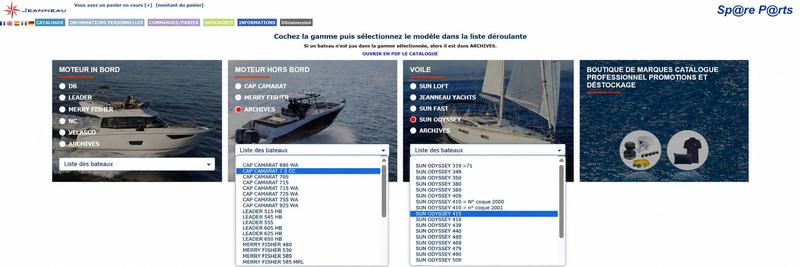
Jeanneau identifies a website called Spareparts that is available exclusively to its dealer network. A dealer can enter information about the particular boat and consult exploded drawings and technical records from the shipyard. Those resources are intended to help distinguish component references and identify what actually fits the vessel.
The distinction between a dealer tool and a consumer storefront matters. An owner cannot assume that the dealer-only system provides a public login or a direct order button. The manufacturer's guidance directs the owner to an intermediary who can interpret the technical information and organise the correct request.
The HIN identifies a specific boat
The hull identification number, known as the HIN, is presented as an essential piece of information. Jeanneau says it typically appears on the aft transom on the starboard side and links the boat to its relevant technical documents. A model name alone may not capture the production changes that matter for a replacement.
An owner should record the number carefully and provide it exactly as shown. Confusing similar letters or digits can lead to delays or the wrong parts reference. The guidance does not imply that a HIN is a substitute for every other detail, particularly where equipment has been replaced or modified since the boat left the yard.
Production changes explain many ordering errors
The manufacturer notes that components can evolve during the life of a model. Two boats that look alike may not share interchangeable parts, even if the owner knows the year and model name. Suppliers, mounting arrangements or technical specifications may have changed without a dramatic alteration in outward appearance.
Owners should therefore avoid selecting a replacement solely from a picture or a guessed model-year match. A dealer's access to factory documentation is intended to reduce that risk. This is particularly relevant to equipment connected to steering, fuel, electrics or other systems where the consequences of an inappropriate replacement may be serious.
An apparent equivalent still needs checking
Jeanneau's guidance acknowledges that a modern reference may replace an older one. The substitute could be compatible as supplied, technically equivalent, or require an adaptation. The company is clear that the substitution must be verified before work proceeds, rather than assuming that a superseded part number translates into a simple one-for-one swap.
This applies even when the new item comes through an established supplier. A technician may need to check connection points, dimensions and the boat's original configuration. Owners should request clear written details about what is being supplied and whether any fitting changes are necessary.
Exploded diagrams help identify what is needed
A dealer with access to the manufacturer's technical catalogue can inspect exploded views of assemblies and their constituent parts. Such diagrams can be especially useful when an owner knows which area is malfunctioning but not the precise reference of a smaller internal component.
An illustration is a tool for identifying components, not a repair procedure for every system. The correct level of intervention depends on the equipment, required skills and local requirements. Safety-critical work should be undertaken by competent technicians with suitable manufacturer information and testing.
The instructions apply to sail and power alike
Jeanneau addresses both sailboats and powerboats in its article. That broad coverage reflects the same need for accurate identification across different hulls and onboard systems, from older cruising sailboats to compact Merry Fisher powerboats. The process begins with knowing the exact boat and consulting the relevant dealer.
However, the required part and maintenance procedure can vary enormously. Sail handling equipment, a cabin hatch and a powerboat's propulsion system cannot be managed as though they were the same task. The HIN helps identify the vessel, while the repair itself must follow the appropriate technical guidance.
Owners should explain the actual fault
Original company photograph from the linked official maker or award press source. © Jeanneau and original photographers; archival model image, not an assertion of witnessed live event action.
The company's article starts from a familiar situation: a worn component, a failure or equipment that has reached the end of its lifespan. Before making a request, an owner can document symptoms, affected systems, visible markings and any prior work, taking clear photographs where appropriate.
Accurate descriptions can make it easier for the dealer to select the right catalogue drawing and assess urgency. Yet photographs are not a substitute for a competent inspection where a fault may affect safe operation. Owners should never continue using safety-critical equipment simply because they expect a replacement part to arrive soon.
Historic drawings can support older models
Jeanneau's guidance explains that factory archives and older technical records may help identify replacements even for models no longer in current production. The existence of historical records is valuable to owners maintaining a boat for many years, although it does not establish that every original part remains manufactured or available.
An older craft may require a verified modern replacement or an approved adaptation. Owners should ask their dealer how any proposed substitution affects fit and functionality. The manufacturer's archive is a basis for informed searching, not a blanket promise of unlimited stock from the original production period.
Original parts are a central recommendation
The builder encourages owners to use original components where appropriate, connecting that advice with the need to match the original boat's specifications. A genuine part can be easier to document in a manufacturer's system, but the important issue is correct compatibility with the actual equipment and intended service.
An owner comparing alternatives should discuss warranty conditions, technical equivalence and who will accept responsibility for installation. The article is not a consumer price comparison and does not establish that one source is always the least expensive. Incorrect parts may prove more costly if they cause a second repair or compromise function.
Dealer support is more than processing an order
The role described for a Jeanneau dealer includes identifying the vessel, researching drawings, checking newer references and helping the owner make the request. That can make the process feel more involved than an ordinary online purchase, but the added technical step is intended to reduce errors.
A useful first conversation should establish whether the boat can safely continue operating, whether the old component can be inspected and whether the new part requires specialist fitting. If the item is simple cosmetic hardware, the response may be different from a steering or fuel-system part. The dealer should explain those distinctions.
Model names can be misleading on the used market
Small boats often pass through several owners, and equipment can change as each person adds systems or replaces fittings. A second-hand boat may therefore differ from the original brochure despite carrying the same badge and registration documents. Jeanneau's emphasis on HIN-based identification can help establish the starting configuration.
It remains important to record later modifications. A dealer can identify the original factory part, but an aftermarket installation may require information from the equipment manufacturer or the installer. The owner's maintenance records can bridge that gap and prevent a search based on assumptions that no longer fit the boat.
The announcement is not a new e-commerce launch
Because the guidance describes a digital Spareparts catalogue, it would be easy to overstate the news as a launch of a public online shop. The manufacturer's wording does not support that claim. It says the system is reserved for authorised dealers and explains how owners should use the network to obtain the correct references.
The real development is practical owner guidance published on 17 November 2026. It aims to make a complex replacement search more understandable, especially where older model-year drawings and revised components may be involved. That is useful service information without a fabricated software launch or public account feature.
Original manufacturer imagery is retained
The Jeanneau article is illustrated with photographs supplied directly through the company's own website. Selected first-party originals were compared with the entire group image archive; an image that matched earlier Luxury Yacht Guide content was rejected, while the other subject-specific photographs remained available for this report.
The pictures should be treated as illustrations of Jeanneau's ownership and service subject, not evidence that an individual owner's component has been inspected. Their source and photographer credits remain attached. The editorial team makes no claim to have carried out a repair or ordered parts through a particular dealership.
How to prepare a useful parts enquiry
An owner can begin by locating and accurately recording the HIN, then noting the model, current equipment, symptoms and any part markings that remain visible. The manufacturer directs the enquiry to an authorised Jeanneau dealer, who can use factory information to search for the compatible reference. Photographs and service history may help explain the problem.
The next step is to request confirmation of the proposed component, any necessary adaptation, pricing and a realistic delivery or fitting plan. The public guidance does not guarantee availability or set standard costs. Where a component affects safe operation, arrangements for diagnosis and testing deserve priority over the speed of ordering.
A small-boat ownership reminder
Although Jeanneau builds craft in many size categories, its advice is directly relevant to the smaller sail and powerboats covered by Leisure Boat Guide. Accurate parts selection is part of responsible maintenance, especially where boats remain in use after several years or owners cannot easily see changes hidden within an assembly.
The verified message is straightforward: identify the specific hull, work through the authorised dealer, rely on the factory's technical references and confirm that any replacement or substitution is compatible before installation. The manufacturer's November document supplies that sequence without pretending every problem has an immediate or universal fix.
Verified original news sources and image credits
Original independent news reporting based on the original responsible organisation or boatbuilder announcement. Original first-party boat photographs used to illustrate the same verified craft are credited © Jeanneau and the original photographers. Earlier manufacturer photos are not represented as 27 November 2026 event-day photos. No first-hand sea trial, price, sales availability or unreported result is claimed.