
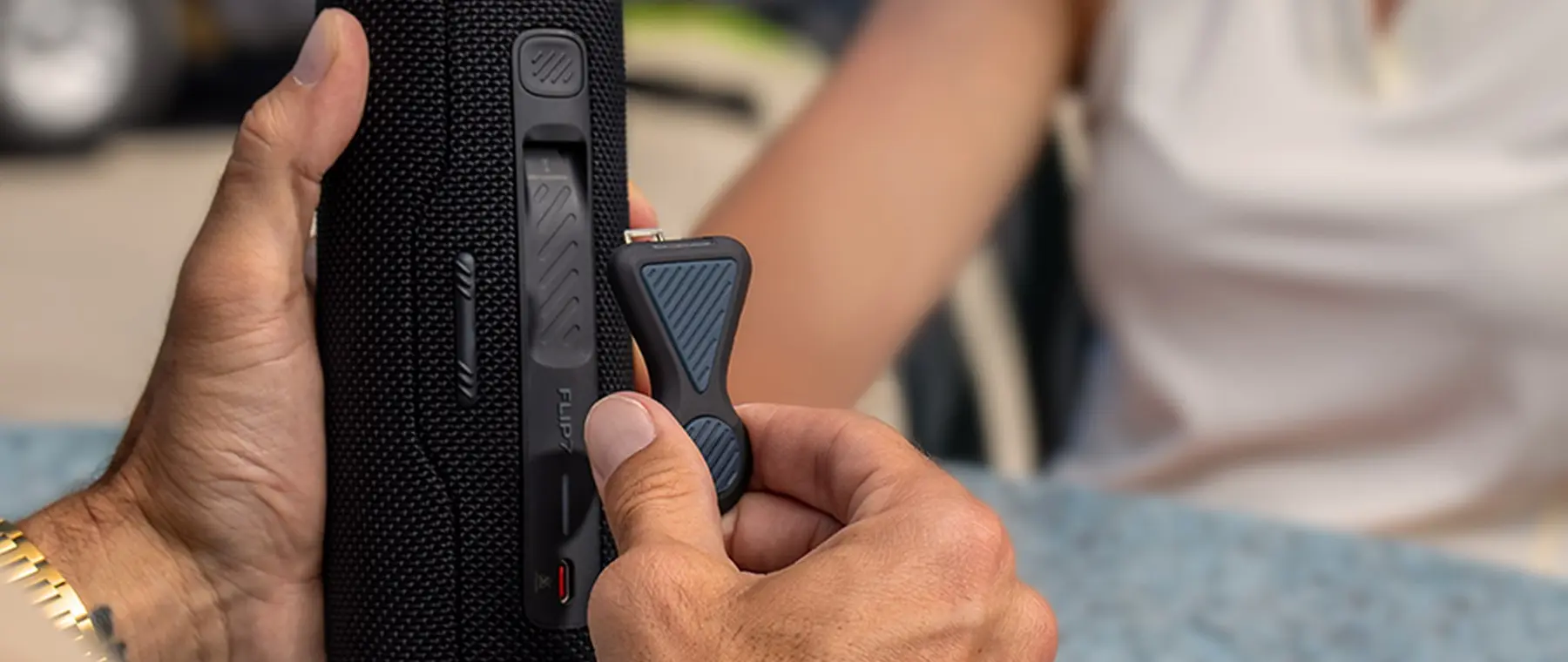
A portable approach to sound on board
JBL has introduced the Flip 7 Magnet, a detachable mounting accessory designed to make its portable Flip 7 speaker more practical around boats and other recreational vehicles. The company announced the product in October, presenting it as an option for owners who want sound close to where passengers are spending time without committing to a fixed marine-audio installation. The accessory is offered separately and as part of a speaker bundle.
It is a particularly relevant idea for smaller leisure boats where cockpit space is limited and there may be little justification for an elaborate built-in system. A portable speaker can move from the cockpit to a dockside table, but it must be properly secured when the boat moves. JBL’s mount is intended to address that practical inconvenience.
Magnetic attachment with a second option
The Magnet accessory uses strong magnets to grip suitable ferrous-metal surfaces. Since many boat decks and consoles are made from fibreglass, aluminium or other nonmagnetic materials, JBL includes a receiver plate that provides an alternative attachment point. The company says the bracket is shaped to allow access to the speaker’s controls and USB-C port while keeping the unit readily removable.
Owners should not assume that any metal rail or painted panel is a suitable mounting surface. The bracket requires the right material and attachment geometry, and a receiver plate needs a secure installation appropriate to the supporting structure. Before heading out, users should check the manufacturer’s instructions and verify that the speaker cannot detach under ordinary movement or vibration.
Keeping the cockpit clear
Loose portable electronics can create problems in busy cockpits. A speaker left on a seat may slide when the boat turns, while a unit placed near a hatch or walking route can become an obstruction. JBL’s new accessory is designed to move the speaker onto a selected mounting point and help free the surfaces that passengers need for sitting, handling lines or preparing equipment.
Placement matters more than a tidy appearance. A bracket should not interfere with steering, visibility, emergency controls, handholds or boarding. It should also be far enough from the edge of the boat to reduce the chance of loss overboard. A trial at the dock is a sensible first step before using the system at speed.
The Flip 7 speaker’s own features
JBL describes the Flip 7 as a compact portable speaker with its AI Sound Boost processing, Bluetooth connectivity and a stated battery runtime of up to 14 hours. The company adds that a Playtime Boost setting can extend the stated figure under certain conditions. The speaker carries an IP68 durability rating, reflecting an emphasis on outdoor use alongside the mounting accessory.
Quoted battery figures depend on volume, content, settings and battery condition. A waterproofing rating also has defined limits and should not be interpreted as a promise that every component will survive any length of immersion. Boat owners should read the applicable care guidance, particularly after exposure to saltwater, and avoid leaving the speaker unsecured near open water.
Connecting more than one speaker
The Flip 7 supports JBL’s Auracast implementation, which the manufacturer says can pair compatible speakers for stereo sound or distribute audio across several units. That could be useful when people are gathered at different points around a small boat or when the same speakers move ashore for a picnic. The product offers a temporary, flexible arrangement rather than permanent wiring through the hull or deck.
Multiple speakers still require thoughtful volume management. Music should never interfere with the ability to hear engine sounds, other vessels or instructions from crew. Owners should also confirm compatibility between the particular JBL products they intend to connect, as shared brand names do not guarantee every speaker has identical wireless capabilities.
Built for an outdoor routine
JBL says the mount is designed for exposure to sunshine, water, mud and ordinary cleaning conditions associated with recreational use. The bracket is intended to avoid clamp marks and does not use the rubber straps or conventional clamps found on some portable mounts. It can therefore be installed in more than one setting without needing a specialised permanent speaker enclosure.
Marine use puts extra demands on accessories, however. Salt deposits, vibration and repeated movement can affect fasteners and contact surfaces. An owner should inspect the mount periodically, rinse or clean it according to the manufacturer’s guidance and replace any worn component. A convenient portable system should still be maintained like other loose equipment carried aboard.
Choosing between portable and built-in systems
The Magnet accessory is not presented as a complete replacement for every marine audio installation. A fixed system may provide better coverage on a larger boat, more robust helm integration or higher power. Portable speakers have a different strength: they are easy to remove, require no complicated wiring and can be taken along when passengers leave the vessel.
For owners of compact boats, tenders or boats used only occasionally, that may be a compelling trade-off. The right solution depends on typical passenger numbers, the space available and whether the owner wants music at anchor, underway or at a beach. Safety and battery management should remain part of the decision.
A small accessory with a practical target
JBL’s official announcement confirms the availability plan for the Flip 7 Magnet as an accessory and bundle, but local pricing and stock will need checking with retailers or authorised suppliers. Buyers should also determine whether their existing Flip 7 is compatible with the specific attachment kit. A secure mounting plan matters as much as the speaker specification.
The development illustrates a wider trend in leisure-boat equipment: useful features are increasingly offered in modular, transferable form. A well-positioned speaker will not transform a boat’s fundamental capabilities, but it can make an ordinary day more convenient without taking up precious space. That is a sensible design objective for the many owners who keep their boating simple.