
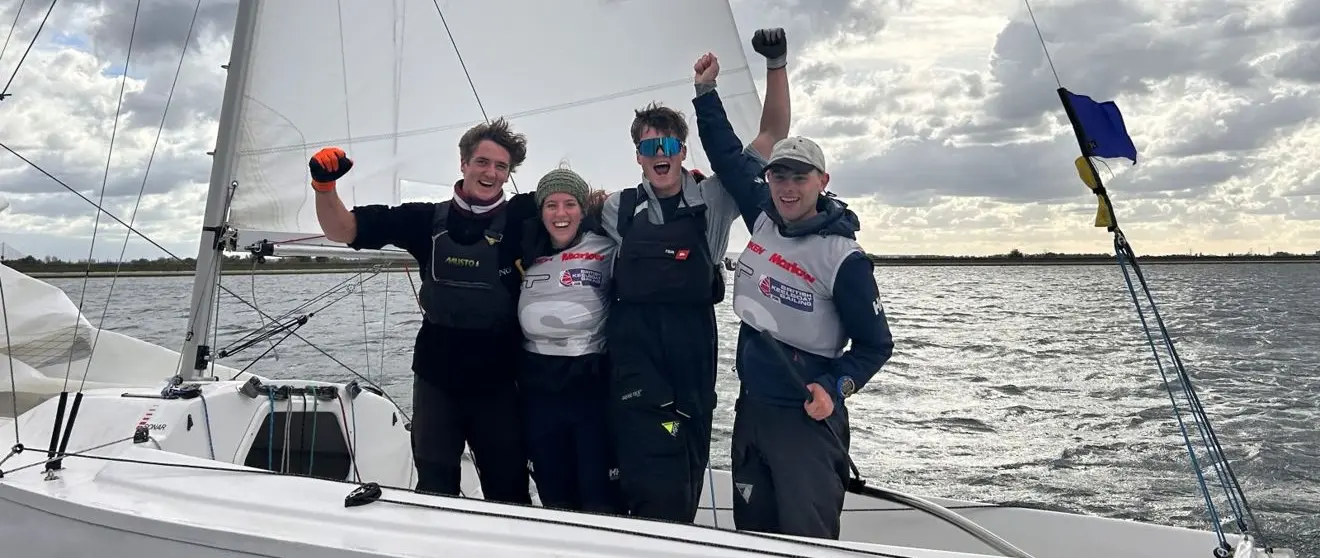
A national title settled in the fifth race
Jamie Tylecote won the 2026 RYA National Match Racing Championship after a final that went the full five races against his brother Ben Tylecote. The championship took place at Queen Mary Sailing Club in London from 16 to 18 October, with the Royal Thames Yacht Club's Sonar keelboats providing the one-design fleet. The Royal Yachting Association reported the victory on 21 October, and the race-by-race final score is independently visible on the Match Racing Results Service.
Ben won the first encounter before Jamie levelled the series and then moved ahead. Ben brought it back to two wins each, leaving a final race to decide the title. Jamie won that last contest for a three-to-two championship victory. It is a particularly accessible example of match racing's appeal: even after four demanding races, the two teams began the decider with an equal chance of taking the trophy.
What Jamie Tylecote's route to victory reveals
Jamie entered the knock-out stages with a strong round-robin record of nine wins from ten races. Matt Greenfield matched that 9–1 record, while Ben Tylecote and Julian Fung each recorded seven victories from ten. Those figures show that Jamie was among the form teams from the beginning, but also that the fleet contained several credible title contenders. The later elimination rounds would test whether round-robin consistency translated into head-to-head performance.
In the quarter-final, Jamie defeated Oli Hale by two races to nil. He then beat Julian Fung 3–0 in the semi-final to earn his place in the championship match. This clean semi-final result contrasted with the closeness of the title decider. As the racing developed, Jamie's route combined strong early results with an ability to preserve composure when the final moved beyond a straightforward best-of-three finish.
Ben Tylecote earns his final place the hard way
Ben's semi-final against Matt Greenfield went to five races, with Ben emerging 3–2. The RYA account describes a dramatic conclusion in which Greenfield was managing a penalty near the finish and then made contact with the pin mark, changing the outcome. The official competition table confirms the five-race result. Ben's passage through such a close semi-final added another demanding contest to an already busy championship weekend.
The eventual final against Jamie was therefore more than a family sporting story. Both skippers had negotiated a competitive qualifying stage and a knock-out bracket against established opponents. Their 3–2 final score says something important about the balance of the racing, but it does not imply that every leg or manoeuvre was equally close. Match racing can create lead changes through tactical pressure, an umpire decision or a single turn executed at the wrong moment.
Greenfield takes third from Julian Fung
Matt Greenfield recovered from his semi-final defeat to finish third. In the petit final, he defeated Julian Fung by two races to one, giving Greenfield the last place on the podium and leaving Fung fourth overall. Both the RYA report and the Match Racing Results Service show that finishing order. It was a fittingly competitive conclusion for two skippers who had featured prominently throughout the weekend.
Greenfield had been joint leader of the round robin on nine wins, so third place did not tell the full story of his pace across the event. Conversely, Fung reached the final four after a 7–3 qualifying record and a two-race quarter-final victory over Terry Hacker. Reading the overall ranking together with the intermediate results produces a more accurate picture than treating each team's final placing as the whole account of its weekend.
Eleven teams, three days and a full racing programme
The 2026 championship featured eleven teams. The RYA said the conditions allowed extensive racing across the three days, including a full qualifying phase, quarter-finals and longer semi-finals. It reported generally steady winds around 10 to 15 knots, with occasional gusts reaching the twenties. Those figures are the organiser's description of the race conditions, rather than an independent meteorological reading, but they help explain the event's busy programme.
The Sonar keelboats used for the championship came from Royal Thames Yacht Club, while Queen Mary Sailing Club provided the venue. A supplied fleet is a defining feature of much match racing, allowing crews to compete in boats of the same class without relying on their own individual yacht. That reduces the influence of equipment differences and directs more attention towards starts, manoeuvring, rules knowledge and team decisions.
Understanding the one-against-one format
Match racing puts two boats directly against each other, rather than scoring an entire fleet across a start line. Success depends on crossing ahead of the opponent, but the route to that result can involve a tactical battle before the starting signal and throughout the course. Sailors need to balance speed with positioning, because a boat with slightly less straight-line pace can still gain an advantage by forcing a rival into a difficult decision.
That makes a five-race final a compelling contest. Teams can learn from each other's preferred starts and responses, then try to apply that information in the next match. The same opponent is always nearby, and a boat's immediate choices can matter more than the broader fleet strategy used in a conventional regatta. It also makes communication between helm, trimmers and other crew crucial during time-sensitive manoeuvres.
A youth pathway visible on the national stage
The RYA noted that several competitors had developed their keelboat and match-racing skills through training at Rutland Sailing Club, including the Tylecote brothers. It also highlighted the participation of a young team skippered by Felix Garlick, whose crew included sailors in their mid-teens. The younger team's involvement demonstrates how a national competition can offer a substantial learning opportunity even when new entrants are not yet challenging for the title.
Experienced competitors and emerging sailors sharing a course can be valuable for the wider sport. The younger teams see the timing and precision required at senior level; established teams face opponents whose tactics may be less predictable. These are general developmental benefits rather than a guarantee of future results. The championship's structured racing and published score sheets provide more concrete evidence of progress than a single isolated win or loss.
Beyond the podium: the complete standings
After the top four, the Match Racing Results Service lists Oli Hale fifth, Terry Hacker sixth, Matt Taylor seventh and Ireland's Tom Coulter eighth. Luke Knezevic was ninth, Felix Garlick tenth and Alice Lucy eleventh. These positions can be checked against the competition's final results table. The RYA's report also described repechage racing, giving crews outside the leading places opportunities to continue competing rather than ending their weekend immediately after qualification.
It is important to distinguish those final placings from the earlier round-robin table. Some teams won more preliminary races than their final position might suggest, because the event used knock-out rounds and additional classification races. For readers looking closely at performance, the full schedule is more illuminating than the top-three summary alone. It shows how the event moved from broad qualification towards direct matches with immediate consequences.
What the championship leaves for the next generation
The immediate result is straightforward: Jamie Tylecote is the 2026 RYA National Match Racing Champion, Ben Tylecote finished runner-up and Matt Greenfield completed the podium. The more useful lesson for developing racing crews is that consistent starts, measured penalties, reliable handling and teamwork must hold up across a series, not just for one fast race. The final required five contests; either finalist could have claimed the title before the last one was decided.
The RYA thanked Queen Mary Sailing Club, Royal Thames Yacht Club and its race officials and volunteers for enabling the championship. The national match-racing circuit continues to give sailors opportunities to practise these head-to-head skills, and the event's detailed results remain available to study. Taken together, the organiser's report and the competition record offer a well-supported account of a closely contested British sailing title.