
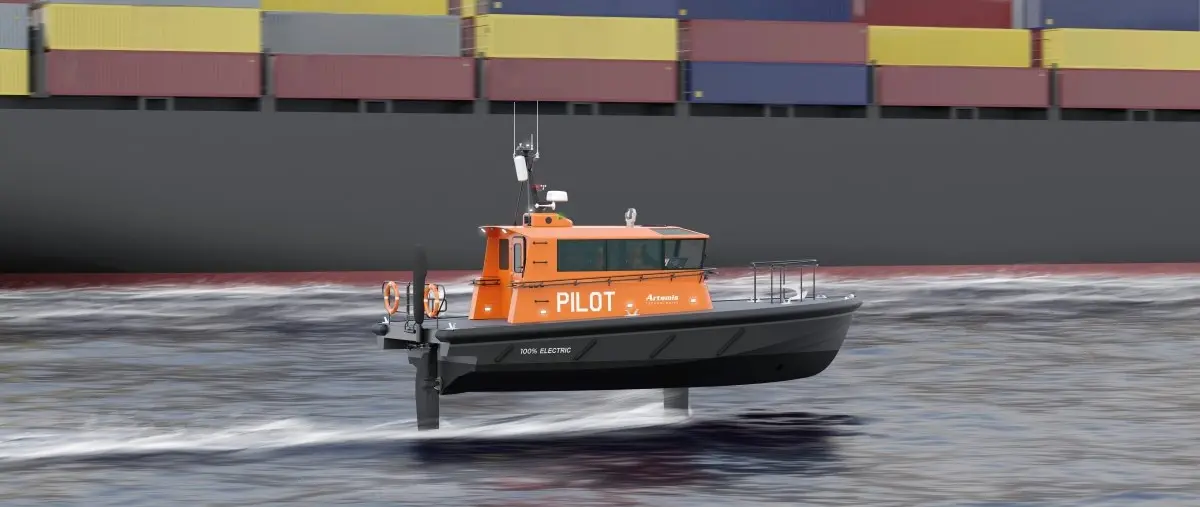
Long Beach pilot operator orders an electric hydrofoil
Jacobsen Pilot Service has ordered an Artemis EF-12 Pilot vessel for operations at the Port of Long Beach, California. Announced by Artemis Technologies on 4 November 2026, the purchase is described as the first commercial deployment of an electric hydrofoil pilot boat in the United States. The vessel is scheduled for delivery in late 2027. That timing makes this an order and a planned operational change, not a boat already undertaking routine pilot transfers at the California port.
Jacobsen is the established pilotage provider serving Long Beach, where pilots assist visiting ships with demanding harbour approaches and departures. Pilot launches operate under a very different duty cycle from pleasure craft, often requiring dependable transfers in changing conditions. The order is significant partly because it proposes the use of electrically powered foiling technology in a safety-critical commercial service. Its eventual performance will be measured under ordinary port conditions rather than demonstration runs alone.
The EF-12 is designed around pilot transfer
Artemis identifies the ordered model as the EF-12 Pilot, a craft intended to carry up to four pilots and two crew. The company gives a service speed of twenty-five knots for the Long Beach arrangement. That figure is important because pilotage depends on reaching ships within predictable operating windows. The manufacturer's wider promotional specifications should not be substituted for the particular duty profile and configuration agreed with the customer without further documentation.
The boat is intended to travel on its hydrofoils during the transit portion of a mission and then return to displacement operation for close contact with a ship. That distinction separates the two phases of work: efficient travel between harbour points and a controlled transfer at the vessel's side. Artemis says the flight-control system is intended to assist stability as conditions change. It remains necessary for crew and pilots to judge transfer safety against weather, sea state and ship motion.
Hydrofoils change the resistance equation
A conventional pilot boat pushes its hull through the water, creating drag that propulsion machinery must overcome. A hydrofoil craft uses submerged lifting surfaces to raise much of its hull clear of the water at suitable speeds. In principle, that can reduce resistance during transit and permit a given speed with less energy. It is the central engineering argument behind Artemis Technologies' eFoiler system, which combines electric propulsion with a controlled foiling arrangement.
Efficiency gains depend on the route, loading, sea conditions, equipment and time spent at foiling speed. They should therefore be understood as a design opportunity rather than a guaranteed saving for every passage. Slow-speed manoeuvring and transfers alongside a large ship still take place with the hull supported by the water. The transition between modes and the crew's familiarity with the system will be central to the vessel's practical usefulness in pilotage.
A diesel-saving projection needs operational proof
Artemis states that once the EF-12 is in service it is expected to account for approximately thirty percent of Jacobsen's annual operating hours. On that basis, the company projects a reduction of roughly 40,000 US gallons of diesel each year, equivalent to about 400 metric tonnes of carbon dioxide. These figures are supplier projections associated with the proposed replacement of some conventional duties, not measured results from the as-yet-undelivered Long Beach vessel.
Actual savings will depend on the missions assigned, reliability, battery charging arrangements and the amount of diesel work genuinely displaced. The electricity used for charging also has an upstream energy and emissions profile that varies with the supply mix. The claim of zero emissions at the point of operation is different from a complete life-cycle assessment. A useful evaluation after commissioning would compare measured energy consumption and operating hours against a representative diesel baseline.
Charging infrastructure is part of the order
The proposed operating model includes a dedicated direct-current fast charger at Jacobsen's dock. That may sound like a supporting detail, but it is fundamental to whether an electric boat can cover frequent commercial missions. Charging time must fit between planned assignments without compromising the operator's ability to respond. The installation also needs sufficient grid capacity, appropriate safety systems and maintenance support, especially in a maritime environment exposed to salt and weather.
An electric vessel cannot be assessed by range alone. Duty cycles, energy reserve requirements, charging availability and backup arrangements all influence whether a particular service is appropriate. Artemis says Jacobsen's new boat will operate alongside the existing fleet, which should give the operator flexibility while the new system is introduced. A mixed fleet may also allow actual operating data to be collected before electric capacity is expanded. No wider replacement programme has been confirmed in this announcement.
California funding supports the purchase
Jacobsen Pilot Service has been awarded $3,233,596 through the Port of Long Beach's System-Wide Investment in Freight Transport programme, known as SWIFT, to support acquisition of the vessel. According to Artemis, the award is funded through the California State Transportation Agency's Port and Freight Infrastructure Program. The announcement places the purchase within broader measures intended to improve air quality and reduce emissions around freight movement at the port.
The funding figure should not be confused with the total purchase price, which the announcement does not specify. Nor does a grant automatically establish that an individual vessel will meet all environmental objectives on the expected schedule. Its value lies in reducing a barrier to adoption while the equipment and infrastructure enter service. For policymakers and operators, the next meaningful evidence will be actual commissioning, utilisation, maintenance and operational energy records once the boat is delivered.
Why Long Beach is a demanding test case
Long Beach is a major commercial gateway with complex movements of large ships. Pilotage depends on coordination between the pilot service, visiting vessels and harbour operations, so a new craft needs to fit into an established safety system. This is a different challenge from operating a passenger hydrofoil over a fixed route between regular terminals. Launches must be able to approach a wide variety of ships and adapt to changes in traffic and sea conditions.
Jacobsen has operated in the port for generations and already uses specialised pilot boats. Artemis says the operator evaluated eFoiler technology before agreeing to the purchase, including exposure to the system in San Francisco and Belfast. That does not replace future operational testing at Long Beach, but it indicates the decision was not made on specification sheets alone. Training, acceptance trials and coordination with port authorities will determine how smoothly the new vessel enters daily service.
Comfort and motion matter to the pilots
The supplier highlights the potential for reduced vibration and motion while the boat is on its foils. Pilot transfers frequently take place before the pilot performs a demanding navigation task aboard a much larger ship, making the journey to the boarding area part of the overall working environment. A calmer transit could have human-factor value beyond fuel saving, provided that stability, visibility and safe handling are maintained in realistic operating conditions.
Comfort claims also require appropriate qualification. Hydrofoiling performance varies with sea state and speed, and no design eliminates the need for conservative decisions in bad weather. The boat must leave foiling mode for actual transfers, when contact with the ship requires different handling. What ultimately matters is predictable behaviour throughout the mission. Pilot feedback after service entry will offer a more reliable account than promotional descriptions of reduced motion during development testing.
The US order fits a wider electric-workboat market
Artemis Technologies has been developing electric hydrofoil vessels for several marine sectors, including passenger movement and professional workboat duties. The Long Beach purchase extends that proposition into a prominent US port. The company notes that other eFoiler vessels have attracted customers in Europe and the Middle East, but it specifically calls this order the first commercial US deployment. That is a narrower and more defensible claim than describing the craft as the world's first electric boat.
Commercial hydrofoils are not automatically suitable for every harbour or route. Their financial case depends on energy costs, vessel utilisation, maintenance requirements, capital investment and the relative efficiency of existing equipment. Operators may also need charging infrastructure and technicians with new skills. For boatbuilders, a successful installation would give a practical reference point for future customers. For buyers, it will be the operating record rather than the headline technology that supports an investment decision.
The real milestone comes after commissioning
The immediate news is that Jacobsen has committed to a defined vessel, supplier and operating concept, supported by a named public funding programme. Delivery is expected in late 2027, after which trials, crew training and service integration can establish what the craft actually contributes. The order suggests that electric foiling is moving from demonstration into more demanding professional work, although the scale of that shift cannot be established from a single purchase.
Over time, credible reporting should distinguish between projected fuel savings and verified consumption, between planned charging capacity and actual utilisation, and between the manufacturer's design claims and pilots' experience. That evidence will matter to other ports considering similar craft. For now, the Long Beach order is a notable development in commercial small-craft technology: a working pilot service has chosen to test electric hydrofoiling within its daily operations, with a clear delivery schedule and quantifiable goals.
Source: Artemis Technologies.