
A different way to arrive at an unfamiliar harbour
Many visiting boaters still reserve a berth by telephone, arrive with incomplete instructions and look for a harbourmaster who can explain which pontoon is available. German developer IT Service Nietzsch is presenting a more integrated approach through ITN Marina Management, with its METSTRADE 2026 exhibitor announcement highlighting an interactive three-dimensional harbour map and a refreshed Customer App 3.0. These changes are intended to connect berth allocation, customer information and marina administration within a single system. For the owners of sailing dinghies, small motor cruisers and trailerable boats, the potential appeal is practical: clearer arrival information and less uncertainty about where a boat can be moored or stored. The announcement establishes what the company is presenting to the market, not that every marina has installed the software or that its 3D map independently depicts the conditions at every berth.
What the new harbour view is meant to do
The official METSTRADE exhibitor notice describes a three-dimensional harbour view that helps staff understand berth occupancy and operations. A visual plan can be useful because marinas are spatial businesses: a berth's suitability depends on location, depth, length, beam, access and nearby facilities, not just a number in a database. A graphical view may also help new staff find areas that are awkward to describe over the phone. However, even a detailed digital representation needs accurate source data. A berthing chart should not be treated as a substitute for current navigational instructions or verified depth information. The physical harbour may change after storms, dredging or construction, and the operator must keep records aligned with reality. The strongest implementation will allow the harbourmaster to correct the display promptly when a pontoon or berth is temporarily unavailable.
Customer App 3.0 extends the process to visitors
The company's 2026 announcement pairs the map with Customer App 3.0, intended to give visiting and resident boaters an easier way to manage aspects of their marina relationship. The broader ITN website describes harbour selection, berth requests, online booking and payments through a customer account. This could reduce the need for repeated form filling when a visitor returns to a participating marina. A family aboard a compact cruiser may appreciate the ability to provide basic boat measurements and contact information before arrival, but the operator still needs to confirm suitability. Booking a berth through an application is not equivalent to permission to enter a harbour in unsafe conditions. Local speed limits, radio procedures, tide and weather instructions remain relevant. A well-designed application should complement, not replace, the judgement of the harbourmaster and the visiting skipper.
Small-boat dimensions cannot be guessed
At an overnight berth, a boat's overall length may include an outboard, bowsprit, bathing platform or other projection. The space required alongside can also depend on beam and the positions of mooring cleats. A digital booking process must define what measurements customers should enter and explain how unusual arrangements are handled. A small catamaran may be short enough for a marina's typical leisure-boat category but too wide for a narrow finger berth. A trailer boat may require a launch ramp, temporary parking and crane booking rather than an ordinary overnight berth. Software is useful if it captures these differences accurately. It can be harmful if a simple dropdown list assigns inappropriate spaces with false confidence. Marina managers should keep a process for reviewing special requests and for correcting errors before a vessel reaches the entrance.
The relationship to harbour office operations
ITN positions its software as a means of coordinating reservations, contracts, invoices and everyday harbour administration. Those tasks often run on separate spreadsheets, booking websites or paper files, making it hard to see whether a berth is truly free. A connected system could help prevent double bookings if it maintains an authoritative record. It may also reduce unnecessary calls between reception, quay staff and management. The benefit depends on process discipline. Staff must enter departures and temporary changes promptly, and existing berth agreements need to be migrated accurately. If an operator adopts the system only for online reservations but continues to maintain a separate informal list, inconsistencies may persist. Marina software should be treated as an operational change with training and clear responsibilities, not merely as a new set of attractive screens.
Winter storage can be as important as summer mooring
The ITN product material extends beyond berth booking to haul-outs, crane work and storage services. This is directly relevant to smaller craft, many of which spend winter ashore or are moved by trailer between seasons. A marina may need to coordinate lift dates, vehicle access, storage locations and work by independent contractors. A shared schedule can reduce confusion when dozens of boats need attention around the same weather window. The system must still account for safety limitations: a booking does not make a crane lift suitable for the vessel's weight or lifting points, nor can it override the operator's procedures. Clear communication about required documents and preparation can help owners arrive ready for work. Digitising this process is most valuable when it reduces avoidable delays without encouraging staff to treat risk assessments as a box-ticking exercise.
How a three-dimensional display might help staff
A harbour layout shown in three dimensions may help communicate pontoons, buildings and access routes to unfamiliar users. It can also provide an intuitive overview for seasonal staff who have not memorised berth numbers and service-pedestal locations. The visual interface is not necessarily a surveyed navigation chart, and it should carry a clear statement about its intended purpose. A digital scene may look precise even when underlying data are approximate. Small-boat visitors must continue to consult official charts, navigation notices and local instructions where relevant. Marina operators should also decide what information is suitable for public display. Revealing the exact berth of a privately owned vessel or occupancy history may create a security risk. Different views and permissions may be needed for staff, residents and temporary visitors. An effective user interface is accurate, understandable and appropriately restrained.
Electricity, water and access controls raise another layer of responsibility
The company's broader marketing discusses integrating services such as water, electricity and access control into marina workflows. These functions are useful only when equipment and operational permissions are handled safely. A digital command to enable a shore-power connection, for example, should not bypass electrical isolation procedures or fault protection. Guest-access credentials may need clear expiration dates, and the system should provide an alternative when a smartphone is lost or its battery is flat. The same applies to drinking-water access or secure gates: convenience must be balanced with emergency entry, accessibility and local regulations. A marina with many small boat users should not assume that every visitor has the latest device or reliable mobile connectivity. Simple fallback processes are a hallmark of a professional installation. The 2026 product announcement is an opportunity for marina operators to examine these workflows before buying into a single connected system.
Personal data can outlast a boating holiday
Marina booking applications collect information that may include a person's name, contact details, boat identity, visits and payment history. Such records can reveal travel patterns or when a boat is left unattended. The operator and software provider should define which information is necessary, who can access it and how long it is retained. European marinas must account for applicable privacy and data protection requirements, and visitors should receive clear notices. Payment information should be processed through appropriate channels, while staff access to customer records should be limited to legitimate tasks. Boat owners may welcome the convenience of using one account at several participating harbours, but that makes transparency more important, not less. Customers should be able to identify the responsible operator and understand how to correct inaccurate records. A useful digital service should not demand unnecessary personal information merely to reserve a small visitor berth.
Reliability matters at the moment of arrival
The most stressful time for a booking system to fail is when a boat is approaching an unfamiliar harbour in difficult weather. The marina should retain a functioning telephone or radio contact, documented arrival procedures and a way for staff to view reservations if an external cloud service is unavailable. Guests should receive essential instructions in a format that can be kept for offline reference when appropriate. An electronic map is convenient, but it cannot take responsibility for navigating a boat through a busy entrance. Operators should test what happens when the booking platform is unreachable, when two staff members edit a record simultaneously and when a customer changes the arrival time. These are ordinary operational problems that determine whether the digital service genuinely improves the boating experience. They deserve as much attention as the quality of the software's graphics.
The economics for a modest marina
A small club harbour may not have the budget or staffing of a large commercial marina. Before adopting new software, management should calculate the actual time spent on invoices, booking calls, key administration and winter-storage scheduling. A system that reduces those tasks may justify its costs, but subscription fees, equipment connections, training and data migration all need consideration. The ITN website offers different approaches for marina administration and customer access, so an operator should seek a quotation matched to the actual site. It would be inappropriate to apply a single price to every harbour without checking current terms. Associations run by volunteers may need a simpler model than a large year-round business. The best purchasing decision should reflect how staff and boaters work in practice, how much control the marina retains over its data and whether support remains available when problems occur.
A launch process that respects existing systems
Marinas often have accumulated customer data, accounting arrangements and local procedures over many years. Introducing a new programme can reveal duplicates, incomplete vessel measurements and outdated contact details. A responsible deployment should validate that information before opening online reservations. Staff should be trained to manage exceptions, while a limited pilot can test a small visitor area before the entire site is migrated. Any integration with payment, access or power systems should be documented by the relevant technical provider. Boat owners also need straightforward instructions about the new process and a way to request assistance if they cannot use the app. A gradual rollout may appear less exciting than a complete overnight change, but it protects the marina's reputation during the busy season. Effective innovation is measured by fewer avoidable errors and clearer communication, not only faster software menus.
What is confirmed by the 2026 sources
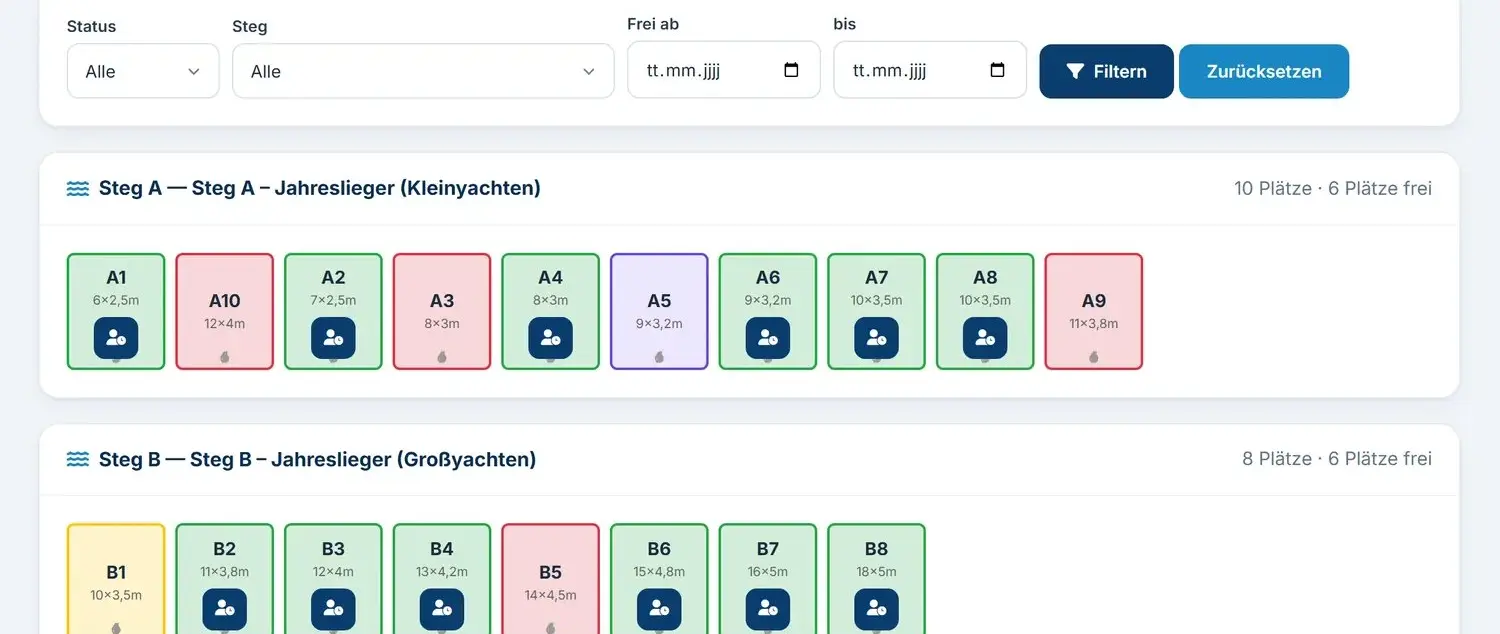
The official ITN exhibitor statement issued for METSTRADE 2026 identifies a new interactive 3D harbour map and Customer App 3.0. The manufacturer's own site describes the broader service for reservations, invoices, storage and marina operations. Those sources substantiate a report on the company's product direction. They do not establish that a particular named harbour has deployed every function or that every booking is processed automatically without human review. The accompanying image is an authentic first-party screenshot of an existing ITN berth-management interface, not an artificially generated marina photograph or a falsely presented image of the new three-dimensional system. This distinction is deliberate: readers should see a genuine example of the company's software while understanding that the updated features require current demonstrations and operator assessment.
A useful test for visiting skippers
For a small-boat owner, the ideal result is simple: provide accurate boat details, receive a suitable berth allocation, understand how to enter safely and settle the account without confusion. If ITN's new mapping and customer features make that sequence clearer, the technology could improve the experience of visiting an unfamiliar marina. Operators should demonstrate the complete customer journey, including cancellation, changes of weather and unexpected late arrival. They should also show staff how the digital map is updated and how a booking is handled when online systems are unavailable. The company is addressing a real administrative need, but its value will emerge from consistent delivery in working harbours rather than from a trade-show announcement alone. A visually sophisticated harbour map is most successful when it supports reliable seamanship, fair access and the practical judgement of harbour staff.
Primary reporting and image credit
Primary manufacturer and organiser source(s): https://www.metstrade.com/exhibitors/itn-marina-management/news/itn-marina-management-one-system-for-the-whole-marina-now-with-3d-harbour-map-and-new-customer-app. © IT Service Nietzsch / ITN Marina Management. Original first-party software screenshot of berth administration, not the announced 3D harbour map or a particular harbour's live positions. Image is used only for correctly attributed factual editorial coverage and never represented as open-licence stock photography.