
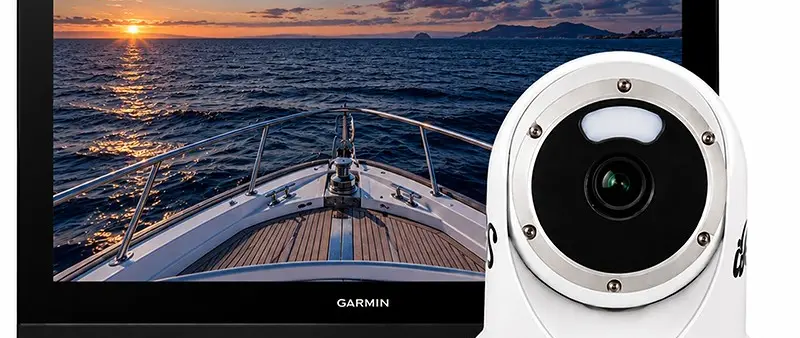
New display compatibility for low-light marine cameras
Owners of smaller boats can benefit from seeing a compatible low-light camera feed at the existing navigation display, avoiding the need for a separate monitor. The latest product announcement describes the available features, but suitability depends on the boat, its existing equipment and a correctly planned installation.
The announcement concerns integration of an existing marine camera range rather than the launch of an entirely new camera model. That distinction is useful for owners who may already have considered Photon but wanted a more straightforward way to view the feed at the main helm.
For a cruising motor yacht, direct control on a familiar display can reduce the number of separate screens required. It also means the installer must understand both the camera’s network connection and the specific Garmin display configuration before promising functionality.
Visible-spectrum imaging has a different role from thermal cameras
Photon uses visible-spectrum imaging designed to retain colour and detail in very low light, with native 4K resolution. Iris describes it as an alternative to some applications of thermal imaging, particularly when recognising shapes and markings that depend on visible colour or reflected light.
The distinction matters because thermal cameras measure differences in heat rather than showing the visible scene in the same way. A low-light colour camera may be useful for identifying harbour structures or vessel markings, while a thermal system may be better suited to some other viewing conditions.
Neither approach eliminates the need for visual watchkeeping or compliance with navigation rules. Camera performance can be influenced by darkness, glare, mist, precipitation and the camera’s installation position, so owners should ask for demonstrations relevant to their intended cruising conditions.
Firmware versions determine which displays are supported
Iris lists several compatible Garmin units, including BlueNet GPSMAP 9000-series multifunction displays and selected Garmin Marine Network display families. Some BlueNet models require firmware 45.02 or 45.03, while other listed models require corresponding software from the Q4 update.
The manufacturer also states that installations using certain Garmin Marine Network displays require a Power over Ethernet isolating coupler, whereas compatible BlueNet setups do not need that particular addition. That is an important integration detail because the camera and display may both work individually while the finished network still needs the right supporting hardware.
Owners should check exact model numbers and firmware before purchasing rather than relying on a general claim that the product works with Garmin. A professional marine electronics installer can also assess power distribution, cabling and suitable physical placement around the yacht.
Integrating camera video into the yacht helm
The direct interface allows compatible displays to receive high-definition video, while further connection options can provide native 4K presentation on selected Garmin systems. Iris identifies a dedicated IP-to-HDMI converter for particular high-resolution installations, making it important to distinguish ordinary network viewing from the full 4K display configuration.
The development may appeal to owners of leisure boats with multiple helm stations, especially when additional cameras could support manoeuvring or security awareness. Such uses should be considered individually and not interpreted as approval to rely on video in place of direct observation.
The Q4 integration brings an established camera family into a widely used navigation ecosystem. Its real value will depend on consistent operation, correct hardware matching and the owner’s ability to use the video without creating unnecessary distraction at the helm.
What a small-boat owner should check
Before fitting the system to a recreational boat, owners should confirm the exact model, supported hardware and any extra parts needed for their installation. It is also worth asking which functions remain available if the vessel loses internet service or a component fails.
The technical benefits must be balanced against installation expense, maintenance and crew familiarisation. A practical demonstration with the actual electronics or machinery configuration is more useful than assuming every capability described by the manufacturer will work on every boat.