
IBEX asks the marine industry to propose practical sessions
The International BoatBuilders' Exhibition and Conference has opened its call for proposals for the 2027 education conference, inviting working professionals to contribute technical presentations that help designers, builders and service yards solve real problems. The announcement was issued on 5 November 2026, with applications due by 4 January 2027. The conference is scheduled alongside IBEX on 7–9 December 2027 at the Tampa Convention Center in Florida. Although the exhibition serves the wider marine industry, the opportunity is important for businesses building and maintaining boats under twelve metres.
The call is more than an ordinary notice of show dates. Those had already been publicised; this announcement concerns the subjects, speakers and technical content that will shape the next education programme. IBEX wants specific practical experience rather than presentations that function as advertisements. For the builder of a seven-metre fishing boat or a small family cruiser, relevant themes include safe electrical installation, composites, production methods, battery integration and repair techniques. Better technical instruction can eventually influence the quality of boats delivered to owners.
The January deadline comes well ahead of the show
Submissions must reach the organisers by 4 January 2027, approximately eleven months before the event itself. That early deadline gives the programme team time to evaluate subjects, presenters and the balance of technical content. It also means companies and independent experts need to prepare now if they wish to take part. A promising topic is not enough on its own; the proposal should explain what participants will learn and how the presenter can demonstrate that knowledge in a clear and useful way.
The official call is open to marine professionals and others with directly applicable experience, but the technical seminar programme is not a general promotional forum. A speaker should identify a particular challenge, the methods used to investigate it and the lessons others can apply. A small yard that has successfully improved vacuum-infusion consistency or reduced electrical installation errors may have a more useful case study than a business offering a broad sales pitch. The deadline concerns proposals, not tickets or ordinary visitor registration.
Ninety-minute seminars require depth
IBEX says its technical seminars will run for ninety minutes on Tuesday through Thursday of the 2027 show. That format creates room for explanations, troubleshooting, practical demonstrations and discussion beyond a brief product presentation. An electrical technician, for instance, could explore fault-finding methods in a compact outboard-powered vessel, while a composites specialist might show how to inspect and repair damaged laminate in a small trailer boat. The association with Professional BoatBuilder reflects the conference's technical focus.
The programme is intended to be non-commercial and specific to boat construction and associated marine work. This is important because practitioners benefit most when the lessons can be applied regardless of brand. A seminar should provide credible methods, observations and limitations, not simply a list of reasons to buy a particular system. Visitors who attend should still evaluate the advice in the light of applicable codes, manufacturer instructions and the design of the boat they are working on.
Electric propulsion and batteries rank among the subjects
The 2027 call explicitly includes electrification, propulsion, battery development and onboard electrical systems. These are important topics for smaller boats because electrification changes how weight, range, charging and thermal management are considered. A six-metre dayboat may have limited space for batteries and associated protection systems, while a trailer boat may be regularly stored away from a permanent charging facility. A good technical session could examine such constraints through real installations rather than appealing but incomplete performance figures.
Electrical safety matters whether a boat uses a conventional petrol outboard, a diesel engine, a hybrid system or fully electric propulsion. Modern boats increasingly carry navigation displays, pumps, entertainment systems and high-capacity batteries. Poor connections, inappropriate protection or inadequate access for maintenance can create faults that undermine the entire vessel. The opportunity for experienced installers to share tested approaches is therefore directly relevant to boatbuilders and refit yards serving the ordinary leisure-boat market.
AI and robotics enter the boatyard conversation
IBEX also lists artificial intelligence, robotics and semi-autonomous or autonomous vessels among the technical innovations for which it welcomes proposals. At a small boatbuilder, useful applications might involve production planning, inspection assistance or repeatable manufacturing tasks, but the announcement does not endorse a particular product or claim that AI can replace trained tradespeople. The technical question is where a tool genuinely improves consistency, safety or efficiency compared with the existing method.
For an owner, manufacturing improvements are less visible than a new console or upholstery colour, but they can affect reliability and cost. A yard using repeatable procedures may make it easier to document quality and identify defects before delivery. Any use of automated systems still requires clear responsibility for checking the result. The call's interest in AI should be read as an invitation to share evidence and methods, not as a statement that boatbuilding has suddenly become autonomous.
New materials and 3D printing need scrutiny
Construction methods and materials are another part of the 2027 programme, including three-dimensional printing, composites, metal construction and renewable materials. These subjects have implications for production of compact hulls and for the small components that owners need to replace. A 3D-printed fitting could be useful in a non-critical application while being unsuitable for a load-bearing or safety-related position without engineering assessment. Technical education helps establish where new methods offer real benefits and where conventional practice remains essential.
Sustainability discussions may address waste reduction and recycling as well as new material choices. A boatbuilder deciding whether to switch resin, reinforcement or finish needs to understand how the change affects strength, repairability, production safety and end-of-life treatment. Marketing descriptions of greener materials are not a substitute for testing or compliance. The benefit of a non-commercial forum is the chance to examine trade-offs without framing every technical decision as a simple improvement.
Survey, repair and refit are central to ownership
IBEX is calling for seminars on marine investigations, surveying, repair, refit and service-yard operations. These topics are especially relevant to small leisure boats, many of which remain in use for years after their initial sale. Owners need access to technicians who can find water ingress, trace an intermittent electrical fault or assess whether a hull repair is structurally suitable. For a busy yard, reliable diagnostic methods can reduce repeat visits and help explain repair choices to customers.
A good presentation could compare inspection approaches on a small RIB, glassfibre cruiser or aluminium fishing craft without implying that one procedure suits every material. Repair quality depends on preparation, the condition of the existing structure, the repair method and subsequent verification. Knowledge-sharing in this area can deliver direct value even when no spectacular new boat is introduced at the exhibition. Practical competence remains one of the industry's most important services.
The programme also considers marina operations
Among the proposed subjects are marina and boatyard management, sustainability and marine-industry policy. For an owner, these subjects may seem less technical than engines or laminates, but they influence the availability and quality of berths, winter storage and servicing. A marina managing more electric visiting craft must consider safe shore-power capacity and charging procedures. A repair yard serving trailer boats needs efficient scheduling, safe lifting arrangements and secure storage for equipment.
The call does not announce new marina legislation or a binding technical standard. It invites people with experience to explain challenges and proven solutions. That distinction matters because a conference discussion may influence professional practice without changing legal requirements. Participants should be ready to explain how their methods comply with relevant current rules. Customers benefit when businesses adopt practical improvements while retaining transparent responsibility for safety and service quality.
Main Stage speakers are invited too
In addition to the technical seminar series, IBEX wants proposals for its Main Stage, which includes presentations, panels and Tech Talks. The Main Stage is designed to address wider industry themes such as workforce development, supply chains, management and emerging technology. For companies serving the under-twelve-metre market, those issues affect material availability, training and the resilience of dealer and service networks. A boatbuilder can design an excellent small craft but still struggle to deliver it if skilled technicians or critical components are unavailable.
The Main Stage is distinct from the detailed ninety-minute seminar programme, and prospective speakers should check the correct submission process and format. A panel examining the shortage of skilled marine electricians may have a different audience from a practical tutorial about wiring a small boat. Both can be useful when grounded in experience. The event's call encourages expertise from across the sector rather than limiting discussion to the largest vessel manufacturers.
Why the call matters to smaller leisure boats
The confirmed development is the launch of IBEX's 2027 education call, with a 4 January application deadline and the conference scheduled for 7–9 December in Tampa. It is distinct from the earlier announcement of event dates. The organisers are seeking practical lessons in materials, construction, electrical systems, propulsion, refit, manufacturing technology and marine operations. Those are foundational concerns for boats under twelve metres, even though IBEX itself serves a broad spectrum of builders and suppliers.
For the small-boat industry, the opportunity is to turn real workshop knowledge into shared professional practice. Owners may never attend a technical conference, but they depend on competent builders, surveyors and repair businesses. More reliable installation methods, better troubleshooting and clearer understanding of new technologies can improve the vessels they use. For now, marine professionals with relevant experience should consult the official call and submit well-supported proposals before the deadline, while visitors await the confirmed programme.
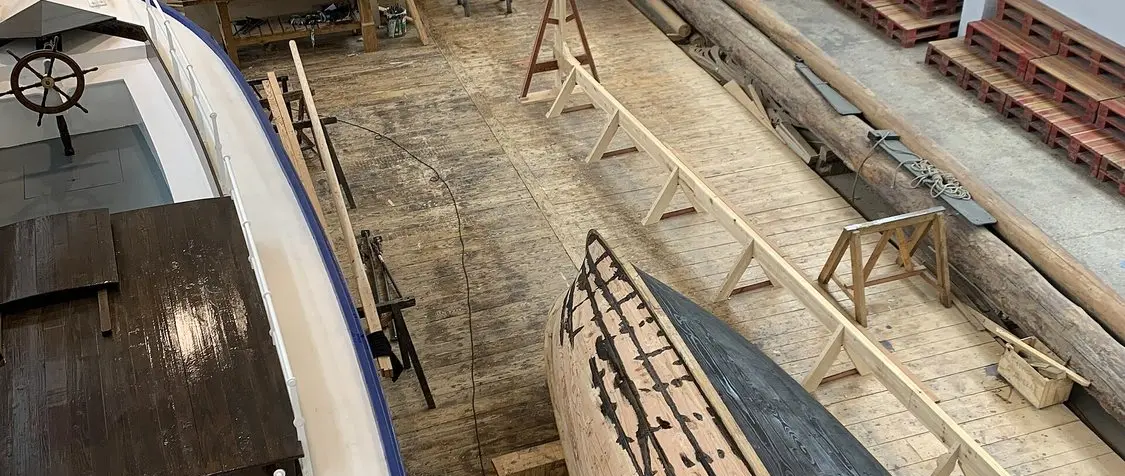
Sources: IBEX announcement, 5 November 2026 and IBEX 2027 proposals page. Photograph: boatbuilding school at Albaola Maritime Culture Factory, by Cailínréalta, Wikimedia Commons, CC BY-SA 4.0, resized. This photograph is an illustrative workshop, not a 2027 IBEX event photograph.
