
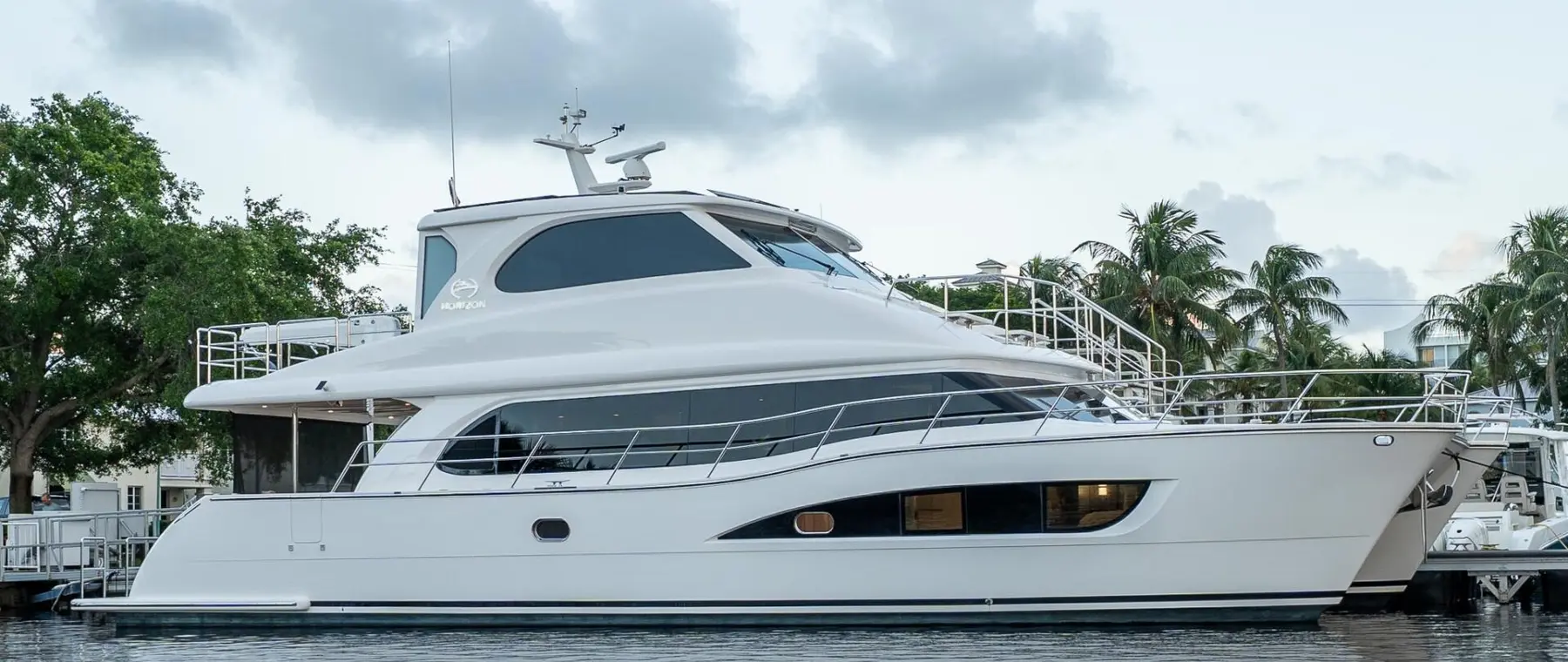
A highly individual PC60 joins the water
Horizon Power Catamarans has revealed Thea, a custom PC60 identified by the builder as hull PC60-635. The yacht was launched during 2026 for owners new to the Horizon Powercat family, and the yard published a detailed introduction on 16 October. Rather than treating a 60-foot platform as a fixed apartment plan, the owners have combined a private main-deck suite, a protected upper lounge and equipment for prolonged cruising.
Thea has three guest and owner staterooms rather than a layout focused on maximising cabin count. Her principal suite is positioned forward on the main deck, with panoramic views and convenient access to the shared accommodation. The choice signals a clear preference for the owners' own daily experience, even though other PC60 arrangements use the available interior differently.
For Leisure Boat Guide readers, this is a particularly useful launch because it demonstrates how much a cruising catamaran can change from one custom commission to the next. The same general hull family can support different priorities, from entertaining larger parties to enjoying quieter extended passages. Thea's story is about the detailed allocation of space and systems more than the novelty of another model name.
A main-deck owner's cabin changes everyday life
Locating the master suite on the principal deck removes some of the constant movement between the living area and a sleeping cabin below. The cabin's forward location also separates it from the aft social spaces, potentially improving privacy during visits by friends and family. Its windows are an important part of the design brief, allowing the owners to remain connected with their surroundings without leaving the accommodation.
Two additional guest cabins are located in the hulls, giving Thea a three-stateroom arrangement. There is no benefit in describing those rooms as identical to the owner's suite, because they occupy different positions within the boat and serve different purposes. Prospective buyers comparing plans should study storage, headroom and access on the specific yacht instead of assuming every PC60 uses one standard deck configuration.
The salon itself is arranged around a substantial sectional seating group and large windows, making it suitable for the long periods spent aboard during a cruising season. A galley island has seating for three, and Horizon lists Miele appliances, full-height refrigeration, dedicated beverage facilities and extensive pantry storage. These are practical decisions on a boat expected to be lived in, not simply staged for a marina visit.
A sheltered skylounge above the main deck
One of the most distinctive spaces aboard Thea is the enclosed upper skylounge. Horizon describes an air-conditioned room containing the principal helm, two Stidd pilot chairs, seating and dining arrangements, storage, an ice maker and its own dayhead. That collection allows the upper level to function as an independent living area even when the weather makes exposed seating uncomfortable.
The protected helm should be particularly relevant on longer coastal routes or in regions where sudden showers and wind changes are common. It provides a quieter environment for navigation and watchkeeping, while guests can occupy separate seating without crowding the driver. The precise view from the wheel and the way instruments are installed still need an on-board inspection; a promotional photograph is not a substitute for a sea trial.
Aft of the enclosed room, the boat deck reserves space for a tender and incorporates a Steelhead crane and a grill. The crane is not merely a convenience, because launching equipment and weight distribution must be planned together. A responsible owner will verify tender capacity, securing arrangements and the manufacturer's operating instructions before selecting a particular dinghy or using lifting gear.
A Portuguese deck for the forward view
Forward of the skylounge, Thea has a Portuguese deck with two settees and fixed tables that can double as footrests. The position creates an alternative retreat away from the aft entertaining areas and places guests closer to the view over the bow. Provision for removable shade poles broadens the situations in which the space can be enjoyed without making any claim that it is sheltered in every condition.
The Portuguese-deck arrangement is also offered within Horizon's wider PC60 family, but its integration matters most when considered with Thea's upper-room layout. Passengers can choose between air-conditioned enclosure, forward open air and the aft decks during a normal day. Good cruising design is often about providing these small choices rather than building one enormous but inflexible leisure zone.
On the main deck, an aft dining table and built-in bar take advantage of the connection between the salon and exterior. Horizon specifies a sink, refrigerator, ice maker and storage within the bar, together with broad swimming platforms and side boarding gates on both sides. That combination should make provisioning, tender arrivals and time at anchor more manageable, subject to actual berth arrangements and conditions.
Equipment aimed at days away from the marina
The builder lists a dedicated diving compressor serving fill stations at both the flybridge and starboard swimming platform. Fishing rod holders, underwater lights, a watermaker and solar panels further indicate a programme built around active cruising. Each of these items introduces maintenance needs of its own, so they should be assessed as an integrated equipment plan rather than as isolated luxury extras.
Having a compressor aboard is especially relevant to owners who dive regularly, but it does not replace careful air-quality procedures, cylinder checks or trained operation. The placement of fill connections can simplify workflow while still requiring safe handling of high-pressure equipment. Similarly, a watermaker offers flexibility only when filters, pumps and source-water conditions are managed correctly.
Horizon also highlights what it calls a Silent Living Package, combining Victron batteries with a Termodinamica variable-speed air-conditioning installation. The manufacturer's publication says the system is designed to reduce generator use and can keep the interior comfortable for up to 20 hours at anchor in suitable conditions. That duration is a builder-stated capability, not an independently measured guarantee for all weather, electrical loads or usage patterns.
An owner planning several nights away from shore power should request a detailed energy budget that accounts for air conditioning, cooking, refrigeration, electronics, water production and battery reserve. Solar panel output will vary with orientation, weather and shading. The value of a quieter anchorage lies in how the complete installation behaves on the owner's actual route, not in a single headline figure.
Engines, tanks and the importance of hull-specific figures
Thea is described by Horizon as having twin MAN i6 engines rated at 850 horsepower each, together with bow and stern thrusters, VEEM propellers and a Zipwake interceptor system. The configuration reflects the priorities of a substantial owner-operated or professionally supported cruising catamaran. Thrusters and interceptors can assist handling, but they should never be presented as substitutes for training, a suitable weather window and good seamanship.
The custom yacht's announcement states 1,200 US gallons of fuel capacity and 250 US gallons of freshwater storage. Notably, the builder's general PC60 model specification page lists 1,000 US gallons of fuel and 300 US gallons of water for its reference configuration. Those figures are different because Thea is a customised individual vessel; readers should use the completed boat's certified specifications rather than applying the catalogue figures indiscriminately.
The wider PC60 model page gives a length overall of 61 feet 7 inches, equivalent to 18.78 metres, and a beam of 24 feet 6 inches, or 7.47 metres. Those figures provide context for the size class but should not be mistaken for an independent survey of hull PC60-635. In particular, buyers assessing marina space, insurance or draft clearances should verify the final as-built measurements and equipment inventory with the shipyard.
The manufacturer's article does not establish a verified range or cruising-speed figure for Thea. It would therefore be misleading to derive one from tank volume alone, as consumption changes with speed, load, sea state and auxiliary demand. A proper passage plan relies on actual fuel-burn observations, reserves and the availability of suitable places to stop.
What Thea says about owner-led catamaran design
Thea's significance is the coherence of her choices. The owners have not simply added a large list of options to a model; they have selected an on-deck master, three-room accommodation, protected upper lounge and working equipment suited to their intended lifestyle. That makes the yacht an informative comparison for anyone deciding between a production specification and a tailored build.
The multiple exterior zones are likely to be most appreciated during longer stays aboard, when guests want privacy as well as company. A forward Portuguese deck, a main-level dining area and a boat deck with tender capacity each meet a different need. Thoughtful separation between these spaces can improve a cruising holiday even when the boat is carrying only a small number of people.
Owners considering a similar arrangement should request a full equipment inventory, stability and load documentation, electrical-load calculations and realistic maintenance estimates. It is also worth discussing how crew responsibilities will be shared when the boat includes dive systems, machinery for tenders and elaborate hotel services. The appeal of a custom powercat is greatest when the management plan is as specific as the interior layout.
The primary account and Thea photographs come from Horizon Power Catamarans' official 16 October 2026 announcement. General dimensions and reference-model capacities were checked against the manufacturer's separate PC60 model specifications on 26 October 2026. The accompanying photograph is from the shipyard's own published image collection, not a generated or stock replacement.