Honda Marine Europe used METSTRADE 2026 in Amsterdam to emphasise closer work with boatbuilders, focusing on how outboard engines fit into complete recreational-boat packages rather than promoting an engine in isolation. In a statement published through British Marine on 16 November, the company said its European strategy involves helping manufacturers match power units to hulls, electronic systems and production processes. The trade exhibition ran from 17 to 19 November. Honda also highlighted the support of its regional dealer network for sales, servicing and warranties. For owners considering a new open boat or compact cruiser, the announcement matters because the quality of a boat-and-engine package depends on much more than the horsepower printed on a cowling.
A change in emphasis from individual engines
A boatbuilder choosing an outboard needs to consider propulsion as part of the vessel's overall design. Engine weight influences balance, the transom must be engineered for the mounting loads, and controls must be positioned sensibly at the helm. Fuel tanks, wiring and hydraulic or electronic steering also require attention. Honda's METSTRADE message places these details at the centre of collaboration with builders. It is not an announcement of a completely new outboard series, nor evidence that every boat sold by a partner is fitted with one specified model. Instead, the company is describing an approach to selecting and integrating engines during product development, with the intention of delivering more complete packages through dealers.
Why an 8-metre boat needs the right power match
Owners of boats below twelve metres may be especially sensitive to engine selection because space, weight and fuel capacity are limited. An outboard that is too heavy for a particular transom can change handling and freeboard, while an engine that does not match the hull's intended operating range may perform inefficiently. Maximum horsepower alone cannot resolve the choice. A boatbuilder must establish permissible power, shaft length, mounting height, propeller dimensions and expected load conditions. Honda's stated goal of working closely with builders could help address these decisions before the finished boat reaches a customer. Still, an individual buyer should check the particular model's certification and approved engine options rather than assume that a collaboration guarantees the ideal configuration.
The official photograph illustrates a real boat package
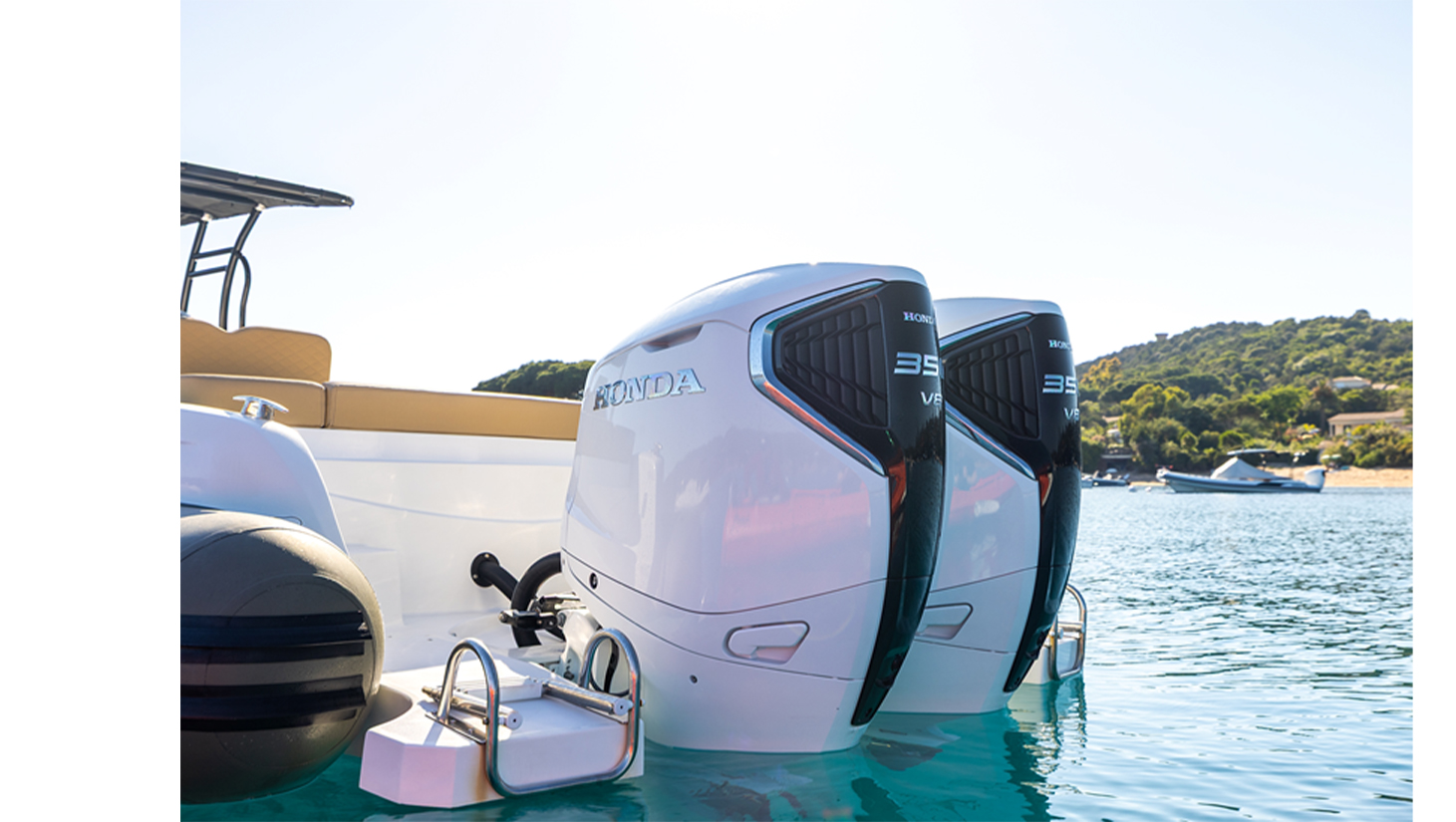
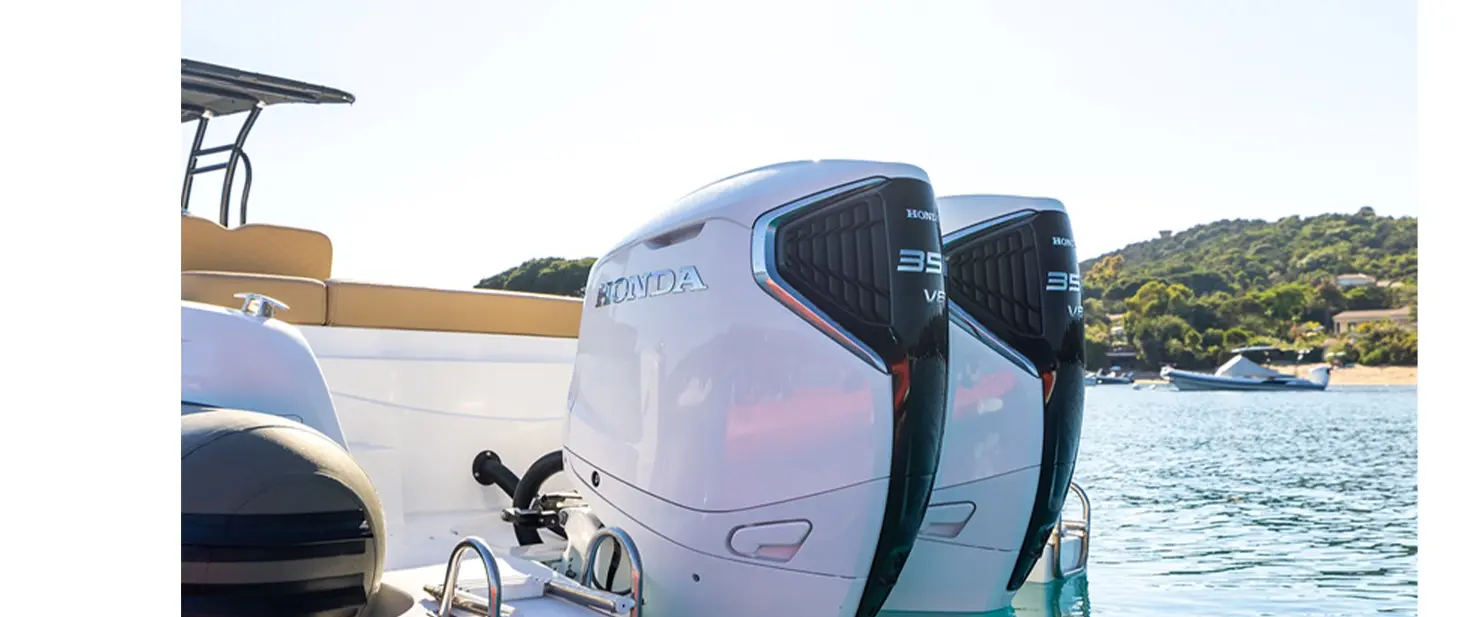
British Marine's original announcement is accompanied by manufacturer-provided imagery of a Honda Marine 4XC Design H266 open centre-console boat fitted with BF150 outboards in the context of collaboration with BMA. The photograph illustrates the kind of integrated package described by Honda, but the November 2026 statement does not say that the H266 was newly launched at that specific METSTRADE exhibition. That difference is important. A familiar design appearing in a fresh industry report should not be presented as a new model unless the source establishes a launch. The image is useful for showing where outboards sit relative to the boat's hull and deck layout, not for making unsupported claims about new specifications.
Electronics integration is becoming a design task
Contemporary recreational boats often combine digital engine instruments, multifunction navigation displays, alarms and networked controls. These systems can be useful when they reduce the number of separate displays and give the operator clear information, but integration creates compatibility requirements. A builder needs to confirm which engine data can be displayed, how alarms are presented and what happens if a network device fails. Honda's announcement identifies connectivity as one of the areas changing the market. It does not establish that every engine model supports every third-party display or automatic control function. Owners should request the exact supported network interfaces and whether an upgrade can be made without losing access to essential engine information.
The helm must remain understandable
An attractive dashboard is not necessarily a safe or convenient one. Instruments and controls should remain readable in bright sun and usable when the boat is moving. The skipper needs quick access to throttle and gear controls, engine alarms, the emergency stop and any trim settings. Owners should not assume that a digital helm can replace training on the behaviour of the boat. It should instead make routine operations easier to understand. When builders and engine suppliers work together from the design stage, they have an opportunity to test the complete interface rather than adding components after the main layout has been finalised. The result should be assessed during a sea trial under realistic loads.
Fuel economy depends on the complete combination
Honda mentioned changing customer expectations around fuel consumption and emissions. These concerns are relevant to boaters who want manageable running costs and a practical cruising range. However, any specific fuel-saving claim must be based on the engine, propeller, hull, load and operating speed being compared. The METSTRADE statement does not publish a measured percentage reduction in consumption, and it would be misleading to invent one. Two boats fitted with the same outboard can perform differently because of hull design, sea conditions or equipment carried aboard. A buyer should request validated performance data for the exact boat-and-engine package and compare figures at realistic cruising speeds rather than relying on maximum-speed headlines.
The engine weight can change how a boat rides
The distribution of mass matters on a compact planing hull. Outboard engines place substantial weight near the stern, so a design intended for a particular engine family should not be casually altered without appropriate checks. Fuel tanks and batteries can also shift the boat's trim, especially when their contents change over a voyage. Honda's message about matching the right engine to each hull recognises that propulsion engineering is part of the whole vessel. Owners contemplating a repower should confirm the maximum permissible transom weight and any structural implications. A replacement engine with similar horsepower may still be significantly different in weight, dimensions or the loads it transmits.
Dealer support matters after delivery
A complete boat package can simplify purchasing if the dealer provides a clear explanation of which company is responsible for the hull, engine, controls and installed accessories. Honda says its European dealer network supports sales, servicing and warranty. That may provide reassurance, particularly for buyers who travel between boating areas. The terms still need to be checked individually: coverage for an engine is not necessarily identical to a boatbuilder's hull warranty, and some components may be supplied by third parties. Owners should request written warranty information and understand how routine servicing must be documented. A useful package is one whose responsibilities remain clear after the initial sale.
Servicing access belongs in the design
An outboard must be accessible for inspection, maintenance and, when necessary, removal. Builders should consider how easily a technician can reach wiring connections, fuel lines and mounting hardware without dismantling surrounding equipment. The position of swim platforms, seating and transom structures may improve comfort for passengers while complicating service work. Coordination with the engine supplier can help avoid such conflicts. For an owner, service access is easy to overlook during an exciting sea trial. It can become important later when a routine procedure takes far longer than expected. A sensible buying checklist should include a demonstration of access to maintenance points and confirmation that the dealer has the appropriate technical support.
Warranty is not a substitute for maintenance
Manufacturer warranties can protect owners against certain defects, but they do not remove the obligation to maintain equipment correctly. Outboards require periodic attention to engine oil, cooling systems, fuel components and other items as specified by the relevant manual. The requirements can vary with engine model and operating environment. Someone boating in salt water may need to follow particular flushing and corrosion-protection procedures. Honda's European dealer network may support this work, but owners should establish who can service their exact engine in the places they intend to use the boat. Planning maintenance before a long coastal trip is more reliable than expecting immediate assistance from any nearby dealer.
Collaboration may help smaller builders
A large production boatbuilder can employ teams dedicated to propulsion integration, but a smaller manufacturer may have fewer resources to test different engine packages. Honda's approach could be valuable if it gives builders access to technical guidance, common components and a clear support structure. The statement does not identify new individual contracts signed at METSTRADE or disclose the commercial terms of partnerships. It is therefore appropriate to describe the strategy without claiming that particular builders have joined it. The broader issue is that product development can benefit when the hull and propulsion system are engineered together, provided the builder retains responsibility for safety, testing and regulatory compliance.
A complete package still needs a proper sea trial
Even a manufacturer-approved combination should be tested with a load representative of normal use. A lightly equipped demonstration boat carrying two people may behave differently from the same model with full fuel tanks, equipment and a larger group aboard. Buyers can ask about acceleration, low-speed control, trim sensitivity, steering effort and noise at the speeds they expect to use. It is also worth examining how the boat handles in a moderate chop rather than only on flat water. Performance figures should be interpreted as conditions-specific evidence, not universal guarantees. A good dealer can explain the package's strengths and limitations, enabling customers to choose a boat suited to their activities.
Emissions expectations are evolving
Recreational boating is under increasing pressure to consider environmental impacts, including fuel use, noise and the handling of lubricants and other materials. Honda cited evolving emissions expectations as one factor influencing boatbuilder discussions. The November release does not announce a new emissions certification or a specific alternative-fuel solution. It is an industry positioning statement about how engines and vessel systems are changing. Owners can still make practical decisions by selecting an appropriately sized boat, avoiding unnecessary idling and maintaining propulsion equipment properly. Responsible operation is not a replacement for technological development, but it can reduce avoidable consumption without assuming that a new engine solves every environmental challenge.
What METSTRADE 2026 actually established
Honda Marine Europe exhibited at RAI Amsterdam from 17 to 19 November, using the event to meet boatbuilders and industry partners. The company's representative Vincenzo Paduano described the importance of discussing technological changes and long-term working relationships in person. The announcement does not identify a new engine launch, a purchase contract or a confirmed expansion in sales at the show. Those distinctions make the report more useful to readers than simply repeating a broad claim of success. Its significance is the emphasis on working with builders to deliver integrated boats supported by service and warranty arrangements, a topic that directly affects the practical quality of many recreational craft.
The owner's questions remain straightforward
For someone choosing a sub-twelve-metre motorboat, the key questions concern whether the engine is approved for the hull, how controls and instruments operate together, what the performance is under realistic loading and who provides after-sales support. Honda Marine's METSTRADE strategy focuses on bringing those elements together through closer cooperation with builders. Such collaboration can improve the finished package, but it does not eliminate the need for independent inspection and a careful demonstration. The best choice is not necessarily the most powerful or newest engine. It is the properly installed system that suits the boat, the owner's intended cruising and the maintenance facilities available throughout its working life.
Official sources and photography
Reporting independently based on Official original press release.
Official source product photograph: Honda Marine BF150 outboard engines on 4XC Design H266 open centre-console motorboat, original company photograph illustrating boat-and-engine integration, not a new launch. Original image rights remain with the source publisher and photographer. Official press-image source.