
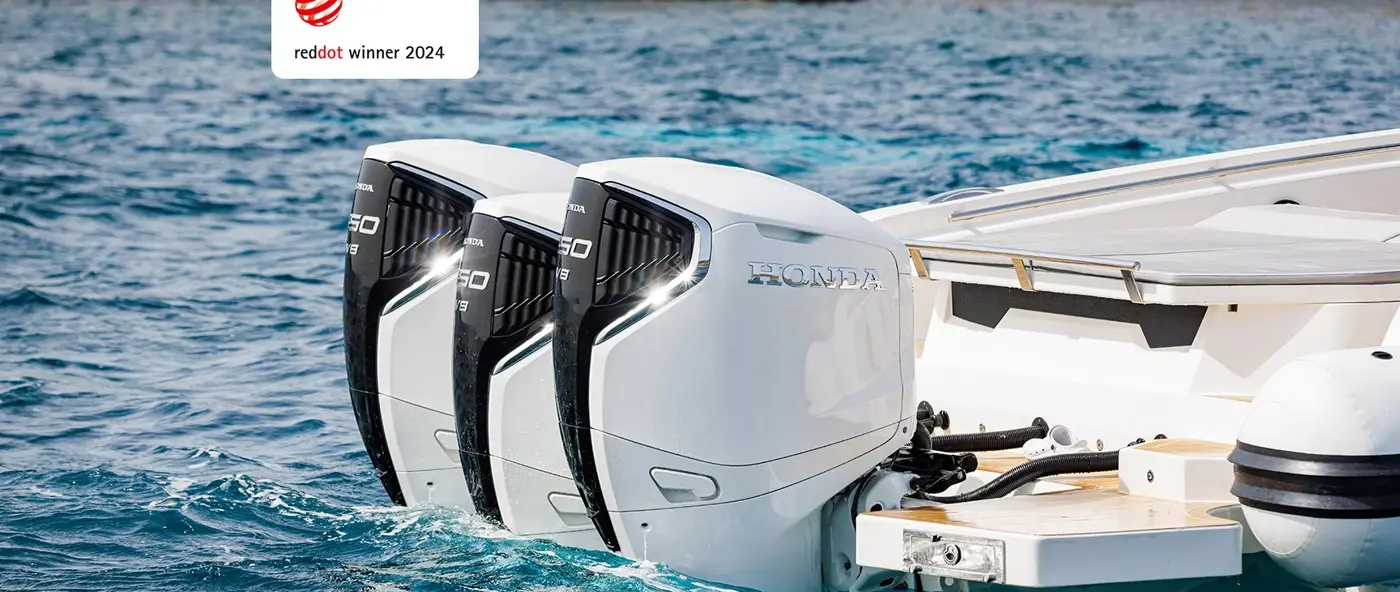
Honda Marine sets out its European ambition
Honda Marine is targeting a leading position in the European outboard market by 2030, according to comments made by its European boatbuilder sales manager Vincenzo Paduano in a first-hand interview published on 5 November 2026. The plan combines a broader engine range, closer cooperation with boatbuilders and more integrated steering and control systems. It is a stated corporate ambition, rather than a confirmed market ranking or a forecast independently tested by the publication.
Paduano told marine publication PressMare that Honda established a dedicated European Marine division in Rome on 1 April 2024. He described Italy as an especially important market for the brand and said the organisation had accelerated its activities since the division was created. For leisure-boat owners, the developments matter because propulsion availability, dealer support and matching an engine to a hull affect costs and usability long after a boat is purchased.
Thirty-three partnerships with European boatbuilders
Honda currently has commercial agreements with 33 European boatbuilders, including BMA and Altamarea, Paduano said in the interview. He identified Joker Boat and Marcopolo among more recent relationships. The arrangements are intended to cover more than supplying an engine to an independent yard, with Honda taking part in testing, engineering development and marketing for boats designed around particular propulsion choices.
The Marcopolo example illustrates the scale of this cooperation: Paduano described an approximately 12-metre boat using three BF350 V8 outboards and weighing about 11 tonnes. He reported a combined fuel consumption around 150 litres per hour at 27 knots for that configuration. Those numbers are the manufacturer's account of a specific boat and setup, not a universal fuel-consumption benchmark for triple-engine leisure craft.
Boat-and-engine packages move to the foreground
The Honda 4XC boat-and-engine programme has been renewed with BMA, a boatbuilder brand established in 2019, according to Paduano. He explained that Spanish designer Carlos Vidal’s work has been updated with input from Honda’s Rome research and development operation. The resulting boats continue to be made by Rib Italy but are intended to be distributed through the Honda Marine dealer network under a clearer joint brand identity.
This package approach is designed to address a familiar problem for first-time buyers: deciding which engine, rigging and accessories belong with a hull. Paduano said the company works with boatbuilders using three-dimensional models, weight and dimensional data and simulations of trim and handling. The stated goal is a more complete, pretested package with an indicative performance profile and a clearly defined base price, while leaving room for optional equipment.
Seven BMA models cover open and cabin boats
Paduano described four open BMA models, the 188, 200, 244 and 266, ranging from around 5.8 metres to approximately 8.2 metres. Three further cabin models, the 255, 277 and 299, extend from roughly 7.5 metres to more than nine metres. Those figures show why the programme is relevant to everyday recreational boating rather than exclusively to high-powered large yachts.
One entry-level example is the approximately 18-foot BMA 188 fitted with a BF40E outboard, which Honda says can be operated without a boating licence under the applicable Italian rules. Paduano gave a starting package price of €26,550 before VAT and referred to a three-year financing option. These terms are market- and configuration-specific, and customers in other countries should verify their own licensing, tax and financing requirements.
Altamarea RIB partnerships are also changing
Honda’s association with Altamarea covers rigid inflatable boats as well as conventional hard-hull craft. According to Paduano, the company introduced the HA 8.5 last year and the HA 9.5 in 2026, positioning these models above the older HA 23 and HA 27 offerings. He noted improved equipment, including a toilet compartment within the console, and said the joint branding has been adjusted to emphasise Honda Marine alongside Altamarea.
The company is considering additional developments and a customer-and-dealer test event next spring, but the interview did not identify a firm date for that event. A genuine on-water comparison could be valuable because a RIB’s feel depends on hull form, weight distribution, propeller selection and load as much as rated engine horsepower. Buyers should therefore treat product descriptions and maker-supplied performance figures as the beginning of their evaluation.
High-power outboards are gaining ground in Italy
Paduano said Italy’s 2026 outboard season closed with growth, particularly in higher-horsepower categories. He reported that engines rated at 350 horsepower and above passed 1,000 units sold for the first time, with more than 1,100 on a rolling twelve-month basis. Honda’s BF350 was said to hold approximately 23 percent of its relevant segment, a figure attributed to the company executive rather than independently audited here.
The BF350 V8 has allowed Honda to compete in a power category that was not previously represented in its range. Yet the wider market contains many different customers, from small-boat users to operators of heavy multi-engine installations. Growth in the upper end should not obscure demand for compact engines or automatically be taken as proof that every leisure-boat sector is expanding at the same rate.
Integrated electric steering remains in development
Honda is working on an integrated electric steering system of its own, Paduano said. The company already offers electronic drive-by-wire controls on its BF350 V8 and BF200, BF225 and BF250 models, but currently sources some steering solutions from external suppliers. Developing more of the control system internally is intended to let engine, steering and helm technology work as a more complete package.
The interview also discussed further renewal of the engine catalogue, with attention to lower weight, fuel efficiency and reliability. Honda points to its wider engineering experience as a potential resource, but Paduano did not announce release dates or specifications for a finished new steering product. That distinction matters: owners planning a refit should buy against current, supported equipment rather than assume an undeclared future component will be available.
Fuel efficiency and competition shape the engine offer
Paduano described Honda’s continued focus on four-stroke combustion efficiency, including sensors monitoring air-fuel mixture and the ECOmo lean-burn system used across parts of the range. Those features are presented by the manufacturer as tools for managing fuel use and emissions. Their real-world benefits depend on the complete boat installation, load, maintenance, speed and operating conditions, which should be established through relevant tests.
On pricing, the executive said the company was reluctant to answer intense competition in the Italian 40-horsepower category with deep reductions. His argument was that buyers should evaluate reliability, engineering and long-term support rather than price alone. That is a corporate position, not proof of superior lifetime cost, and boaters should compare full installed quotations, maintenance schedules, local servicing and warranty terms across brands.
Making small-boat ownership more accessible
Affordability formed a substantial part of the interview. Paduano pointed to the BMA 188 and Altamarea HA20 as roughly six-metre entry packages priced below €30,000 before Italian VAT, designed for use without a boating licence under relevant Italian regulations. He argued that the rising entry cost of recreational boating can discourage newcomers even when manufacturers develop more powerful and sophisticated equipment.
He also discussed a shift towards renting, club membership and other ways of using boats without owning one outright. Honda has considered a boat-club project, he said, but no timetable or operating structure has been confirmed. These ideas are relevant to younger customers who may value occasional access and predictable spending more than the responsibilities of keeping a privately owned boat in the water year-round.
Marina access could be as important as new engines
One of Paduano’s strongest concerns was the difficulty of obtaining affordable berths in parts of Italy. He contrasted the limited availability of conventional marina space with French examples offering substantial dry-stack storage and other alternatives. The executive argued that high berthing costs and insufficient access points can discourage participation even when small, relatively affordable boats and outboards are available.
The wider lesson from the interview is that engines, boats, dealers and infrastructure must develop together if recreational boating is to attract new users. Honda’s stated ambition is clear, as are its 33 European builder relationships and the expanded package strategy. Whether the company reaches its 2030 market goal will depend on future launches, dealer performance and independent market results; the current evidence establishes the direction of travel, not the final outcome.
Source: PressMare — first-hand interview with Honda Marine's Vincenzo Paduano, 5 November 2026.