
Honda returns to the equipment industry show
Honda Marine Europe will exhibit at METSTRADE in Amsterdam from 17 to 19 November 2026, using the trade exhibition to meet boatbuilders and discuss complete boat-and-engine partnerships. Its representatives will be available at stand 01.561. The company describes a strategy in which engine integration and dealer support are considered alongside the outboard itself. For owners of small recreational boats, that business approach can be significant because the quality of a power package depends on decisions made before a new boat reaches the showroom.
The announcement was published on 13 November and is not a claim that Honda is launching a new engine at the event. It refers to the company's existing engineering, its European builder relationships and the opportunities for future projects. The distinction matters: trade-show discussions about product planning should not be reported as confirmed new models or signed supply contracts. The clear development is the manufacturer's emphasis on a closer relationship with yards producing complete leisure boats.
Why an outboard is part of the entire vessel
An outboard motor is often the most recognisable piece of equipment on a small sportsboat, RIB or open centre-console craft. However, selecting an engine is much more complicated than matching a horsepower figure to an advertised maximum speed. The engine's weight, mounting height, steering system, propeller, fuel supply and interaction with the hull are all parts of an engineered installation. Honda argues that working with boatbuilders directly helps the companies configure coherent packages rather than leaving every decision to a dealer at the end of the production line.
For a buyer, good integration can make a boat easier to handle and more predictable over time. A carefully matched engine should have appropriate operating limits and a known range of propellers and service procedures. Yet those outcomes depend on the specific hull and the quality of the finished installation. Owners should still ask for performance data from a representative boat with realistic loading and sea conditions, because promotional speed figures obtained under different circumstances may not reflect ordinary cruising.
The 4XC H266 example
Honda points to the 4XC Design H266 Open Center Console as a recent example of collaboration with BMA. The company says the boat was developed as a complete hull-and-engine proposition using BF150 outboards. It is important to keep the reporting precise: the 4XC H266 is an existing product example, not a newly revealed 13 November 2026 boat. The company is using it to illustrate how manufacturers and boatbuilders can work together on an appropriate propulsion package.
A centre-console design is especially sensitive to the overall distribution of weight and the location of people aboard. Engine positioning can affect trim, the boarding platform, fuel economy and how the boat responds when accelerating or turning. The specification should also account for how owners use the craft, from short harbour trips to longer coastal passages. None of those decisions can be resolved by quoting horsepower in isolation; they require a complete test programme and the boatbuilder's recommendations.
What a boatbuilder gains from early discussions
By involving the engine supplier at an early design stage, a yard can consider rigging space, throttle and shift systems, dashboard presentation, cabling and access for routine maintenance before interior mouldings and deck structures are fixed. Those changes can save time in production and reduce the likelihood of awkward compromises at the customer handover. A builder also benefits from training and parts support when introducing an engine family that its local dealers may not previously have installed.
Honda's announcement describes this coordination as a long-term partnership rather than a series of individual engine sales. That can improve continuity across several model years, although owners should not assume every product will remain unchanged or every service outlet will have identical capabilities. Buyers should ask whether the engine and boat are supplied as one complete warranty package or whether separate obligations apply. The answer may matter years later when a problem involves both the installation and the propulsion system.
Fuel efficiency and emissions require comparable evidence
The company identifies fuel economy, emissions and electronics among the subjects increasingly discussed by builders. These are legitimate areas of development, but the announcement does not give new independently tested fuel-consumption figures for a particular hull. A useful buyer comparison should specify litres per nautical mile at real cruising speeds, the boat's load and sea conditions. Maximum range claims also require an explanation of usable fuel, reserves and how the boat was tested.
A well-selected outboard can operate efficiently in its intended use, but no one engine is automatically the best choice for every small craft. A lightly loaded dayboat and a heavily equipped fishing boat may require different arrangements even when their hull lengths are similar. Buyers can ask the dealer to provide a speed-and-fuel table from a comparable configuration instead of relying on a broad marketing statement about efficiency.
Electronics have become part of engine selection
Modern outboards interact with digital displays, alarms, steering equipment and vessel electrical systems. The availability of appropriate data at the helm can help owners monitor operating conditions, but it also requires careful decisions about compatibility. An engine may supply information through a particular interface while the boat's chartplotter expects another configuration. The integration must ensure essential warnings remain visible and can be understood without a phone connection or subscription.
The company notes that technology and owner expectations continue to develop rapidly. Boatbuilders have to decide which functions are genuinely useful and how to support them after delivery. The quality of a screen display is secondary to the reliability of the underlying sensors, wiring and diagnostic procedures. Owners should understand which software elements can be updated, who is authorised to perform changes and what happens when equipment becomes obsolete.
Dealer and service networks matter
Honda says its European dealer network handles sales, servicing and warranty support for boat-and-engine partnerships. That framework is useful for owners travelling between cruising areas, particularly when an outboard requires scheduled maintenance or a repair during a holiday. Nevertheless, the existence of a network does not establish that every service point stocks all components for every model. Owners should check the nearest authorised support location and confirm the arrangements for emergency repairs.
A complete new-boat purchase should include the engine's serial details, service intervals, propeller specification and clear documentation of warranty conditions. The buyer should be told who is responsible if a fault appears to involve installation rather than the motor itself. A dealer accustomed to working with both the boatbuilder and engine manufacturer may be able to resolve such questions more efficiently. This is a practical reason to value coordinated supply relationships.
More than a choice of maximum horsepower
Engine power attracts attention because it seems to offer an easy numerical comparison. In practice, a good small boat should plane comfortably where appropriate, manoeuvre safely at low speed and retain useful performance with typical passengers aboard. The correct engine installation also needs to meet structural and certification requirements. An engine that can produce more power is not necessarily the right engine for a hull with a lower permitted rating or an owner who mainly cruises at moderate speeds.
Honda's approach encourages a package-level evaluation. Buyers should ask the builder about propeller testing, steering setup, engine height, performance with a full fuel tank and the effect of optional equipment. That information is especially important when comparing boats supplied with different manufacturers' outboards. A fair comparison uses equivalent loading, not brochure figures taken from unrelated tests.
Handling at the dock is part of the package
Most small boats spend a surprisingly high proportion of their operating time arriving, departing or manoeuvring in confined water. The rigging and controls chosen by the boatbuilder can affect how easy those tasks feel. A good installation should allow smooth throttle response, precise steering and good visibility from the helm. These qualities deserve the same attention as acceleration or top speed during a demonstration.
A prospective buyer should test the complete boat in conditions representative of intended use. A gentle sea trial with the dealer's skipper may not reveal how the craft handles a crosswind or a crowded landing. Owners should ask for a proper familiarisation session, including safe shutdown procedures and the interpretation of alarms. The resulting confidence comes from the complete design, not merely the badge on the outboard cowling.
What METSTRADE changes—and what it does not
METSTRADE is an industry exhibition where boatbuilders, suppliers, designers and distributors discuss future production decisions. Honda's attendance gives those businesses an opportunity to evaluate its European approach and the available engine packages. The show is not a public announcement that a specific new boat will reach dealers on a particular date. Those details will need confirmation from the relevant builder after contracts, engineering and production plans have been finalised.
Honda Marine Europe's Country Sales and Boat Builder Manager, Vincenzo Paduano, says the exhibition is a place to discuss how technology fits the boats, customers and businesses of the companies attending. That is the substance of the November statement. It does not give an independent performance test or a list of newly agreed European builder partners. Responsible reporting should distinguish the manufacturer's strategic ambition from results that can only be confirmed later.
The implications for leisure boat buyers
For someone choosing a boat below twelve metres, the best propulsion package is one that has been developed, tested and supported as a whole. Honda's focus on direct collaboration with builders illustrates why owners should look beyond an engine's advertised horsepower. It directs attention to hull matching, electronics, rigging and after-sales assistance—matters that can determine whether a boat remains enjoyable after the initial purchase excitement has passed.
The next useful evidence will come from actual boatbuilder agreements and independently documented performance of completed packages. Until then, the confirmed news is Honda's presence at METSTRADE 2026, its stated European cooperation strategy and the 4XC H266 example. Those are worthwhile developments in the small-boat sector, provided they are presented as the company's current programme rather than as a series of unannounced product launches.
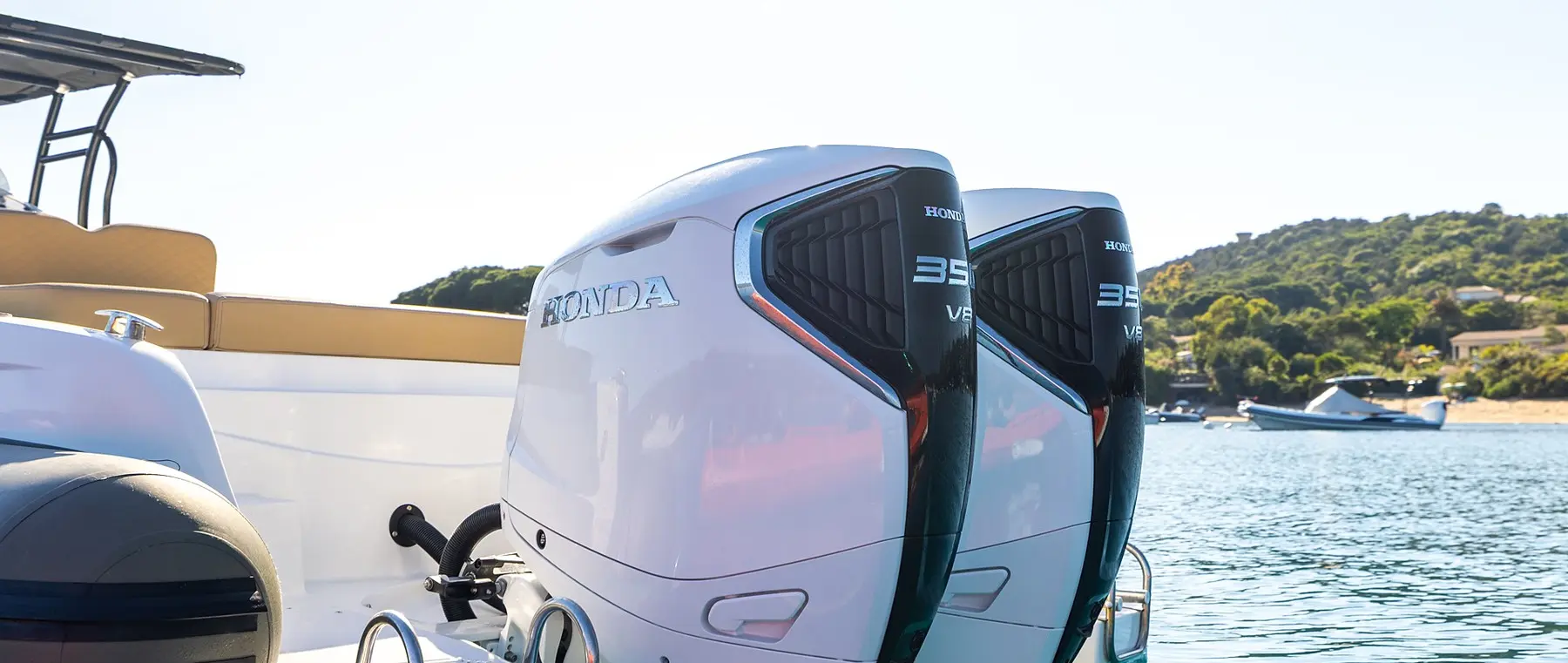
Official source: pressmare.it. Honda Marine Europe official November 2026 press photograph showing Honda outboard engines; illustrative of the builder-partnership strategy, not the specific 4XC H266 boat.