
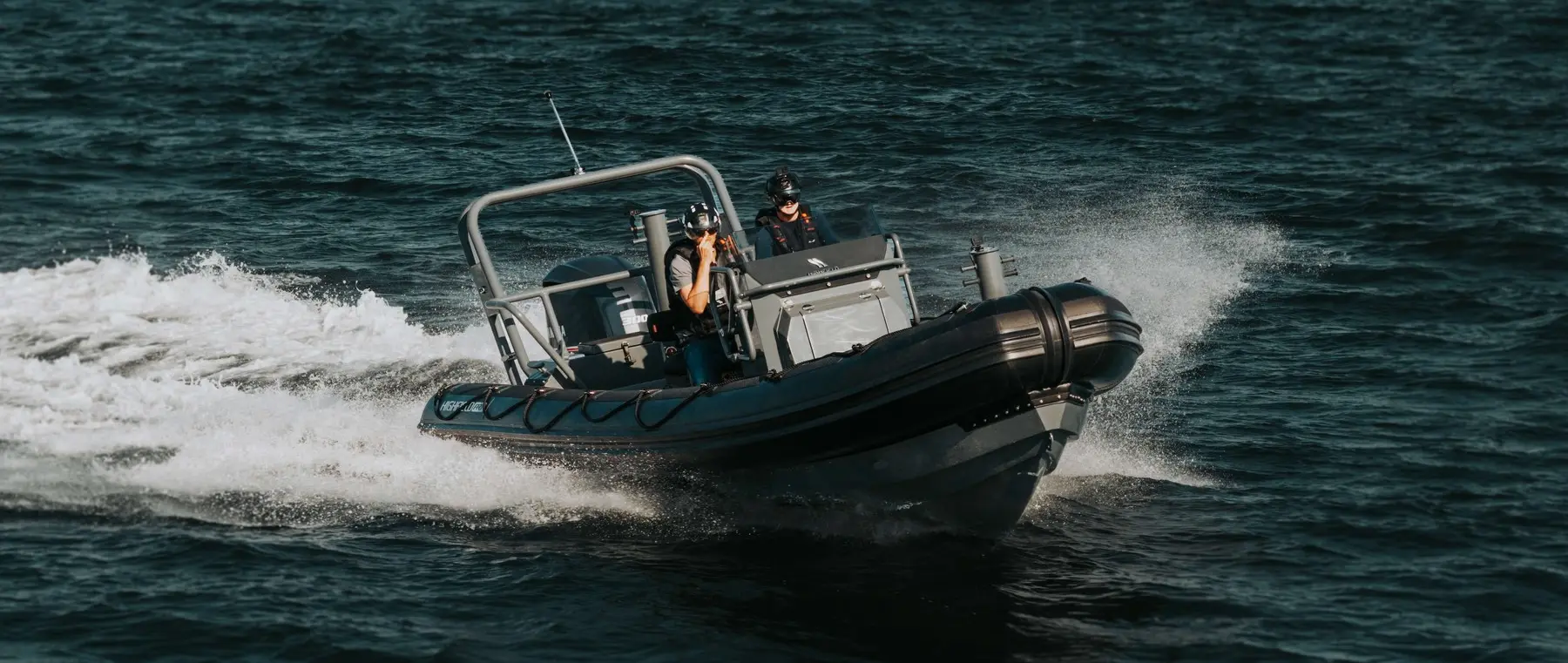
A dedicated branch for working RIBs
Highfield Boats has formalised its workboat activities in a new professional division called Highfield PRT, short for Patrol, Rescue and Tactical. The manufacturer announced the move in October 2026, bringing boats intended for rescue services, patrol units and commercial operators under a business structure separate from its familiar recreational rigid-inflatable range.
The initiative is more than a new badge applied to an existing leisure hull. Highfield says the division will handle purpose-specified vessels, equipment integration and support arrangements for organisations whose boats must perform a job reliably and may be used intensively throughout the year.
Three ranges from 3.8 to 11 metres
The launch portfolio is organised into three families named VIPER, RAPTOR and SENTINEL, with announced lengths extending from 3.8 to 11 metres. All sit within the size range familiar to leisure-boat and tender operators, but their intended use, equipment choices and maintenance expectations differ from those of a family dayboat.
VIPER is the lightweight rapid-deployment inflatable line, covering 3.8 to 5.8 metres. The maker lists VPR380, VPR420, VPR470 and VPR580 versions and describes craft that can be transported and inflated for deployment, with adaptable layouts and an emphasis on carrying useful loads in a modest package.
Highfield positions this smaller group for emergency or institutional users who need a flexible platform and shallow-water access. Neither the press announcement nor its product overview should be read as permission to exceed specified load limits; the final capacity and operational envelope will depend on the configuration and relevant approval.
RAPTOR focuses on heavy-duty patrol duties
The RAPTOR family consists of heavy-duty rigid-inflatable boats measuring between 6.6 and 8.7 metres, named RPT660, RPT760 and RPT860. According to the manufacturer, applications include patrol, rescue, boarding support, inspection and other work in which deck access and dependable handling matter.
A working RIB may spend much more time alongside larger ships or operating in exposed conditions than an ordinary day cruiser. For that reason, buyers in these sectors often prioritise robust structures, practical movement around the cockpit, secure equipment stowage and the ability to maintain a vessel with minimal downtime.
The launch information does not provide a universal engine package, speed or fuel consumption for each RAPTOR configuration. It would be misleading to present one headline performance figure as applicable to every mission-equipped hull, particularly where installed equipment and crew complement can differ substantially.
SENTINEL for the larger assignments
SENTINEL is the broadest and largest line, with D-tube rigid-inflatable boats from about 6 to 11 metres. Highfield identifies the SNT600, SNT660, SNT760, SNT900 and SNT1100, describing a platform intended for institutions that need additional working space and adaptability.
The division says air-filled or foam-filled D-tubes can be selected according to requirements. Such decisions affect how a craft is used, maintained and repaired, while the final layout must reflect whether the owner prioritises people, equipment or particular workstations.
For leisure-boating readers, there is a useful parallel with high-quality tender design: a deck arrangement that looks sparse in a photograph can be extremely practical when the job requires safe movement and quick access. The distinction is that professional users must judge those choices against documented operational needs, not simply comfort at anchor.
Leadership and support
Highfield founder Julien Carussi is taking the position of chief executive of Highfield PRT, while Stefanie Sun moves from her supply-chain role at Highfield Boats to become the new division's director of operations. The appointments put existing manufacturing and logistics experience behind the professional offering.
Highfield says its aim is to provide assistance throughout the vessel's service life, encompassing specification, customisation, technical support, spare parts, training and after-sales service. That is important in this market because an organisation may need to coordinate an entire small fleet rather than maintain a single privately owned boat.
What the announcement does and does not establish
The new division reflects the increasing specialisation of the small-craft market, with recreational RIBs and professional intervention boats drawing on related construction methods while answering very different customer requirements. It also signals that established leisure-boat builders see opportunities in the demands of public and commercial organisations.
Highfield has provided the three range names, model families, operating intentions and senior appointments, but has not published a full set of final prices, individual performance tests or delivery schedules in the announcement. Buyers should seek model-specific approved specifications and independent trials before comparing one platform with another.
For owners of smaller boats, the development is a reminder that safety, serviceability and thoughtful deck planning remain valuable principles irrespective of whether a RIB is bought for pleasure or professional use. Those priorities help explain why designs originally proven in demanding work can influence wider expectations across the boating market.