
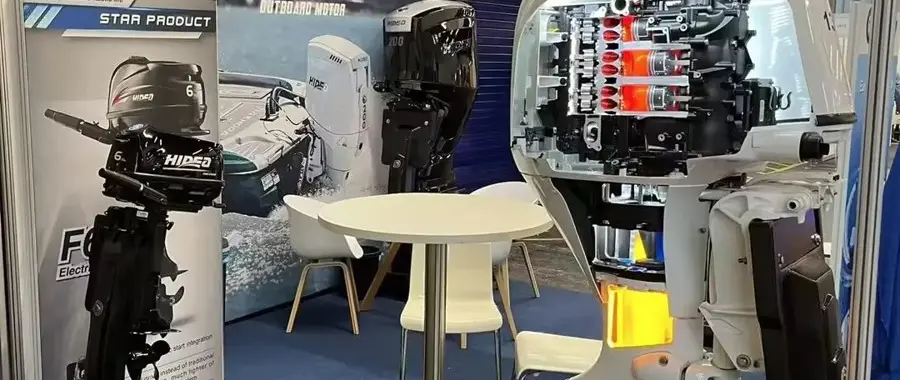
HideaPower has introduced its Easy1000 electric outboard to the European leisure-marine industry at METSTRADE 2026 in Amsterdam. An official company announcement dated 17 November identifies the new motor as the centrepiece of its display at stand 06.101, alongside an established range of petrol-powered and electric outboards. The manufacturer says the Easy1000 has been developed as a portable propulsion option for people seeking quieter and more convenient power on smaller boats. The announcement is relevant to owners of dinghies, small fishing craft and lightweight auxiliary vessels, but the company has not included a complete independently verified technical specification in this particular release. Buyers should therefore reserve judgement on actual thrust, operating time, price and compatibility until the appropriate product documentation is available.
The launch took place in Amsterdam
METSTRADE ran at RAI Amsterdam from 17 to 19 November 2026, bringing marine equipment manufacturers, builders and distributors together. HideaPower used the event to present its new electric outboard and discuss its wider range. Trade exhibitions provide an opportunity for buyers and other manufacturers to inspect a product, but a stand demonstration is not the same as an independent test under a variety of boating conditions. The company's announcement confirms the product's presence at the show and the intention to promote it to the European market. It does not establish that every distributor is already stocking the motor or that customers can order immediate delivery.
Why compact electric outboards attract interest
Small boats are often used for short trips where quiet operation, straightforward starting and reduced routine engine work are attractive. An electric outboard can remove the need to carry petrol for that motor and may suit particular inland waters or short harbour journeys. Those advantages depend on the complete system and the way the boat is used. A compact motor on a sheltered lake faces very different demands from the same motor driving a heavily loaded inflatable against wind and current. The Easy1000 announcement places it within a growing market for portable electric propulsion, but owners should avoid treating broad environmental or convenience claims as proof of fitness for their own vessel.
The manufacturer describes a portable solution
HideaPower presents the Easy1000 as a new product developed for quiet and accessible marine power. The release connects the motor with interest from boaters using European inland lakes, harbours and other recreational waterways. However, it does not provide a reliable package weight, battery capacity, continuous power rating or standard propeller specification that can be independently checked from the text. The name Easy1000 should not be interpreted as a verified 1,000-watt output without a supporting technical sheet. Precise values matter because they determine how a motor compares with alternatives and whether it is compatible with a particular hull.
What an owner needs to know about power
For a small boat, required propulsion depends on displacement, hull shape, loading, wind, sea state and the desired speed. A rated electrical input is not the same as propulsive efficiency or speed through water. It can be tempting to compare a new electric motor directly with a petrol outboard using a marketing equivalence, but the basis for those claims should be understood. The official Easy1000 release does not supply a complete measured comparison. Buyers should seek test results conducted on representative boats and clarify whether any published power value describes electrical input, shaft output or another measurement. Such distinctions are essential for making a useful choice.
Range depends on more than the battery
Electric propulsion raises an obvious practical question: how long can the boat travel before recharging is necessary? The answer depends on battery energy, motor consumption, chosen speed, hull resistance and conditions. Operating at a modest speed in calm water can create a very different endurance profile from pushing hard against a current. HideaPower's exhibition announcement does not publish a validated range curve for the Easy1000, so assigning one would be speculative. Prospective customers should ask for the battery's usable energy capacity, compatible charging methods and performance information for a boat similar to their own. A reserve should be maintained for the unexpected, particularly when operating away from shelter.
The size of the boat is not a complete guide
A motor may be described as suitable for tenders and dinghies, but length alone does not establish compatibility. Two boats of similar length can have substantially different weights, underwater shapes and carrying loads. The Easy1000 may appeal to the under-12-metre leisure-boat sector, yet no responsible report should imply that it can power every boat in that category. Transom geometry, shaft length, mounting arrangements and steering clearance also matter. Owners should compare their boat manufacturer's maximum and recommended motor specifications with the propulsion supplier's installation instructions. Choosing a motor based only on the fact that it is portable or electric could produce disappointing or unsafe results.
The importance of safe battery handling
The battery and electrical system deserve as much attention as the motor itself. A suitable marine installation needs reliable connectors, clear instructions for charging, protection from accidental damage and appropriate procedures for storage. Saltwater exposure and water ingress require particular care. The manufacturer's statement uses language about clean propulsion, but this should not be confused with a verified technical ingress-protection rating or a guarantee that all parts can be immersed. The full manual should identify limitations and relevant certifications. Owners should also consider how they will transport the battery and whether charging equipment is suitable for the available shore power system.
Electric drive changes maintenance routines
Compared with a conventional combustion outboard, an electric motor may have fewer familiar tasks associated with fuel and ignition systems. That does not make the installation maintenance-free. Propellers, fasteners, controls, cables and seals still require inspection, while batteries and chargers need care according to the manufacturer's guidance. An equipment choice should be considered over years of ownership rather than only during the first quiet demonstration. Availability of spare parts and local technical support can be as important as the motor's purchase price. HideaPower's November statement emphasises distributor relationships and service support, but it does not guarantee a particular service outlet in every country.
The product sits within a broader company range
At METSTRADE, HideaPower also displayed fuel-injected four-stroke models, two-stroke products and other electric propulsion units. This matters because the new motor is not being presented as the manufacturer's only route into recreational boating. Buyers may have different requirements and may compare electric and combustion systems within the same supplier's range. A show display can help people inspect controls and discuss engineering choices with representatives, but performance comparisons should be based on documented results rather than promotional language. The launch reflects the increasingly varied propulsion options available to small-craft owners. It does not demonstrate that every boating application is ready for an immediate switch to electric power.
A distributor-focused announcement
The company's release is directed partly toward European dealers, boatbuilders and marine equipment businesses. It refers to distribution arrangements, support for regional partners and conversations about 2027 inventory. That is relevant to end users because after-sales service and local availability influence ownership. However, an invitation to discuss distributor opportunities is not the same as an announcement that a network is already complete or that retail prices have been set. Dealers need accurate specifications, warranties and training before they can offer meaningful advice. For customers, the most useful outcome of a trade-show introduction will be clear documentation and dependable support as the product enters the market.
The practical appeal for inflatables and tenders
Inflatable boats and light tenders can be attractive candidates for portable propulsion because owners often need to remove, carry or store the motor. Weight distribution matters, especially on a small transom, and the complete battery-and-motor system should be considered rather than the weight of one component. Quiet operation may be welcome when moving through sheltered harbours or near other users, but environmental regulations and local restrictions differ. The launch does not state a particular tender length or maximum passenger load for the Easy1000. Owners should confirm manufacturer guidance and avoid relying on broad phrases about portability as a substitute for compatibility checks.
Fishing boats present another application
An electric outboard can appeal to anglers who value low noise and controlled movement over short distances. Some fishing activity involves holding position or moving slowly, but the power required to reach a fishing ground safely may be very different. Weather conditions, distance from harbour and the need for a reliable return reserve are particularly important. The official announcement does not identify the Easy1000 as an approved or tested solution for a specific fishing boat, and it should not be presented as one. Users considering electric propulsion for fishing should obtain representative performance information and evaluate whether the motor suits the distances and conditions involved.
Do not mistake trade-show publicity for independent trials
The manufacturer describes the product in enthusiastic language and states that it is intended to meet growing interest in electric propulsion. These are company claims. METSTRADE provides visibility and access to industry professionals but is not proof that the new model has passed an independent long-term durability trial. The article's role is to document what HideaPower announced and identify the questions that remain unanswered. Clear distinctions between confirmed information and future expectations are particularly important when a product has just been unveiled. Consumers should treat any specific performance figures circulated elsewhere cautiously until they can be traced to official technical documents or credible testing.
Availability, pricing and warranty remain to be checked
The November release invites interested parties to seek product and distributor information but does not provide a verified consumer price, delivery schedule or final warranty terms for the Easy1000. It would be inappropriate to invent these figures or assume that every territory has the same arrangements. Prospective buyers should ask for the current manual, a detailed specification sheet, compatible battery options, charging instructions and a written warranty. Local laws may impose additional requirements on electrical equipment and boat operation. A product's appeal is better assessed once those practical matters are clear than through a trade-show photograph alone.
Marine environmental claims need precision
Electric outboards do not produce exhaust emissions at the point of operation, which can be valuable in some sensitive waterways. Their wider environmental impact depends on battery production, electricity generation, product life and eventual recycling. The company's announcement uses the language of zero-emission marine propulsion, which is best understood as a reference to exhaust at the boat rather than a complete life-cycle assessment. Noise can also vary between products and installations. Buyers interested in environmental performance should look for measured information and consider how frequently they will use the system. A realistic assessment is more helpful than treating any electric motor as automatically ideal for every setting.
The relevance to leisure boats below 12 metres
Leisure Boat Guide's audience includes portable-outboard users, dinghy owners, small anglers and people considering less complicated propulsion for short trips. A new electric outboard is relevant to these readers because equipment choices can shape how convenient and enjoyable a day afloat becomes. The Easy1000 is a developing product story rather than a proven replacement for a particular petrol model. Its main confirmed milestones are the 17 November manufacturer announcement and its presence at the Amsterdam trade exhibition. Further details should be assessed against the needs of individual boats before a purchasing decision is made.
What the launch actually establishes
HideaPower's official statement confirms the Easy1000 as a new electric outboard presented at METSTRADE 2026 and identifies its target as part of the compact, accessible marine-propulsion market. It also describes the company's wider range and its efforts to strengthen dealer relationships in Europe. It does not independently establish a particular top speed, cruising range, price or long-term performance standard. For the small-boat community, the news is a useful addition to the range of emerging electric options, but it is a starting point for evaluation rather than a completed buyer's recommendation. The next important evidence will be detailed specifications, real installation guidance and independent performance tests.
Official source: HideaPower, *Live from Amsterdam: HideaPower Unveils the Easy1000 Electric Outboard at METSTRADE 2026*, 17 November 2026, https://www.hideaeurope.com/activities/214.html. Image: Original HideaPower manufacturer editorial image supplied within the same official release, with producer attribution. All unspecified performance values remain unverified.