
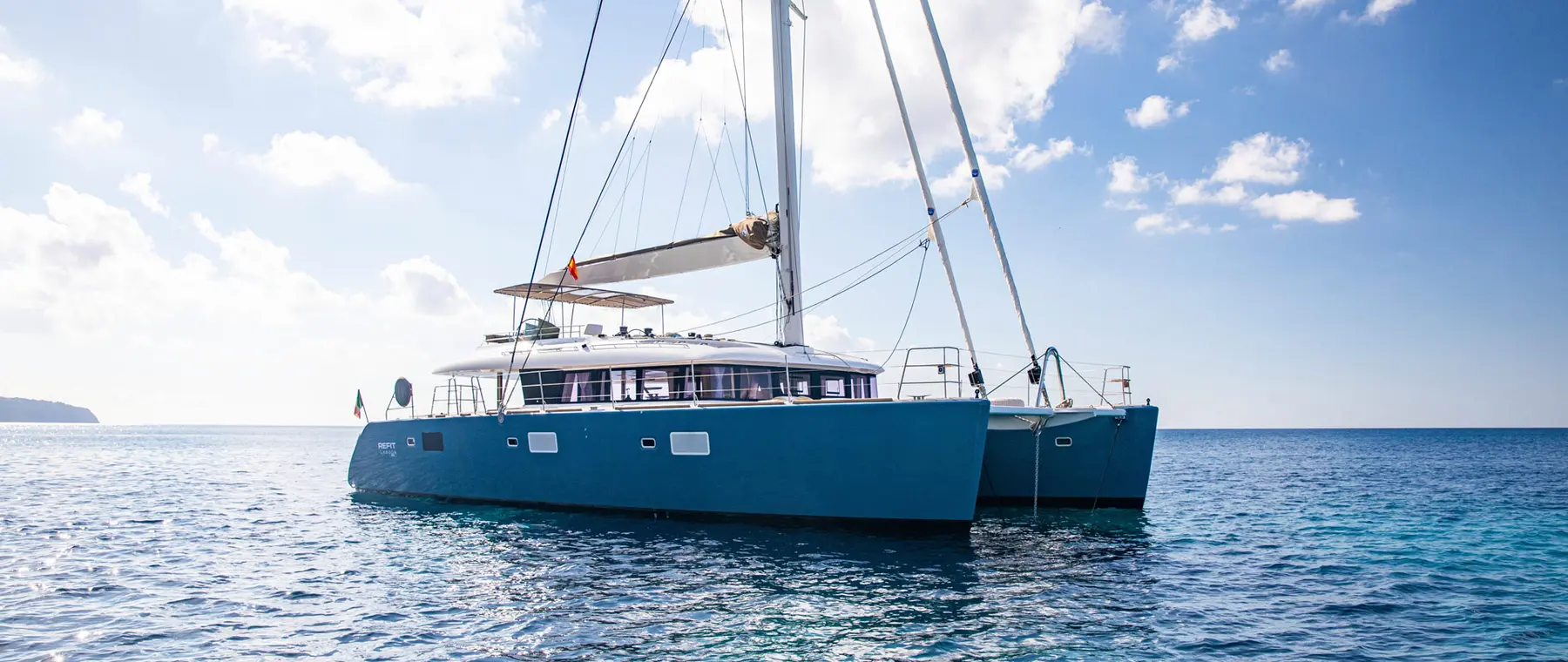
A proposed Mediterranean base for larger yachts and refits
Groupe Beneteau has announced plans for a new large-yacht service and refit base at Canet-en-Roussillon in the south of France. The proposed site covers around 15,000 square metres, with an opening envisaged in mid-2029, according to a 23 October 2026 statement from the manufacturer. It is a significant future investment in the ownership and maintenance side of boating, although the facility is not operating today and the company makes clear that studies and permits are still part of the development process.
The announcement centres on building more capacity for sailing and motor catamarans and monohulls over 60 feet, while strengthening the company's programme for renewing pre-owned boats. It is not a launch of a new Beneteau model or a guarantee that every yacht in the manufacturer's catalogue can immediately be brought to the proposed centre. Rather, it signals a shift towards treating preparation, customisation, technical maintenance and refurbishment as a more integrated part of the business after a vessel leaves the new-boat showroom.
For recreational owners, such investment matters in a practical way. A new yacht has extensive manufacturer support during delivery, but years later the owner must still find expertise in original construction methods, model-specific components and reliable scheduling. A dedicated service hub could reduce the need to piece together multiple contractors for work requiring several disciplines. That promise will ultimately depend on capacity, location, costs and the standard of finished projects when the centre opens.
What is planned for the Canet-en-Roussillon site
Groupe Beneteau says the first stage would involve approximately 2,200 square metres of buildings on the larger 15,000-square-metre site. Its press statement allows for a potential doubling of the built footprint in a later phase and an optional extension of around 10,000 square metres of land. Those additional areas should be described as possibilities, not approved or completed construction. The extent of the finished facility will become clearer as permits, layouts and investment decisions progress.
The location builds on the expertise of BMS, a company specialising in the maintenance and refit of large catamarans that joined Groupe Beneteau in October 2025. Beneteau identifies BMS as a Canet-based business with an established technical team and experience in highly customised work. The planned centre is expected to combine that service knowledge with the larger manufacturer's engineering resources and access to original boat records. Success will require that the scale of the new operation supports careful craftsmanship rather than compromising it.
The project also fits a wider strategy of placing service operations in areas with direct waterfront access. The company points to another developing hub at Port Olona 3 in Les Sables-d'Olonne for preparing and commissioning new craft. Waterfront access can be essential for moving a boat safely between yard and water, but it does not in itself establish the future centre's lift capacity, maximum dimensions or available berths. Those details should be confirmed before an owner makes refit plans around the proposed facilities.
The NEO refit programme moves beyond a small pilot
A major reason for the Canet proposal is the NEO programme, under which Groupe Beneteau refurbishes selected pre-owned boats using knowledge retained by the original manufacturer. The company says its programme has broadened from two to eight models across Lagoon, Beneteau and Jeanneau, following an expansion announced during the Cannes Yachting Festival. This is not simply cosmetic detailing: the stated method starts with an inspection and then draws on original design documentation, mould information and parts lists associated with the hull.
Beneteau reports that the programme completed work on a Lagoon 42 and a Lagoon 450 during the first half of 2026. The manufacturer also sets an ambition of reaching 130 refitted boats annually by 2030, with the proposed Canet site potentially handling about ten larger yachts per year as part of the wider network. These figures are targets in a future operating plan rather than output achieved now. Owners should therefore distinguish the existing programme from the additional capacity expected later.
The potential benefit of using original plans is especially clear when changes affect several onboard systems. Replacing equipment may require understanding weight distribution, electrical loads, cooling, access panels and how the structure was originally built. Manufacturer documentation cannot eliminate unforeseen problems in a used boat, but it may support more consistent decisions about the suitability of parts and modifications. The challenge is to translate those records into a transparent work scope, realistic schedule and clear handover once refurbishment is complete.
How the expansion could change ownership decisions
For somebody considering a used catamaran, the idea of a manufacturer-supported refit changes the comparison with a new purchase. Instead of measuring only asking prices and cosmetic condition, buyers may be able to assess an older hull alongside a defined refurbishment plan. A sensible comparison should include the cost of the boat, survey findings, expected yard time, equipment upgrades, transport and accommodation while work is carried out. Any warranty or certification terms must be checked against the precise project rather than presumed from the NEO name.
Existing owners may be more interested in keeping a familiar boat for another cruising season than in exchanging it for a new model. Improved electrical capacity, updated controls, rigging or interior comfort can make an older platform better suited to how a family actually uses it. Yet some defects are uneconomic to correct, and the suitability of modifications depends on hull age and design. An independent survey remains useful even when the refurbishment provider is linked to the original manufacturer.
The 60-to-80-foot segment targeted in Beneteau's statement occupies an interesting space between small owner-operated boats and professionally managed yachts. Owners in that range often face increasing complexity in engines, sails, docking arrangements, electrical systems and crew support, while still expecting the flexibility to use the boat personally. A service centre that can coordinate specialist work may be attractive, but booking capacity and response time will be at least as important as the range of services shown in promotional material.
Training ambitions and the questions that remain open
Beneteau also raises the possibility of an owner-and-crew training area in a second phase. Its proposal describes practical sessions for boat handling, safety and onboard systems, conducted either on a customer's own boat or a comparable model. It could also support customer events and educational programmes. That is a prospective development, not a timetable of courses ready to book, and detailed curricula or accreditation arrangements have not been announced in the statement.
Training is a natural companion to technical upgrades, because installing modern equipment does not automatically make it easy to operate safely. A new battery system, helm display or anchoring arrangement introduces new operating procedures that should be understood by everyone who uses the boat. If realised, the Canet training concept could help close the gap between a successful yard handover and confident independent cruising, though the practical format will require further confirmation.
The next milestones are therefore straightforward to monitor: planning and permitting, a definitive facility layout, the opening schedule, the scope of supported models and a realistic booking process. Groupe Beneteau's ambitions for mid-2029 and 2030 give owners and the wider industry a direction of travel, but not an immediate new maintenance address. The official 23 October announcement is the authoritative reference, while Lagoon's own NEO material illustrates the existing manufacturer-led approach to refurbishment.