
A traditional piece of boating equipment gains attention
Grey Owl Paddles has placed its Monarch 12-degree bent-shaft model in the recreational product selection associated with the 2027 Paddle Sports Show awards. The official entry highlights its butterfly-inspired blade shape and describes a design intended to provide smooth, efficient strokes on longer days afloat. The submission is a product presentation, not an announcement that the Monarch won the category award, a distinction worth preserving when assessing its significance.
Canoe paddles are often described simply by material and length, but geometry influences how the blade moves through the water and how a paddler positions the hands and shoulders. A bent shaft can make a particular cruising stroke feel more natural, especially when the paddler maintains a steady cadence across open water. It is one reason apparently uncomplicated equipment continues to receive attention from specialist manufacturers.
Understanding the twelve-degree bend
The Monarch's defining measurement is the twelve-degree shaft bend. This changes the relationship between the grip and the blade during a forward stroke, with the objective of keeping the blade at a useful orientation through the most productive part of the movement. A paddler in a seated canoe may find that the arrangement promotes a more consistent pull without excessive wrist or upper-body adjustment.
The benefits depend on boat type, seat position and technique. A bent shaft is not automatically a better tool for every manoeuvre; traditional straight paddles offer their own advantages in steering, bracing and changes of direction. A person who regularly paddles moving water or uses specialised strokes should discuss those requirements before choosing a touring-oriented design purely for its efficiency claims.
The Monarch's distinctive blade
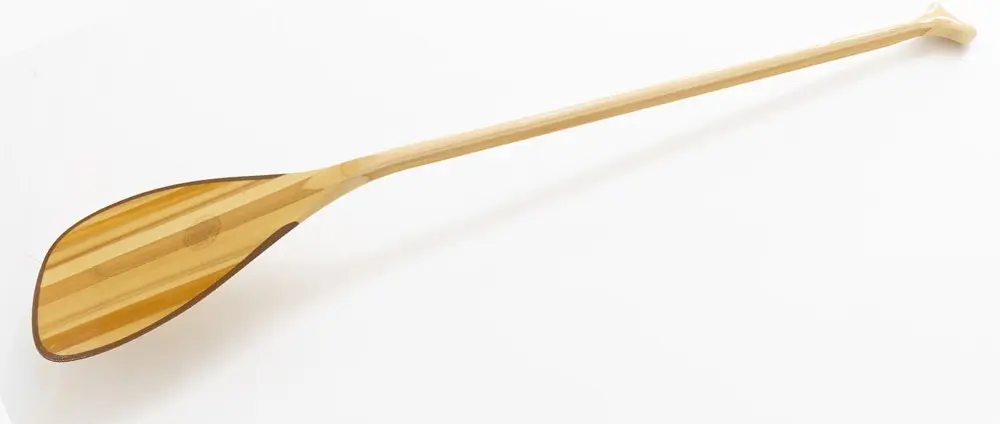
The show entry draws attention to the Monarch's butterfly-inspired blade profile. That unusual outline gives the paddle an identity beyond the conventional flat blade, while potentially influencing how the surface enters, holds and leaves the water. The organiser presents the model as both visually attractive and functional, but the exact effect of the shape on propulsion is something a paddler should establish through practical experience.
Customers should evaluate the blade's area, thickness and edge finishing, along with any manufacturer's guidance on suitable conditions. A larger surface can feel powerful at slow cadence yet tire some shoulders over distance. Conversely, a narrower blade may suit a relaxed rhythm. An attractive wooden blade is best considered in the context of its intended work, rather than treated as a decorative accessory.
Long-distance comfort is more than low weight
For recreational canoeists, an efficient stroke pattern can matter significantly during an extended crossing or a multi-hour route between campsites. A correctly sized paddle allows a comfortable reach and reduces the temptation to hunch or overextend the arms. Shaft diameter, grip shape and the way the paddle balances in the hand can all influence fatigue, even when two models have similar published weights.
It is important to distinguish comfort from a guarantee of injury prevention. Different paddlers have different shoulder mobility, strength and technique, and an unfamiliar bend may take time to master. A local instructor or experienced retailer can help the customer try the paddle with a canoe at a typical load, discovering whether the feel actually improves their stroke.
Care of a finely finished wooden paddle
A wooden recreational paddle can be a durable and pleasant object to use, but it also benefits from appropriate maintenance. Its protective finish should be inspected for abrasion and any exposed wood should be treated according to the manufacturer's instructions. Repeated scraping against rocks or using the blade as a lever can damage even a well-made paddle in ways unrelated to the quality of its design.
Owners should rinse away grit, allow the equipment to dry and avoid prolonged storage in conditions that encourage moisture damage or extreme heat. A wooden paddle kept in a vehicle or open boat may experience temperatures very different from those inside a house. Sensible care contributes to the product's longevity and helps maintain the finish that makes a timber model appealing.
A straightforward option for touring canoes
The Monarch is presented principally as a recreational paddle rather than an accessory designed to produce a record speed. That focus matches the way many canoe owners use their boats: gentle exploration of lakes, rivers and sheltered inlets, with attention to scenery and a comfortable pace. Paddling equipment suited to such activity should allow changes of hand position and reliable control throughout a day.
For tandem canoe users, partners may prefer different lengths or shaft styles. It is not necessary for everyone aboard to hold an identical paddle if their roles and reach differ. The person at the stern may perform more steering strokes, while the bow paddler often focuses on propulsion. A thoughtful pair of paddles can support the whole crew more effectively than buying two solely because the finish matches.
What the 2027 selection means
The Paddle Sports Show brings together manufacturers and trade professionals to discuss new products, including designs that refine established equipment rather than introducing electronics or propulsion. Inclusion in the recreational selection provides the Monarch with an opportunity to be evaluated alongside other paddles, kayaks and safety accessories. The organiser's entry is a source of product information, not evidence of an independent performance comparison.
Prospective owners should obtain the full published specification from Grey Owl, including available shaft lengths, materials, blade dimensions and current price. The sample photographed in the official listing is a product image of the paddle itself, allowing readers to inspect the characteristic bend and blade outline rather than rely on a generic boating scene. A real demonstration remains the best next step.
The lasting role of simple equipment
Canoe equipment has changed in materials and production techniques, yet the relationship between a paddler, a blade and the water remains direct. A well-chosen paddle can influence enjoyment without adding batteries, charging systems or complex maintenance. The Monarch's 2027 presentation underlines that there is still room for considered design within this older, more personal part of recreational boating.
For Leisure Boat Guide readers, the practical message is to treat the paddle as an essential component of the boat. Its fit and intended technique deserve time and comparison. Whether a customer ultimately chooses the Monarch or a more traditional straight shaft, a comfortable and controlled stroke makes exploration of smaller waterways more enjoyable.