
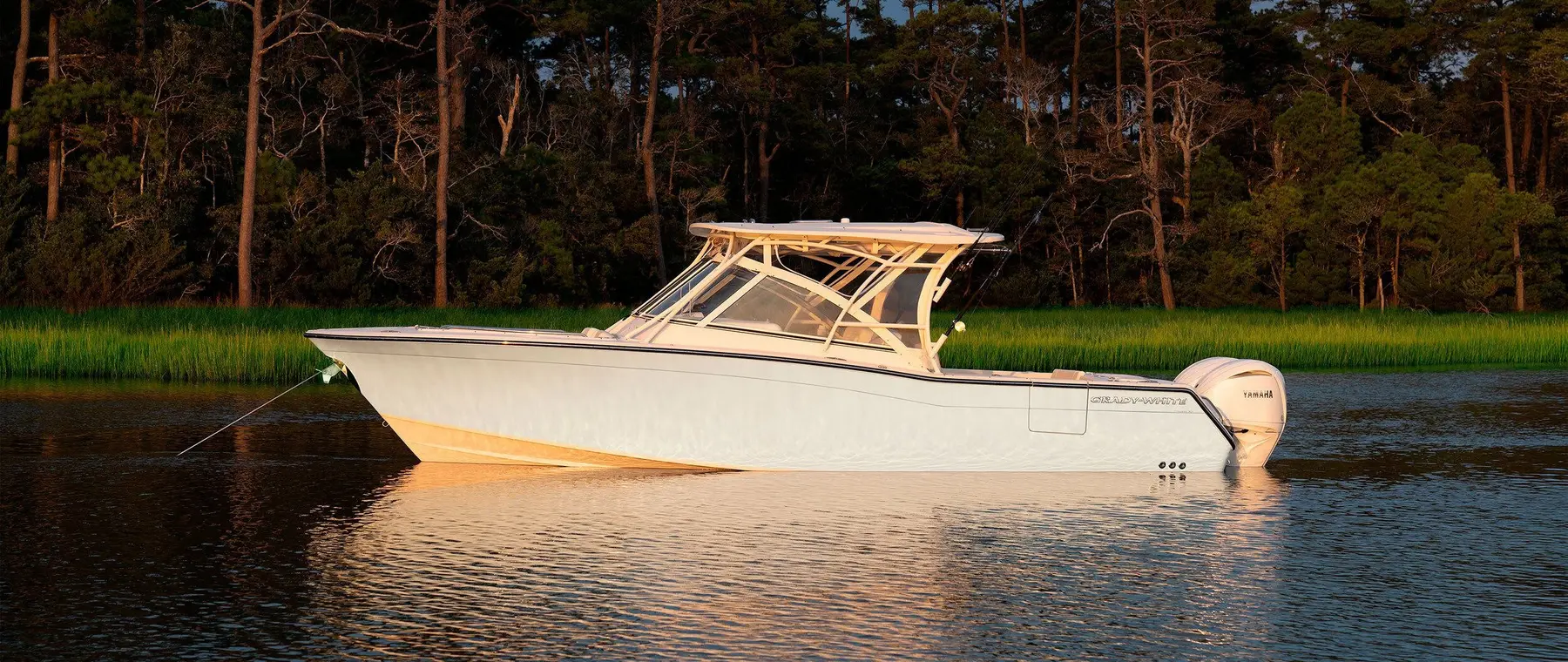
A dual-console with room to do more than fish
The Grady-White Freedom 307 is a useful example of how a dual-console can serve a family whose plans vary from week to week. A trip may begin with a run to a fishing mark, shift to swimming or a relaxed lunch, and finish with a sheltered ride home. Such mixed use demands more than a pair of comfortable helm seats. The cockpit must be workable, the walkways must be clear and storage needs to remain accessible after the day’s equipment comes aboard.
Grady-White presents the Freedom 307 as a 30-foot dual-console intended for fishing, cruising and entertaining, with a console head and sink plus a wet bar. Those features affect the boat’s practical appeal because they extend the time guests can comfortably remain away from a marina. A prospective buyer should nevertheless assess every compartment in person. The arrangement that makes sense on a website may feel very different when fishing rods, a cooler, family bags and several passengers all occupy the deck.
Length, beam and the meaning of the measurements
The current builder model page gives a centreline length without engines of 30 feet 6 inches, equivalent to about 9.30 metres, with a beam amidships of 10 feet 7 inches or roughly 3.23 metres. It also quotes maximum horsepower of 700. Those are useful starting figures, not a substitute for a complete specification of the particular boat being considered. Engine installation, equipment, loading and model-year changes all influence the final dimensions and the way the boat behaves.
The beam promises a broader working platform than a narrow trailerable runabout, but it also creates transport and berth-planning questions. Buyers who expect to move the boat overland should investigate local width restrictions and the exact trailer specification before making a purchase. For a marina-based owner, check the beam against the berth, fender allowance and access alongside neighbouring vessels. These routine considerations are not glamorous, yet they determine how straightforward ownership feels long after the first sea trial.
A hull designed around exposed-water use
Grady-White highlights its SeaV² hull design and identifies a 19.5-degree transom deadrise progression on the Freedom 307. The builder also quotes a hull draft of 22 inches, or about 0.56 metres, but the precise operating draft needs to be considered alongside motors, loading and manoeuvring conditions. Hull geometry matters when a boat has to cross short, choppy coastal seas while carrying passengers who would prefer a quiet conversation to repeated jolts.
A sea trial is essential because ride comfort is not a guaranteed property of a single deadrise number or marketing phrase. Ask to drive the boat at realistic cruising speeds, in turns and across the sort of water expected in ordinary use. Observe spray, trim response, helm visibility and the way the bow meets a wake. Test with a practical load where possible, since a nearly empty demonstration craft may reveal less about the ownership experience than a boat carrying its normal cruising party.
Comfort features that matter on an ordinary day
The enclosed console accommodation containing a head and sink can make the difference between a short excursion and a comfortable full day. A wet bar similarly reduces dependence on a nearby restaurant or marina facility, although it is worth checking actual water capacity, drainage and refrigeration specifications for the chosen configuration. Equally important is how easily passengers move between the bow seating and aft cockpit when the boat is underway rather than at the dock.
Pay attention to shade as carefully as to upholstery. A hardtop may protect the helm without covering every social seat, and the usefulness of cockpit shade depends on sun angle and cruising direction. Try sitting in each intended position, not only at the wheel, and examine grab handles and foot support when the deck moves. The Freedom 307 may promise the combination of fishing and entertaining, but the right owner should establish which of those functions the family will use most often.
Fishing layout versus a social cockpit
A dual-console is often attractive because it avoids the feeling that every surface exists solely for fishing gear. That trade-off still needs to be inspected. Ask where rods, tackle, bait and a landing net can be stowed without obstructing a passenger stepping aboard. Check which seats fold away and where an angler can stand securely while another guest moves through the cockpit. The best multipurpose layouts make their transitions obvious and quick.
For swimming and watersports, look at boarding from the water and the practical route to towels and drinks afterward. A crowded stern is particularly challenging when several guests return from the sea at once. Owners should also check the placement of livewell, fish boxes or other fishing amenities against their own habits rather than relying on a generic inventory. A feature that sounds impressive in isolation is less valuable if accessing it requires moving people and loose equipment every time.
The buyer’s checklist
Start with the builder’s current specifications, then request the equipment list and loading information for the exact model year and engine installation. Compare the physical boat with the family’s intended use and available storage arrangements. If fishing is important, bring the people who will use the cockpit. If family cruising matters more, have everyone test the seating, boarding and washroom access. A useful assessment should cover ease of cleaning and service access as well as the visible upholstery.
Finally, drive the Freedom 307 in representative conditions and budget for its real operating environment: fuel, marina fees, maintenance, electronics and safety gear. The 700-horsepower maximum is an engineering limit rather than a recommendation to fit the greatest possible output. What matters is the combination of power, loading, handling and owner priorities. With that discipline, the dual-console format can offer genuine versatility instead of simply compiling a long list of features that rarely get used.