
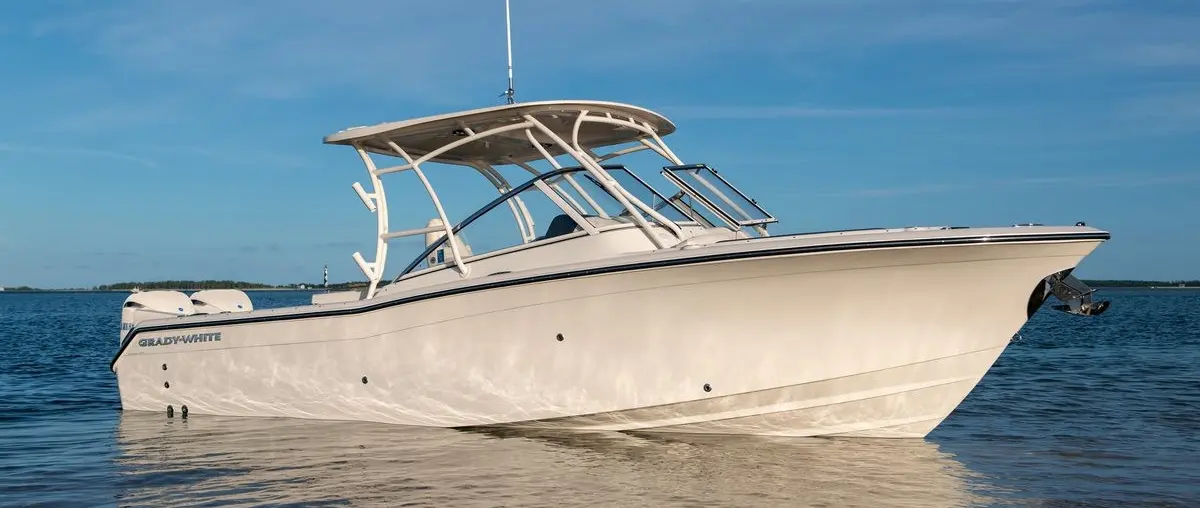
A dual-console built around a mixed itinerary
The Freedom 275 illustrates why the dual-console format remains attractive to owners who use a boat for more than one purpose. Grady-White puts an enclosed helm to starboard and a separate port console around an open passage to the bow, so the crew can move between seating areas without threading through a fishing-focused centre console. That arrangement matters most when family cruising, swimming and angling are all expected on the same day.
At 26 feet 11 inches (8.20 metres) in stated centreline length and 8 feet 6 inches (2.59 metres) in beam, the boat occupies a manageable size category while still offering distinct gathering zones. The beam also remains a consideration for trailering and berth selection, which an owner should confirm against local road regulations and the actual transport configuration. Neither the nominal length nor a marketing photograph substitutes for checking the full rig dimensions.
The aft cockpit carries folding seating that can free working space, while cushioned bow seats offer a quieter place to sit during slower passages or at anchor. An available bow table can also be used farther aft, according to the manufacturer. The significance is practical flexibility: crew are not committed to a fixed lounge arrangement during an entire outing, and the layout can change as the day develops.
Hull, power and how to read the numbers
Grady-White builds the Freedom 275 around its SeaV2 hull, describing a variable-deadrise arrangement intended to balance ride comfort and control. The builder lists 19 degrees of transom deadrise, a 20-inch hull draft and a maximum rating of 400 horsepower. These numbers are useful starting points, but sea-state comfort depends on trim, loading, speed and the operator, none of which can be established by the specification sheet alone.
The listed twin Yamaha 200 four-stroke configuration reaches the published maximum rating. Grady-White also provides performance data recorded under named test conditions, including load, engine and propeller information; prospective buyers should read those conditions before comparing speeds or fuel burn with another boat. Actual figures can differ with bottom condition, weather, additional equipment and the total weight carried aboard.
Standard fuel capacity is quoted at 184 US gallons, or approximately 696 litres, giving the owner a substantial planning reserve for coastal use. Endurance nevertheless needs to be calculated from a conservative real-world burn rate and a deliberate fuel margin, rather than from a maximum range claim. For owners who alternate short harbour visits and longer offshore runs, a written fuel plan is a more useful decision tool than a headline top speed.
Fishing equipment remains central
The cockpit is not merely a leisure lounge with a rod holder added afterward. The manufacturer specifies a 32-gallon livewell, an insulated 185-quart aft fish or ice box and an additional 88-quart insulated starboard box. Those separate capacities let an owner organise bait, catch and cold storage without asking one compartment to do every job. Drainage, pump maintenance and access should still be checked in person.
Grady-White lists cockpit and transom rod holders, horizontal rod-storage racks and a pressurised raw-water washdown. Foldaway aft seating is particularly helpful when a pair of anglers needs space to move across the transom while a fish is being brought aboard. As on any family boat, hooks, tackle and working lines need a secure stowage routine before guests move around the cockpit.
The builder also provides an optional outrigger package, making the boat relevant to owners who want more elaborate trolling arrangements without abandoning the dual-console concept. Whether that option is justified depends on the waters fished, the number of regular crew and how frequently the boat is used for serious angling. An unused specialist fitting is still equipment that needs inspection, cleaning and eventual service.
The comforts that broaden its appeal
The port console incorporates a lockable head compartment with an electric-flush marine toilet, mirror and storage, a notably useful amenity during a long day with family or guests. The walk-through windscreen and windbreak door help define a more sheltered central area when conditions cool. Neither feature turns an open boat into an all-weather cruiser, but both extend the circumstances in which guests may be comfortable.
A wet bar with sink, drawers and a refuse compartment supports simple drinks and snacks without requiring a full galley. The boat also carries a 20-gallon freshwater tank and cockpit shower, useful when children return from swimming or the crew needs to rinse salt from hands. Owners planning extended use should think realistically about water consumption and the relatively small tank capacity.
The broad appeal lies in the transitions between activities: a bow lounge in the morning, a swim stop at midday and an uncluttered aft cockpit for an afternoon of fishing. The passageways, high-use fittings and foot positions deserve as much attention during a viewing as the upholstery finish. A layout is successful when guests can move safely and crew can restore the boat quickly between different uses.
Electronics, options and real ownership decisions
A flush-mount electronics area at the helm gives an installer room to plan navigation equipment, while the builder lists hydraulic trim tabs and twin-engine battery arrangements. As technology packages vary, buyers should seek the exact helm inventory for the boat they are purchasing rather than assume that photographed screens form part of the standard specification. A clear electrical schematic and service records have lasting value.
Optional features include electric cockpit shade arrangements, an adjustable helm bench with alternative wet-bar specification and Yamaha manoeuvring technology, with package dependencies described by Grady-White. The right configuration is the one that serves a defined usage pattern. Shade may be more valuable to an owner who hosts at anchor, while a more advanced handling package may appeal where tight berths and frequent docking are routine.
Before ordering, the buyer should consider dry storage versus marina berth, engine-service access, freshwater supply, safety equipment, trailer suitability and whether the boat will be operated mainly in sheltered bays or exposed coastal waters. The Freedom 275 offers several credible answers, but they must be matched to an actual home port and crew. Equipment selection is best confirmed with the builder or authorised dealer.
The buying conclusion
Viewed as a whole, the Freedom 275 is a strong example of a boat intended to avoid the hard division between a fishing platform and a family dayboat. Its measurable strengths are the dual-console circulation, a defined head compartment, serious fish and livewell storage and the flexibility of its aft seating. Those are features a buyer can inspect and test rather than lifestyle promises that cannot be verified.
The trade-offs should be considered just as carefully. Open bow seating places passengers closer to weather, the cabin facilities are compact, and a twin-engine installation carries two power units to service. Owners seeking overnight accommodation or extended protection may be better served by a different style of vessel, whereas owners who return to port after active day trips may find the compromise particularly sensible.
All specifications and equipment described here are based on Grady-White's published Freedom 275 materials; fittings and packages may differ by model year and market. A sea trial with a representative load, a clear written specification and a service-access inspection are the final checks. For an owner who values both fishing credibility and guest comfort, those checks will reveal whether the boat fits the way it will actually be used.