
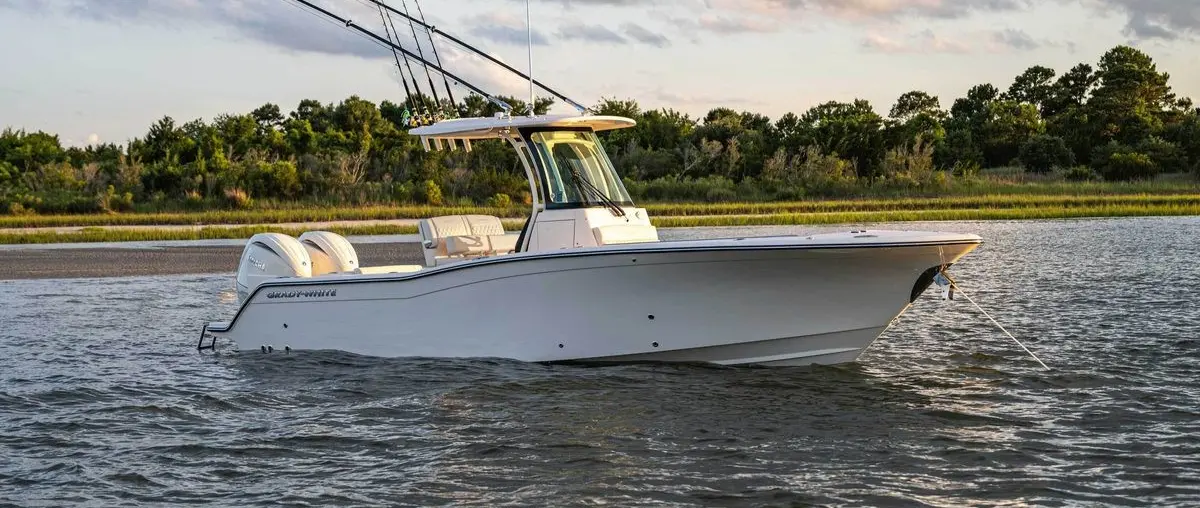
Grady-White's new 26-foot centre console
The Grady-White Canyon 266 brings a fresh specification to the American builder's offshore centre-console range. Marketed within its 2027 model lineup, the new design aims to place equipment commonly associated with larger fishing boats into a 26-foot hull while retaining practical comforts for family day cruising. The result is not a pure racing or expedition craft, but a versatile outboard-powered platform for owners who routinely mix fishing, coastal trips and time at anchor.
The manufacturer's latest page describes the Canyon 266 as an all-new model, with a nine-foot beam and maximum engine rating of 600 horsepower. That puts it in an interesting size band between smaller trailer-oriented runabouts and the more substantial sportfishing centre consoles that require extensive marina infrastructure. As always, the headline length alone is insufficient for planning a berth or launch arrangement.
Overall length, draft and displacement
Grady-White gives a centreline length of 26 feet excluding swim platforms and engines, and an overall length of 27 feet 7 inches including swim platforms. The stated hull draft is 22 inches and the cockpit depth is 26 inches, useful measures when evaluating where the boat can operate and how secure its working deck feels. Actual water clearance and loaded dimensions must be confirmed on the chosen equipment configuration.
According to the builder, the hull weighs 5,750 pounds without engines and uses a 20-degree transom deadrise within the firm's SeaV2 hull system. The manufacturer claims the combination is designed to manage offshore conditions while supporting family comfort. However, the weight of twin outboards, full tanks, tackle and people can change the operating feel considerably, so comparisons should always be made with realistic load estimates.
Large-boat details in the fishing cockpit
The list of standard features includes a deluxe leaning-bar arrangement with split flip-up bolsters, folding armrests, tackle storage, rod holders and an integrated 31-gallon insulated raw-water livewell. A further 15.5-gallon aft livewell is also specified. Together, these arrangements show that bait care and equipment access were design priorities rather than accessories added after the deck had been drawn.
Fish storage also gets serious attention. Grady-White details two 60-quart insulated forward fish boxes and an aft 167-quart insulated compartment, with overboard drainage specified for those spaces. Rod holders and horizontal racks are placed around the cockpit for different types of tackle. A buyer who fishes with several companions should nevertheless check that the particular pattern of tackle and coolers carried fits without blocking walkways.
A cockpit side door makes boarding easier
The Canyon 266 includes a cockpit side door with a boarding ladder, a feature increasingly valued by anglers, divers and families alike. Side access can help with dockside boarding and with returning to the boat from the water, especially where a high stern or crowded outboard installation makes traditional entry awkward. The model also lists a transom door and swim or dockside boarding platforms.
These openings should be assessed in the context of normal boat use. The best place to board changes with dock height, tide and mooring direction, while a removable ladder has to be accessible when needed. Operators should learn the proper closing and securing procedures for doors before heading offshore. Good design provides options, but each opening remains an item for careful seamanship and routine inspection.
Bow seating and a convertible working deck
Grady-White has specified cushioned seating along the port and starboard sides of the bow, including electromechanically adjustable backrests. A casting-platform insert with a cushion also appears in the model's feature presentation, allowing the forward area to change character when fishing activity gives way to relaxing. The helm console includes a moulded forward lounger with a backrest and a large divided cooler compartment below.
That combination gives the boat two distinct identities over the course of a day. Seating and cushions suit a leisurely passage or picnic, while anglers may prefer an unobstructed forward platform. Buyers should check how the inserts are fitted and removed, how wet cushions are stored and what footholds are available if the crew fish from the forward deck while the boat moves in a swell.
More amenities inside the console
The maker's illustrated features include a lockable console compartment with a marine head, sink and indirect lighting. On a day boat used by a family or mixed group, a private enclosed facility can expand how long guests are comfortable remaining aboard. There is also a practical benefit to being able to wash hands and deal with equipment during a day that combines fishing with eating and swimming.
The actual usable size and access to that compartment are best confirmed in person. Storage, plumbing, ventilation and service panels compete for space inside a centre-console structure, and photographs cannot show the full reality of moving within it. Someone who values the head as a major purchase criterion should enter the compartment at a show or dealership rather than relying on a specification line.
Engine choices and genuine manufacturer test data
The published maximum rating of 600 horsepower permits twin outboard configurations up to the specified limit. Grady-White's own performance information includes a twin Yamaha 200-horsepower test recorded on 1 June 2026 and a separate twin Yamaha 300-horsepower test on 13 August 2026. These are builder-generated trials under defined conditions, not promises that every completed boat will achieve precisely the same results.
In the twin-300 test, the manufacturer reports an optimum cruise point of 30.6 miles per hour at 3,400 rpm, with 14.4 gallons per hour consumption under the stated test load. That illustrates one possible cruising setup but does not determine individual range or efficiency. Propellers, equipment, hull finish, water conditions and load change those outcomes; a buyer should obtain the complete performance bulletin corresponding to the actual engine and propeller package ordered.
A 150-gallon fuel tank demands realistic passage planning
Fuel capacity is listed at 150 US gallons, approximately 568 litres. The capacity, combined with twin outboards, will interest owners who plan longer offshore fishing runs but do not need a dedicated overnight cruiser. Still, carrying fuel and having a responsible operating range are different matters. Offshore planning requires allowance for return passages against weather and current, manoeuvring time, and a reserve that reflects the crew's risk tolerance and local guidance.
Owners comparing the 266 with smaller centre consoles should examine not only a claimed fuel-economy figure but also the day-to-day costs of the chosen power package. Two engines mean separate servicing requirements, mounting arrangements and potential insurance implications. The value can include handling redundancy and power choice, but it should be measured against the owner's real operating area and how often longer trips will occur.
A useful alternative for mixed fishing and family days
A foldaway aft bench seat is another way the Canyon 266 adapts to changing demands. Stowed, it helps return useful working room to the stern; deployed, it accommodates guests during a relaxed run or when the boat is stationary. The combination of a centre console, extensive fishing storage and flexible seating makes the design especially relevant to a household where one member prioritises fishing and others enjoy coastal cruising.
Versatility is only useful when the transition between activities is straightforward. A buyer should try the folding seat, open the large locker lids and imagine moving around the cockpit with several people aboard. This is also the moment to examine whether shade, electronics, anchoring equipment and onboard power are standard or costed options. A well-specified demonstration boat may include equipment that is absent from an entry-level quotation.
Questions to take to the dealer
The Canyon 266 makes a persuasive case through its detailed fishing arrangement, 26-foot hull size and provision for passengers away from the rods. It carries a wider range of uses than the term centre console alone might suggest. Whether those features justify the price for an individual owner depends on the quality of their local boating waters, storage situation, crew size and preferred fishing methods.
Grady-White's official Canyon 266 model specification and builder performance tables are the starting points for independent assessment. Ask the dealer for a written list of standard and optional equipment, clarify any specification changes during the new-model rollout, and arrange an on-water demonstration with the intended normal load. The central lesson is familiar: genuine ownership fit matters as much as a detailed features list.