
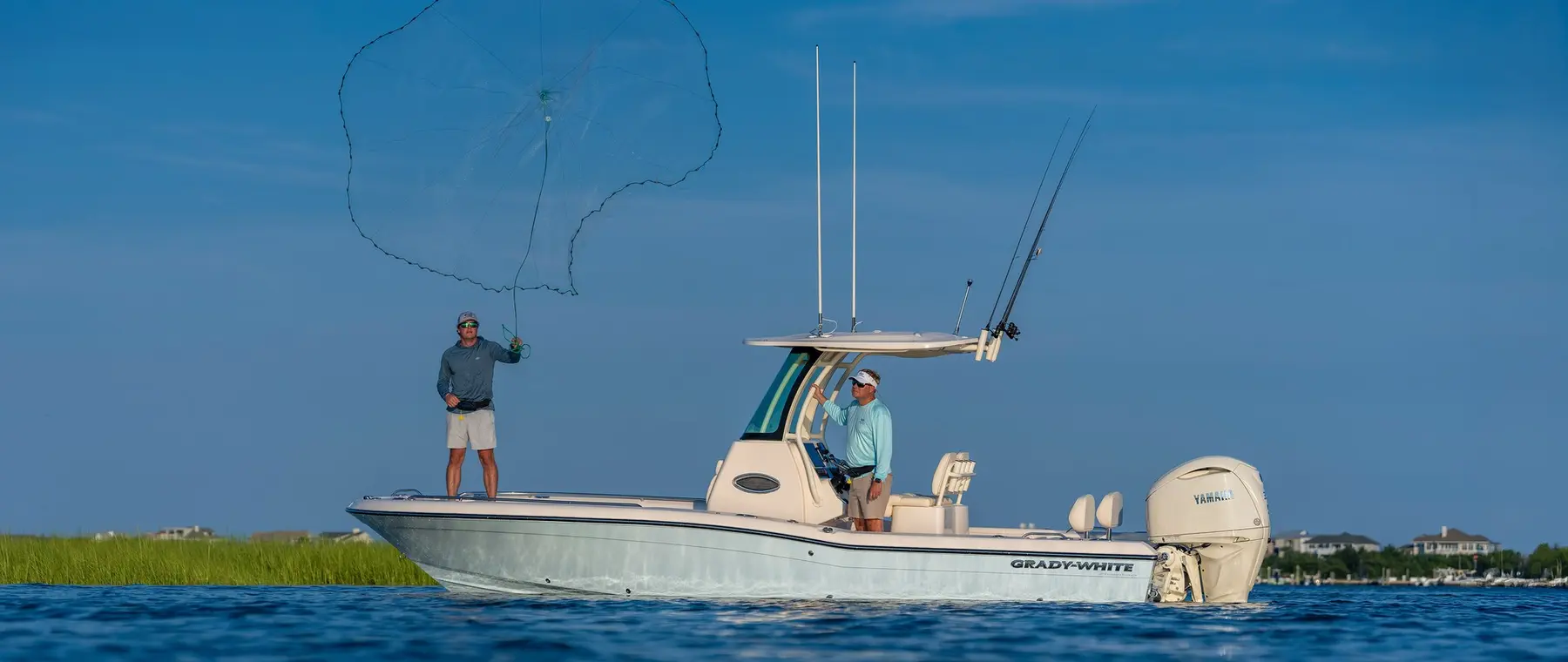
A centre console with two distinct jobs
Grady-White's 251 Coastal Explorer is built for people who want serious fishing equipment without making every family outing feel like a working tournament day. The 25-foot-class centre console has a casting-friendly forward deck, dedicated livewells and fishing storage, but also cushioned seating and access to the water. The design tries to connect two uses that often compete for deck space: anglers need clear working room, while family members want secure seats and convenient boarding.
The manufacturer presents the 251 CE as comfortable in inshore areas while having the capacity for offshore excursions when conditions permit. Its SeaV2 hull design is a longstanding part of the builder's identity. That brand claim should not be confused with a guarantee that any operator can venture offshore safely in any weather. Crew experience, local forecast, range and appropriate safety equipment should always determine how far a recreational boat travels.
Dimensions and equipment that matter
The official specifications list a centreline length of 24 feet 7 inches, equivalent to about 7.49 metres, and a beam of 8 feet 6 inches, or 2.59 metres. Maximum engine power is 350 horsepower, and the standard fuel capacity is 78 US gallons, approximately 295 litres. The published hull weight excluding engines is 4,050 pounds. These numbers matter when comparing trailer arrangements, marina berths and total ready-to-run weight.
A buyer should not assume that the bare hull weight represents the load on a trailer or the mass a tow vehicle must manage. Engine, fuel, batteries, fishing equipment, water and passengers can add substantially to the actual figure. The boat's relatively compact beam is useful for access, but local trailer regulations and any required permits still need to be checked. Grady-White's detailed equipment list is a good starting point for asking a dealer about the weight of a fully specified boat.
A useful new reference from the Yamaha 350
Grady-White's current product page includes a performance test dated 13 August 2026 using a single Yamaha 350-horsepower four-stroke outboard. In that test, the builder reports a top speed of 52.3 miles per hour at 6,100 rpm. It identifies an optimum cruise of 28.3 miles per hour at 3,500 rpm, consuming 8.2 US gallons per hour. The corresponding published economy is 3.45 miles per gallon under the stated test conditions.
Those numbers are specific builder measurements, not an independently replicated sea trial or a prediction of what every buyer will achieve. The manufacturer's test boat weighed 6,014 pounds including people, fluids, engine and equipment, so a differently loaded 251 CE may perform differently. Even the stated optimum cruise is a selected test point rather than a universal recommendation for every sea state. Owners planning a fishing run should use real consumption, weather allowances and appropriate fuel reserves.
How the working cockpit is organised
The 251 CE gives anglers several dedicated areas for storing and handling catch. Grady-White lists insulated fish boxes in the bow and two different livewell capacities, including a 25-gallon unit incorporated within the deluxe leaning-bar arrangement. Vertical and horizontal rod storage helps keep equipment away from moving passengers. That sort of organisation has practical value because a crowded cockpit becomes more difficult to use and less safe when loose gear is underfoot.
An aft bench with walk-through backrest sections makes the rear deck adaptable, while forward seating can offer a comfortable place for non-fishing companions. The boat also has aft and bow ladder arrangements in its official equipment description, useful for swimming or beach access when conditions are suitable. Buyers should physically test access around the transom and engine rather than rely only on plan drawings. The most versatile layout is the one that remains easy to navigate with people and gear aboard.
Comfort does not require a full cabin
Although the 251 CE is not presented as an overnight cruiser with dedicated sleeping cabins, the console provides a private enclosed area with space for a portable head. That is a meaningful convenience on a family day out, especially when a marina or shore facility is not nearby. The helm's leaning-bar seating and available electronics area also support trips that last considerably longer than a quick run to a beach.
The limitations should be equally clear. Storage, shade, drinking water and safe passenger seating need thought during an extended day at sea, and the boat is not a substitute for a cabin cruiser with beds and a galley. Families should inspect the actual hardtop and weather-protection choices, plus the locations of handholds and non-slip surfaces. What matters is not the number of amenities in a brochure but how well each one helps the boat's intended use.
Who benefits from the 251 CE
Grady-White's strongest proposition is a boating routine that mixes angling with ordinary coastal leisure. One morning might involve live bait and a serious early start, while the next could be spent cruising a sheltered bay with friends. The ability to reconfigure seating and access equipment allows those different activities to coexist. Buyers who never fish may prefer a dayboat with more permanent lounging space, while specialist anglers may prioritise a less social cockpit.
The fresh 2026 Yamaha 350 results provide an especially useful basis for a disciplined comparison with other 25-foot-class boats, provided the load and conditions are kept in view. Confirm dealer specifications, engine rigging and current warranty terms before placing an order. The 251 CE is interesting because it does not require an owner to choose between a competent fishing platform and a pleasant family day on the water. It aims to do both within one manageable hull.
Explore our Grady-White Boats company profile and consult the official manufacturer specifications for current equipment and availability.