
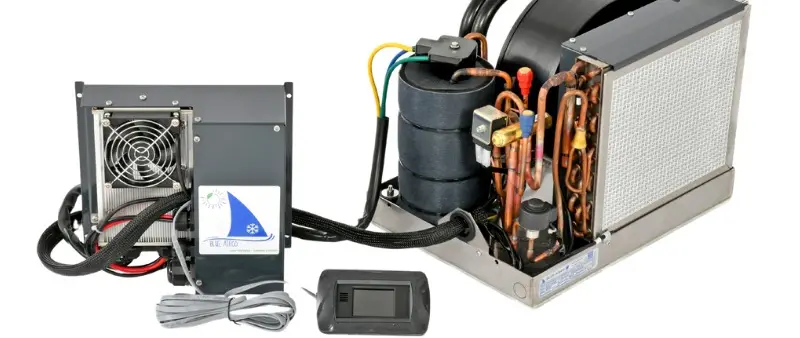
Blue-Airco is part of Gineico's Melbourne debut
Gineico Marine introduced visitors at the 2026 Melbourne Boat Show to three product families, including Blue-Airco low-voltage air conditioning. The Australian distributor's October announcement placed its first Melbourne exhibit at Stand 150 in Docklands from 15 to 18 October, alongside Quick Gyro stabilisers and SMARTDOCK monitoring. With the event completed, the product demonstrations provide a useful starting point for examining how smaller vessels can manage onboard comfort without relying on constant generator use.
The Blue-Airco system is manufactured in Italy and is offered for boats with 12-, 24- or 48-volt direct-current electrical networks. Gineico describes a compact, self-contained design that supplies cooling and heat-pump operation, with variable-speed control to match demand. Those design features can be relevant to both refits and new builds, but every installation still depends on how much energy a vessel can store and supply.
Why DC-powered air conditioning matters
Conventional marine air-conditioning systems commonly use alternating current supplied by shore power, an inverter or a generator. A low-voltage direct-current unit can instead use compatible battery banks without first converting the electrical supply to AC. That may reduce some conversion losses and allow a boat at anchor to cool a cabin without immediately starting an auxiliary generator. The manufacturer stresses that the entire electrical system must be sized correctly.
The benefit should not be interpreted as free cooling or indefinite generator-free operation. Compressors, seawater pumps and fans all consume energy, and battery capacity is finite. The useful measure is how long a particular installation can sustain acceptable temperatures under realistic summer conditions while retaining enough reserve for essential systems. Owners considering an upgrade need a complete electrical-load calculation rather than a brochure claim taken in isolation.
Three electrical voltages for different boats
Blue-Airco provides versions for 12-, 24- and 48-volt DC installations. A smaller recreational boat may already have a 12-volt electrical system, while larger cruisers increasingly use 24 or 48 volts for higher loads. The supplier's selection of voltages allows installers to specify a unit matched to an existing battery architecture rather than assuming that every owner must replace the whole electrical system.
Voltage selection has implications for cable size, protection devices, current draw and compatibility with charging equipment. At the same power level, raising the system voltage reduces the current required, which can make some high-load installations easier to accommodate. However, the final design must still account for cable runs, connections, heat, battery-management limits and the relevant marine electrical standards. Qualified installation is especially important when working around seawater.
Variable-speed operation and ECO mode
The manufacturer describes variable-speed compressors and fans that respond to the cooling requirement instead of operating only at full load. The Blue-Airco ECO function is intended to reduce consumption during extended use, including overnight cabin cooling. Gineico also highlights a titanium seawater heat exchanger chosen for corrosion resistance, reflecting the demanding conditions in which cooling equipment must operate aboard boats.
For an owner, quieter running and fewer disruptive starts can be as significant as any energy saving. But perceived noise depends on mounting, airflow and pump placement as well as compressor design. A system that is efficient in a controlled test may draw more power in a hot, humid cabin with doors frequently opened. The cooling-load survey should include insulation, glazed area, seawater temperature and the typical number of people onboard.
What the capacity figures mean
Gineico's October product notice describes compact systems with nominal cooling capacities extending to about 18,200 British thermal units per hour. That is a measure of heat-removal capacity, not electricity consumed. The manufacturer's detailed model tables distinguish cooling capacity from the watts and amperes drawn under specified conditions, which is important when planning a battery-backed installation.
The BTU rating alone cannot determine whether a unit suits a particular cabin. A heavily glazed saloon may require more cooling than a smaller shaded space, even when both have similar floor areas. Vessel use also changes the demands: daytime running under direct sun differs from nighttime use at anchor. An installer should determine the thermal requirement first, then match the selected equipment and power system to it.
Refits need more than a space measurement
A self-contained air-conditioning unit needs appropriate space, ventilation paths, condensate management and connections to seawater cooling. The fact that a product can be supplied at the correct voltage does not guarantee that it will fit behind existing furniture. Gineico offers integration guidance and commissioning information for marine retrofit work, underlining the need to assess mechanical and electrical systems together.
Boat owners considering replacement should ask about access for filter cleaning, pump maintenance and any future repair. The effects of noise and vibration on sleeping areas also deserve attention. Electrical protection, seawater strainers, safe hose routing and the location of discharge fittings can have greater practical consequences than the appearance of the control panel. Good installation is a matter of long-term reliability, not simply successful start-up.
Quick Gyro and SMARTDOCK widen the display
Gineico also presented Quick Gyro stabilisation and SMARTDOCK remote-monitoring products in Melbourne. These address quite different concerns from cabin temperature: controlling unwanted roll and making selected onboard status information easier to inspect. Showing the products together reflected the distributor's broader approach to supplying boatbuilders, refit yards and owners with equipment that can improve comfort and awareness aboard.
It would be misleading to assume that adding one system automatically integrates it with every other system. An owner evaluating several upgrades should check power availability, installation space, network interfaces and service responsibilities for each item. The combination may offer useful conveniences, but the vessel's existing electrical and mechanical architecture should determine what can be installed sensibly.
Questions before specifying low-voltage cooling
The Melbourne announcement gives owners a reason to examine direct-current cooling, but a sound purchase decision begins with a cabin heat-load calculation and an energy budget. A dealer should explain the performance of the selected model at realistic seawater and air temperatures, the continuous power consumption and the charging capacity needed during a normal day or night. Product literature should also identify protection devices and maintenance requirements.
Gineico's first Melbourne appearance has now concluded, but its technical material and distribution network remain available for prospective customers. For leisure boaters, low-voltage variable-speed air conditioning is one more way of arranging onboard comfort. Whether it is the right solution depends on vessel size, electrical design, intended operating pattern and verified installation costs rather than the promise of effortless generator-free cooling.