
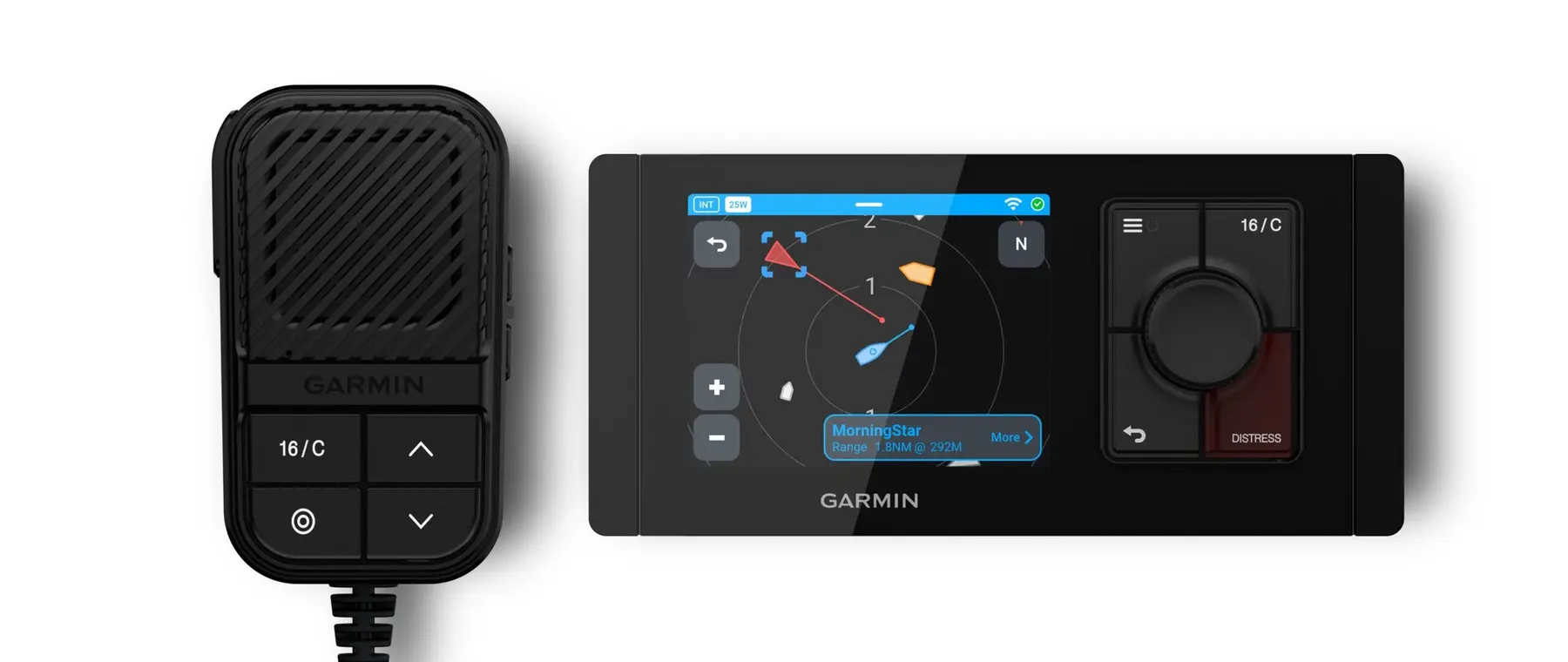
Garmin's Signal VHF marine radio family has been recognised as one of three joint Overall Winners of the 2026 DAME Design Awards, announced during METSTRADE in Amsterdam on 17 November. Garmin confirmed the honour in a company statement dated 19 November, explaining that the system also won the Navigation and Communication category. The judges singled out its combination of voice radio, digital selective calling and, in the Signal VHF 400 version, integrated Class B AIS transmission and reception. For the owner of a compact cruising boat, the development is worth examining because communications equipment occupies valuable space at the helm and must remain practical under pressure. The award is an independent design assessment, not a guarantee that every installation will be appropriate for every boat.
An award with three overall winners
The DAME Design Awards marked their thirty-fifth anniversary in 2026. Organiser METSTRADE reported 153 entries, of which 74 reached the nominated-products stage. For the first time, the jury could not separate three leading entries and awarded joint overall honours to Garmin, Scanstrut and Teignbridge Propellers. The different winners illustrate how marine design can involve electronics, a removable navigation light or a more complex propeller system. Garmin's recognition therefore needs to be described accurately. It did not defeat every other product in a single ranking; it shared the overall award. For owners comparing equipment, the result is evidence that a specialist jury considered the design important, while actual suitability still depends on installation details.
The radio remains essential safety equipment
A fixed VHF radio is a fundamental part of many coastal boats. It can provide voice communication between vessels, harbours, marinas and maritime rescue services, subject to the channel and operating rules that apply in each country. It also offers an important means of contacting assistance when mobile telephone coverage is unreliable. The purchase decision should therefore begin with reliable reception, clear audio, accessible controls and compliant installation rather than visual design. Garmin's award highlights a different approach to packaging these functions, but the operator still needs the appropriate training and licence where required. A touchscreen cannot replace knowledge of distress procedures, correct channel selection or the judgment needed in an emergency.
A colour touchscreen changes the interface
Garmin describes a 3.5-inch colour touchscreen with edge-to-edge glass in the Signal range. On a small boat, that display may make certain settings easier to understand, particularly if information is arranged clearly. It also introduces questions that are familiar to any owner using touch-operated helm equipment. Can the controls be operated with wet fingers or gloves? How easy is the display to read in direct sunlight? Can essential functions still be reached quickly when the boat is moving? These are practical questions to examine during a demonstration. The design jury praised the integration, but buyers should not infer that a touchscreen will always be more usable than well-placed physical buttons in rough conditions.
The Signal VHF 400 adds a Class B AIS transponder
An important distinction within the family is that the Signal VHF 400 incorporates a Class B Automatic Identification System transponder. AIS is designed to broadcast and receive information about participating vessels and can improve situational awareness where signals are available and correctly interpreted. It should not be confused with radar or treated as an assurance that every other craft will appear on screen. Small boats without transmitting equipment, objects without AIS and vessels with incorrect data may not be represented as expected. Owners should also check the model configuration and local requirements before assuming that another member of the Signal family provides the same transmit capability.
One antenna can simplify a compact installation
Garmin says the Signal VHF 400 arrangement allows VHF voice, DSC and AIS communication through a single VHF antenna. This may help reduce the complexity of installing separate devices on a boat with limited space and relatively few suitable mounting positions. The advantage should not be interpreted as permission to connect arbitrary antennas or omit the proper cabling and testing. Antenna placement, grounding where applicable, cable condition and the manufacturer's instructions remain essential to system performance. An installation professional should consider the complete radio-frequency environment, particularly on a small boat where lights, aerials and equipment are grouped closely together. The system's integration is most useful when the finished installation is compliant and serviceable.
Digital selective calling depends on proper setup
Digital selective calling, or DSC, allows suitably equipped radios to transmit digitally encoded calls, including distress alerts in appropriate circumstances. This is valuable only when the radio has been configured correctly with the vessel's required maritime identity and, where needed, accurate position data. Owners should follow national rules concerning MMSI registration and licensing. It is not enough to switch on a new screen and assume the emergency functions are operational. Installer handover should include checking the intended operating channels, distress-button protection and the connection to any necessary navigation data. A responsible supplier will explain how to test the equipment without issuing a false distress call.
The remote station can serve a second helm
Garmin also describes compatibility with the Signal RM 100 remote station, intended to provide control from another location such as a flybridge or secondary helm. Some boats under twelve metres have a second steering position, while others may benefit from a radio handset positioned closer to where the skipper operates. The actual value depends on the boat's layout. A single-station open runabout will have different requirements from a small cabin cruiser. The jury noted that the radio and remote share similar styling and control logic, but the buyer should check cable routing, network compatibility and what equipment is required for the second station. A system should be selected around operational needs rather than the prospect of adding another screen.
Recent transmissions can be revisited
The DAME jury highlighted the facility to recall the last three minutes of a transmission. On a busy channel, the ability to replay something that was difficult to hear could be useful, especially when engine noise, wind or another task interrupted the operator. It is still not an acceptable substitute for confirming critical instructions with the sender. An unclear position report or navigation warning should be clarified directly when possible. Crew should also understand that recorded audio is only as reliable as the original reception. The feature may assist communication, but it cannot correct a weak signal, a misunderstood channel or an incomplete message.
Networked data can be useful but needs restraint
The organiser's technical description refers to NMEA integration and Wi-Fi connectivity with Garmin's ActiveCaptain app, including some remote configuration functions. Networking may reduce the number of separate controls and make equipment easier to manage, but it introduces compatibility and maintenance questions. Owners should establish which messages and functions are actually supported and what happens if a network connection fails. Critical radio operation must remain understandable when a phone battery is flat or a Wi-Fi link is unavailable. Software updates should be made according to the manufacturer's guidance and at a suitable time, not immediately before a demanding passage without checking the result.
A compact boat has special installation constraints
A leisure boat below twelve metres can have limited console space, relatively shallow cable routes and a busy electrical system. A multifunction VHF may therefore be attractive because it combines facilities that might otherwise require separate boxes. However, the electrical supply, fuse protection, speaker positioning and antenna run still need careful design. Equipment fitted too close to compass sensors or other electronics can create interference problems. A supplier should inspect the boat and identify where the display can be read without blocking instruments or access to important switches. The award-winning appearance of the device matters less than whether a skipper can operate it reliably while maintaining a lookout.
What the award does and does not establish
Garmin received a significant independent design award. The company has also cited recognition from other industry organisations during 2026. Awards provide information about how products are viewed by expert panels, but they do not automatically establish independent long-term reliability, universal compatibility or compliance in every jurisdiction. Buyers should request the exact model certification, installation documentation, warranty and current firmware information. In some markets, rules for AIS transmission and VHF licences differ. A product sold in one region may require a different approval or configuration elsewhere. An informed buyer should value the award without allowing it to replace the usual technical checks.
A different question for owners of older radios
The Signal family may interest an owner whose existing VHF is difficult to read or whose helm has grown crowded with separate communication devices. Replacement is not simply a matter of exchanging one front panel for another. The new equipment may require a different cut-out, electrical connection, antenna arrangement or data link to the boat's navigation system. A retrofit can also reveal outdated wiring that deserves attention in its own right. Before ordering, owners should measure the available space and compare the full installation cost, including any additional remote station, network components and labour. A modern radio can be a worthwhile improvement when it addresses a real operational need.
The value of a straightforward handover
A technician should leave the owner with more than a switched-on display. The handover should demonstrate routine voice operation, DSC configuration, the AIS presentation and any relevant audio or network settings. Crew who share helming duties should have the chance to learn the controls. A brief laminated operating reference may be more useful in a stressful situation than a long manual stored below deck. Owners should also understand how to use handheld VHF equipment if the fixed system loses power. Sensible redundancy is particularly important when cruising farther from sheltered waters, because even sophisticated electronics can become unavailable at an inconvenient moment.
A busy year for compact marine electronics
The 2026 METSTRADE results underline the role of practical design in the recreational marine industry. Communication equipment is evolving alongside navigation systems, power management and digital interfaces. Smaller boats can benefit from these changes when they reduce complexity and improve access to information, yet integration must not become a source of overconfidence. The award-winning features should encourage questions about the complete user experience: visibility, installation, training, maintenance and the ease of using essential controls in difficult circumstances. Boaters should resist the temptation to treat a helm as a collection of unrelated gadgets. An effective system is one that the crew understands and can operate under normal and adverse conditions.
Garmin's achievement in perspective
The Signal VHF family's joint Overall DAME win and its Navigation and Communication category honour are significant results for Garmin. The official statements identify the design features that impressed the jury, particularly the integration of radio, AIS and remote-station functions within a modern interface. For owners of sub-twelve-metre craft, the important next step is to assess whether those features fit the boat, the region and the crew's skill level. Buyers should not assume a quoted feature applies to every model or that an award removes the need for a competent installation. The lasting value of the technology will be measured in the everyday clarity of communication and in the ability to use it correctly when it matters most.
Official sources and photography
Reporting independently based on Original primary publisher announcement.
Original lead product photograph: Garmin Signal VHF 400 integrated AIS marine VHF radio and compatible Signal remote, manufacturer original editorial image. Original image rights remain with the source publisher and photographer. Official press-image source.
