
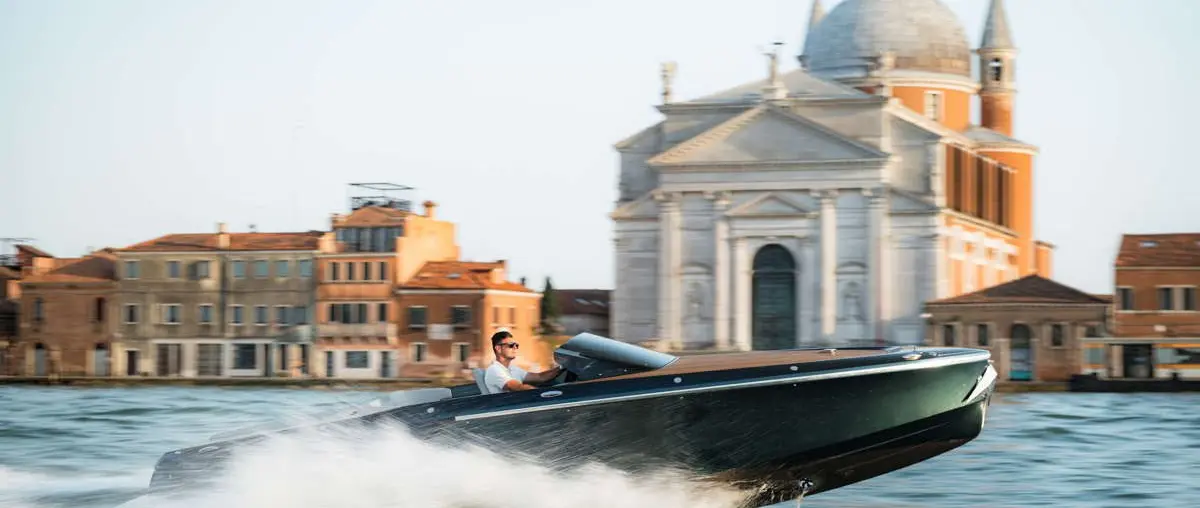
A new electric-boat winner in Berlin
The Frauscher x Porsche 790 Spectre has won Best Electric at the 2026 Best of Boats Awards, with the result announced during the 26 November ceremony in Berlin. The award organiser's winner entry identifies the 7.92-metre sports boat and explains the jury's emphasis on acceleration, usability, handling, craftsmanship and quiet electric operation. The outcome is a new international category award, separate from any earlier nominations or regional design recognition.
For owners considering electric dayboats, the result is important because it recognises a boat that is both compact and performance-focused. It does not establish that all electric propulsion systems are equivalent or that the winner is a suitable replacement for every combustion-powered vessel.
The boat is 7.92 metres long
The official award page lists the Frauscher x Porsche 790 Spectre at 7.92 metres. This places the model comfortably within the under-twelve-metre market and the range of small sports boats considered by Leisure Boat Guide. The size is relevant to the way a recreational owner might use the craft for short leisure outings.
Length is only the first dimension that matters. Beam, weight, battery location, loading and marina access affect day-to-day practicality. A boat with compact overall dimensions can still require specialised electrical and charging arrangements, and those should be assessed before a purchase or a berth agreement.
The category tests more than environmental language
The Best of Boats jury describes electric-boat evaluation as an exercise involving performance, reliability, user friendliness and sustainability considerations. That framing is broader than a marketing statement about the absence of an exhaust at the point of use. The organiser believes the Spectre combines those qualities in a compelling package.
An award is an editorial conclusion, not a full life-cycle environmental assessment. The sources do not quantify the impact of manufacturing the boat or batteries, and this article does not imply carbon neutrality. Owners who prioritise environmental performance can request additional verified information about electricity, battery lifecycle and materials.
Porsche technology meets Austrian boatbuilding
The Spectre was developed by Frauscher in collaboration with Porsche. The two brands bring different areas of expertise to the project, with the boatbuilder responsible for marine construction and design and the automotive company contributing the electric performance identity behind the concept.
Such a collaboration can be appealing, but a car brand's reputation cannot replace an assessment of marine reliability. Water, spray, continuous loads and service access create different challenges from road use. Buyers should ask which organisation provides technical support for each subsystem and how the warranties operate together.
The award record cites 51 knots
The Best of Boats winner entry states that the model reaches 51 knots. This is presented as evidence that the electric system can support a highly responsive performance boat. The result helps challenge the idea that electric propulsion must be limited to the slowest cruising speeds.
Nevertheless, a quoted top speed should never be confused with an appropriate sustained operating speed, and it does not determine practical range. Higher output draws substantial energy. The real journey length will vary with weather, load, acceleration and operating speed; a buyer should obtain manufacturer data for the intended use.
Instant response changes the driving character
The organiser's description praises immediate acceleration and responsiveness. Electric motors can deliver rapid torque changes, making the throttle feel different from some conventional engines. In a sports boat that is designed for engagement at the helm, the character of this response is a central part of the jury's positive assessment.
Fast throttle response also requires care near docks, swimming areas and other vessels. New owners should become familiar with controls at low speed under safe conditions rather than explore full power in crowded water. The award does not establish that fast acceleration is automatically beneficial in every manoeuvre.
Quietness is a meaningful amenity
The jury points to lower propulsion noise as a defining part of the onboard experience. Quiet travel at suitable speeds may make conversation and the sounds of a coastal environment more noticeable. This is a practical difference that some owners may value as much as the headline speed.
Quiet operation does not mean the vessel is silent. Wind, water against the hull, equipment and nearby traffic continue to create sound. It also remains important to maintain lookout procedures, since swimmers and other boaters may be less likely to hear an approaching electric craft.
The design seeks both sport and comfort
The winner profile connects performance to Frauscher's design and workmanship. A fast sports boat still needs to provide secure seating, workable deck circulation and a comfortable environment for passengers. The jury's decision suggests it valued these combined attributes rather than an isolated engineering statistic.
Those qualities are best examined on the actual hull. Buyers should inspect access to the helm, passenger protection, storage and safe movement while underway. A promotional photograph can demonstrate styling but cannot describe the motion of the boat in waves or the comfort of an individual seat.
A separate Austrian prize came earlier
Frauscher had previously announced recognition for its Porsche collaboration at the Austrian OÖ Handwerkspreis in 2026. That prize concerned craftsmanship. The new Berlin Best Electric award is a different result, with different judging priorities and a distinct organiser.
Keeping the chronology and the award names separate avoids turning several genuinely different distinctions into a misleading claim of one combined trophy. A boat may be recognised for its design, its production methods and its handling, but each award should be reported on the basis of the actual programme that issued it.
Charging infrastructure is part of ownership
Buying an electric sports boat requires a realistic plan for access to suitable electrical power. Charging arrangements, shore-side permissions, connection types and local service support all affect its usefulness. Even a very fast boat may not match a traditional petrol-powered dayboat's refuelling routine in every marina.
The organiser's winner summary does not provide a universal charging time or an infrastructure map. Owners should obtain the manufacturer's current battery and charging specifications and confirm them with the facilities they intend to use. An award cannot itself establish access to a charger.
Range needs a separate conversation
The difference between maximum performance and normal cruise is especially important in electric boating. A sports-boat headline may focus on the quickest run, while a practical owner asks how far the vessel travels with normal passengers and reserve energy. Those questions need official range curves and a realistic operating profile.
The public Best Electric entry does not supply a complete range table under different loads, so a fixed distance would be speculative. The responsible approach is to ask for verified manufacturer figures, understand the test conditions and allow suitable reserves for the actual voyage.
Maintenance changes rather than disappears
An electric driveline has different maintenance requirements from an internal-combustion engine, but boats retain hull, cooling, electrical, steering and safety systems that must be checked. Battery management and high-voltage components may require specialised skills and manufacturer-approved procedures.
Owners should not attempt high-voltage work without appropriate training and authorisation. They should learn how to secure the boat, isolate energy systems and report faults through recognised service routes. The jury's recognition for reliability should not be interpreted as a lifetime maintenance exemption.
The choice depends on where the boat is used
A compact electric sports boat may be compelling for day trips where suitable charging is available and the operating area is well understood. The same vessel may pose logistical questions for an owner accustomed to spontaneous long-distance trips or remote marinas with limited electrical supply.
A buyer can make a useful comparison by listing typical distances, number of guests, expected speeds, local charging options and the ability to service the model. The award helps identify a candidate, while that operating plan determines whether it works in practice.
The original photograph has a defined source
The article's image comes from the official Best of Boats 2026 winner page and was supplied as a first-party Frauscher x Porsche model photograph. It identifies the relevant sports boat, but it does not prove that a particular on-water photograph was taken during the Berlin award ceremony.
The image was checked against the photo originals already in the SYG, LYG and LBG archives with exact and perceptual comparisons. Copyright belongs to the originating boatbuilder and photographer, and no generated imagery or competitor publication photograph is used.
The confirmed Best Electric decision
The new verified fact is that the 7.92-metre Frauscher x Porsche 790 Spectre won the 2026 Best Electric category in Berlin on 26 November. The award organiser lists the model's 51-knot top-speed figure and explains the jury's positive assessment of acceleration, quietness, usability and craftsmanship.
The award does not confirm a new boat launch, a specific customer delivery, a public charging network or any guaranteed range. For small-boat owners, it is a timely recognition of an electric performance option that merits careful comparison with actual boating requirements.
Verified original news sources and image credits
Original independent news reporting based on the original responsible organisation or boatbuilder announcement, the corroborating official or independent record. Original first-party boat photographs used to illustrate the same verified craft are credited © Best of Boats Award and Frauscher Boats and the original photographers. Earlier manufacturer photos are not represented as 27 November 2026 event-day photos. No first-hand sea trial, price, sales availability or unreported result is claimed.