
An Austrian award for an electric sportsboat
Frauscher Bootswerft says its Frauscher x Porsche 790 Spectre has won first prize at the 2026 Upper Austrian Craftsmanship Awards, known locally as the OÖ Handwerkspreis. The announcement, issued on 4 November, credits the project built with Porsche and the integration of traditional boatbuilding with electric-drive engineering. This is recognition for a completed collaborative design, not the announcement of a new vessel delivery. The 790 Spectre is a compact recreational sportsboat rather than a superyacht, making it a clear fit for readers interested in craft below twelve metres.
The distinction matters because boat awards recognise different things. The craftsmanship prize is not an independently published range test or proof of the lowest operating cost. Frauscher describes how its hull, propulsion and weight distribution were developed together, and it presents the prize as validation of that approach. Owners can take the award as a reason to examine the design more closely while keeping separate questions about charging, usable range, maintenance and local service. Those details still determine whether an electric dayboat suits a particular berth and cruising pattern.
A 7.97-metre boat developed around its powertrain
Porsche's earlier description puts the 790 Spectre at 7.97 metres, an overall size that sits firmly inside the Leisure Boat Guide remit. The project differs from a conventional hull simply fitted with an electric motor after the fact. Its designers worked around the electrical architecture and mass distribution of Porsche Macan electric-drive technology, while Frauscher contributed the hull and marine construction. A road-vehicle drivetrain has to meet a very different environment at sea, and the manufacturer's account is about engineering the components into a marine system rather than bolting in an unchanged automotive unit.
In a boat of this size, batteries, cooling circuits and service access compete with passengers, storage, seating and freeboard. A heavy component placed poorly can change the trim, the speed at which the hull begins to plane and how the craft responds to chop. Good integration may help balance those compromises, but a public design statement cannot substitute for a test with a declared load and sea state. Buyers should ask for the certified capacity, actual boat weight, number of passengers and usable endurance under conditions close to their intended trips.
Monaco speed figure, properly understood
Frauscher also points to a 51.05-knot result for the 790 Spectre during the 2026 YCM Speed Record event in Monaco, equivalent to about 94.54 kilometres per hour. That is a noteworthy demonstration of electric performance for a leisure-sized boat. It does not establish a normal cruising speed or tell a prospective owner how long that pace can be sustained. Speed-run conditions, the state of battery charge, crew weight and water conditions need to be known before any wider performance comparison can be made.
A headline speed also says little about the practical day. Many buyers will spend more time moving through restricted-speed harbours, waiting at marinas or cruising at a comfortable pace than attempting a record. Electric drive can offer quiet manoeuvring and immediate control, but electrical consumption typically rises substantially at high sustained speed. It is more useful to compare distance and energy use at several realistic cruise settings than to project a race-run figure across an ordinary coastal outing. No universal cruising range should be inferred from the Monaco result alone.
Craftsmanship is not merely surface finish
The award's craftsmanship emphasis invites a broader look at the production process. On a small sportsboat, the best-finished upholstery cannot compensate for inaccessible electrical protection, poor drainage or an installation that is difficult to inspect. Frauscher's statement says the boat was constructed at its Ohlsdorf shipyard and that hull, powertrain and weight distribution were treated as one concept. The strongest practical interpretation of craftsmanship includes repeatable building tolerances, secure fittings, a coherent service plan and a boat that retains its designed characteristics under normal use.
Owners contemplating an electric boat should look behind the visible styling. They need access to battery and power-electronics isolation procedures, safe lifting points, the cooling system and the manufacturer's fault response guidance. The craft must also be supported by people familiar with high-voltage marine systems. A beautifully executed demonstration boat can make an important engineering statement, but maintainability and documentation are just as much part of a premium product. The prize gives the maker attention; subsequent ownership experience will establish how the concept works over time.
Two nominations still awaiting decisions
Separately, Frauscher has said the 790 Spectre is nominated for the Best of Boats Award 2026 in the Best Electric category and for European Powerboat of the Year 2027 in the electric-boats category. They are nominations, not additional wins. The Upper Austrian prize announced this week should therefore be described independently from the other competitions. In an industry where promotional descriptions often place awards and nominations side by side, accurate status helps consumers understand what has actually been judged and when a result may become available.
Each programme will have its own criteria, jurors and assessment arrangements. A boat can excel in design, construction or innovation yet still face practical limitations for a particular owner. Some awards may include hands-on examination; others may focus on a defined body of evidence. Without the full scoring documents, it would be wrong to equate the competitions or imply a ranking of competing electric dayboats. Leisure Boat Guide will treat announced results as results and pending nominations as opportunities for further scrutiny.
Charging is part of the boat, not an afterthought
For a privately owned electric sportsboat, the charging location can be as important as the boat itself. Shore-power capacity varies among marinas, and a socket that serves modest hotel loads may not support fast battery replenishment. Owners should establish the charger specification, approved connection arrangements, expected time between trips and whether the home berth permits the intended equipment. If a boat is kept on a mooring without reliable shore power, the logistics may be quite different from a berth with an appropriate dedicated supply.
Electrical safety responsibilities also extend beyond connecting a cable. The owner and marina need compatible protective equipment, suitable installation standards and a clear process for reporting faults. Cable runs must not become trip hazards or obstacles to emergency movement. High-voltage work is not a do-it-yourself substitute for ordinary outboard servicing. The 790 Spectre's development story is interesting, but the charging and maintenance infrastructure that surrounds such boats is part of the ownership proposition. This is why availability at a particular dealer does not alone answer the buyer's readiness questions.
How a prospective buyer should sea-trial it
A useful evaluation starts with the planned route, not with maximum speed. A couple making a short day trip with restaurant stops has a different requirement from someone crossing an exposed stretch with several passengers and equipment aboard. The trial should include representative loading, repeated acceleration, a settled cruise and low-speed handling in wind. Energy remaining at the end ought to be read alongside distance and conditions, with the manufacturer's reserve guidance respected throughout. A single calm-water demonstration should not be extrapolated to all weather.
Noise levels, vibration, visibility, deck movement and the ease of getting back aboard can also make or break a small sportsboat. The helm should give the operator clear information about remaining usable energy and system warnings without creating distraction. Family members need secure seating and sensible access to safety equipment. An electric architecture may reduce some routine engine tasks, yet it introduces specialist components and software. An honest trial considers the entire vessel and normal operating routine, not just the novelty of its propulsion.
The market for compact premium electric craft
The Frauscher-Porsche collaboration occupies a premium segment of the leisure market rather than the mainstream low-cost dayboat category. Its value to the wider industry may lie in showing what integrated design can accomplish within a hull below eight metres. That does not mean the technical package can be priced or packaged for every trailer boat, nor does a speed record establish mass adoption. Different recreational uses place different values on silence, rapid acceleration, range, transportability and ease of charging.
A small electric fishing boat used on inland waters, for example, can succeed with far less installed power and a very different battery strategy. A high-performance coastal boat needs to balance demanding bursts of power against thermal management and cruising endurance. Comparing the two by peak kilowatts alone would not help a buyer. The 790 Spectre is best understood as one engineering direction in a diverse market, not as evidence that one propulsion solution has displaced all others.
What this prize confirms—and what it does not
The directly verified news is that Frauscher announced first prize at the 2026 Upper Austrian Craftsmanship Awards for the 790 Spectre project. The builder also cites its Ohlsdorf production and the Monaco speed achievement. The award does not, in the material released, give a measured full-load range, battery life, charging tariff, insurance premium or resale outcome. None of those values should be invented simply because the project carries a familiar automotive name. Readers deserve the distinction between a manufacturer's confirmed statement and an independently measured operating result.
There is nevertheless a strong story here: a boat that has been engineered as a unified hull-and-drive package has attracted recognition from a regional craftsmanship programme. The next useful reporting would compare installation details, actual owner usage and performance across declared conditions. The boat's designers have made a specific proposition about integration and finish. The market will decide whether those qualities translate into reliable, repeatable boating without the compromises that matter most to individual owners.
The questions to follow in 2027
The next stage should be measured rather than speculative. How many 790 Spectre boats have been handed over, what charging facilities are specified at delivery and where will owners receive qualified maintenance? Can the manufacturer publish repeatable energy consumption at a realistic cruise speed, with load, sea conditions and reserve identified? How are replacement batteries, software support and high-voltage safety managed over the useful life of the hull? Those are the questions that convert a prize-winning design into a clear buying proposition.
For Leisure Boat Guide readers, the essential point is the vessel's modest physical length and ambitious engineering brief. A 7.97-metre hull can contain a sophisticated electric installation and still be judged as a piece of boatbuilding craftsmanship. The Austrian award is well worth reporting, with its date and scope stated accurately. It should now encourage informed testing and ownership reporting rather than a rush to declare a universal winner in the electric-boat debate.
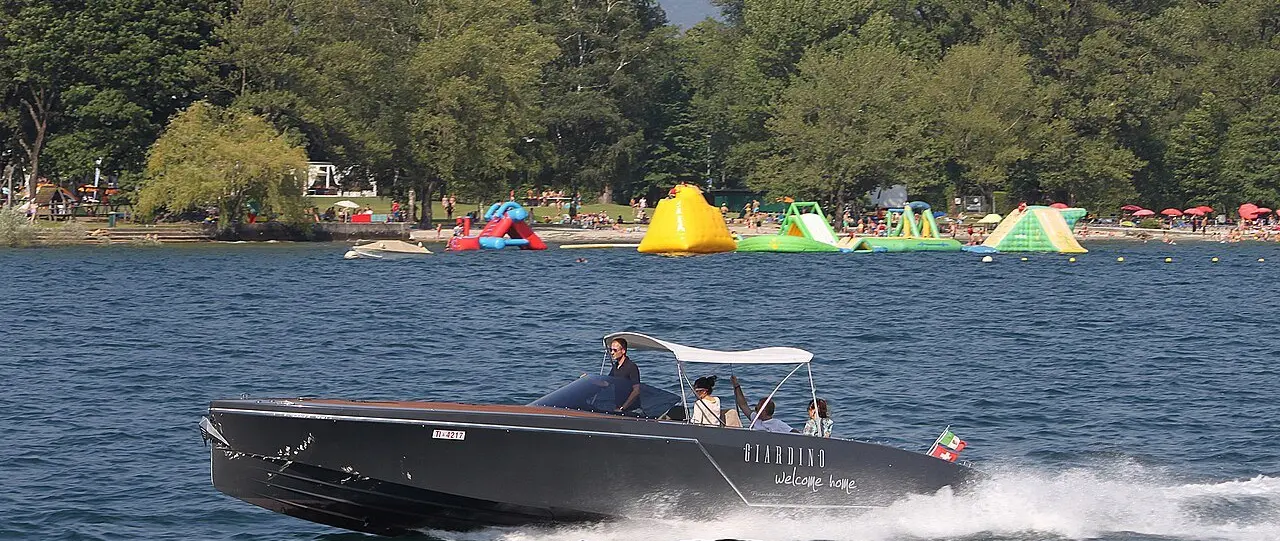
Source: Frauscher Bootswerft, 4 November 2026; supporting material: official information. Photograph: 6 Frauscher Hotel Giardino Ascona 300619.jpg by NAC, Wikimedia Commons, CC BY-SA 4.0. An archival photograph of a different Frauscher boat on Lake Maggiore in 2019; it is not the 790 Spectre or the 2026 award presentation. Resized for web presentation.
