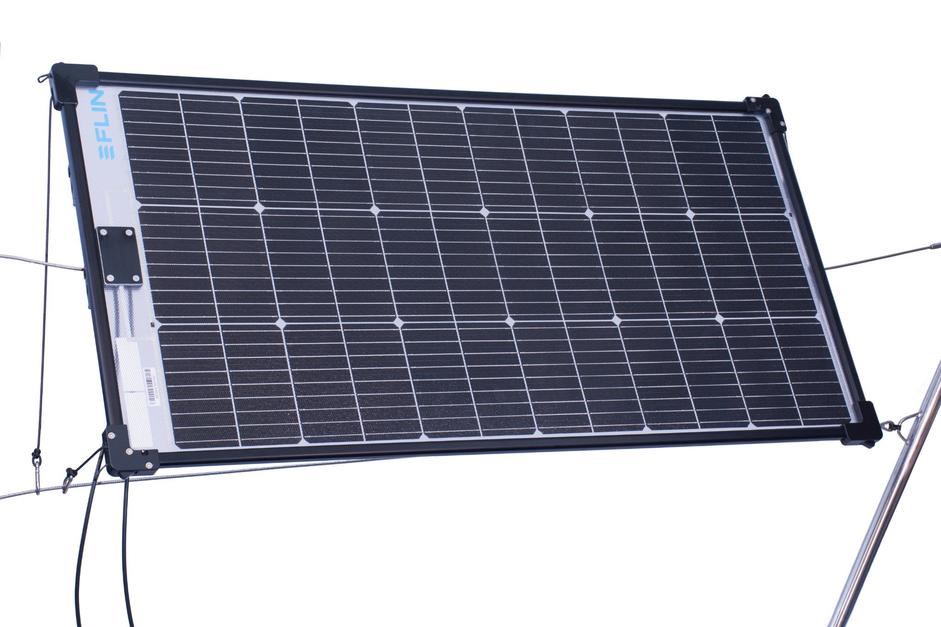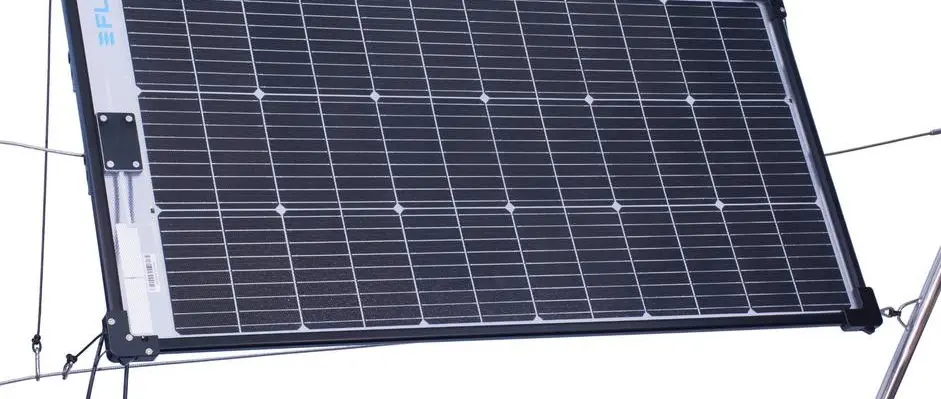
A panel that uses the rail rather than the cabin roof
FLIN solar GmbH is displaying its FLINrail+ solar charging system in the METSTRADE 2026 marine equipment catalogue, showing a panel intended to attach to the railing of a sailing boat using two hooks. The official supplier page describes a nominal 100-watt FLINrail+ product, the ability to adjust its orientation toward the sun and a separate 50-watt version for owners who need a smaller arrangement. These details address a familiar problem in boats below 12 metres: there may be little clear deck area for permanent solar panels, particularly on vessels whose cabins are covered with hatches, lines and walking routes. Rail mounting offers another potential location for collecting daylight energy while at anchor or sailing. But the installation must be assessed in the context of crew movement, load-bearing rail fittings and exposure to wind and water. A nominal 100-watt rating is not a promise of continuous 100-watt generation, and a rail-mounted panel should not be regarded as an accessory that needs no engineering attention.
What the manufacturer actually provides
The METSTRADE product page names FLINrail+ 100W+ and says the unit mounts with two hooks to a boat's railing. It refers to adjustable orientation to improve solar exposure and mentions an alternative FLINrail+ 50W+ module with dimensions of 610 by 560 by 20 millimetres. The page identifies fastening options for pipe railings of 20 and 25 millimetres in diameter and says custom fasteners can be produced for other sizes on request. These statements are more useful than a generic claim that a system works on every boat, but important details remain to be verified. Buyers need the weight, full dimensions of the chosen 100-watt configuration, approved wind-loading limits, electrical outputs and the precise method of securing the assembly. The dimensions quoted for the 50-watt version should not be transferred to the 100-watt unit without checking its datasheet.
Why small boats find solar panel placement difficult
A compact sailing boat may have a large boom, several rigging lines, a sliding companionway and a deck that needs to remain clear for crew movement. Flexible panels on a cabin roof can be shaded by sails or fittings, while a rigid arch adds weight and complexity. The guardrail offers an alternative mounting position without necessarily covering a hatch or walking route. Yet the rail is itself an important safety feature, and anything attached to it must not interfere with how people move around the boat or what they use for support. A panel hanging outside the hull may also be exposed to impact during mooring. Designers should consider the boat's entire operating routine, including tacking, docking and handling the tender, not only the energy collected during a calm afternoon at anchor. A convenient electrical location can be inappropriate if it creates another obstruction on deck.
How much energy can 100 watts actually provide?
A nominal solar rating describes performance under standardised test conditions rather than the electricity an owner can expect every hour. Actual output changes with sun angle, clouds, temperature, partial shade and the condition of the panel. A 100-watt module may deliver useful energy into a battery system under favourable conditions, but the daily total requires a realistic calculation. A boat owner should list loads such as instruments, cabin lights, communications, refrigeration and pumps, then estimate their consumption over a complete day. This makes it easier to judge whether a small solar module could meaningfully reduce the need for engine-driven charging or shore power. Owners should avoid designing critical equipment around optimistic peak-output figures. Solar generation can supplement other sources, but its uncertainty needs to be reflected in reserve planning.
Why adjustable orientation matters
The manufacturer highlights the ability to aim the panel toward the sun. In principle, this may help increase energy collection compared with leaving a small module at an unfavourable angle throughout the day. The practical benefit depends on how often the owner adjusts it and whether the chosen position is safe. A boat underway may roll or heel, and the sun moves relative to the hull as the vessel changes course. A panel set for maximum exposure in the morning may be shaded or badly aligned by afternoon. Owners should check the permitted orientation range and how the adjustment is secured against vibration or sudden movement. The ability to tilt or turn equipment is useful only when the locking arrangement remains reliable and does not invite crew to reach outside the guardrails while the boat is moving.
The mounting hooks require close examination
FLIN describes a two-hook attachment system with prefabricated fasteners for 20- and 25-millimetre pipe rails. Boatbuilders and owners should confirm the actual diameter and condition of their rails before ordering. Different boats may use polished stainless tubing, other metals or guardwire arrangements that do not share the same load-bearing characteristics. A bracket that fits around the tube is not necessarily appropriate for every rail structure. The crew should examine whether the panel can rotate unexpectedly or contact the hull, sails or other equipment. Any metal interface should be protected against unsuitable wear or corrosion according to the manufacturer's instructions. A permanent installation may need a different fastening strategy from a portable panel removed after each weekend. The exact hardware specification and retention method matter, especially when the vessel is left unattended.
Guardrail safety must come first
A guardrail helps define the edge of the boat and may be part of the crew's protection while moving on deck. A solar module should not weaken it, obstruct it or encourage a person to lean dangerously over the side while adjusting the angle. The manufacturer should identify any restrictions on fitting panels to particular rail structures and how loads from wind are transferred into the supporting fittings. A panel that is stable in a marina may experience very different forces at sea. It must not interfere with a lifeline gate, boarding ladder or the deployment of safety equipment. Owners should also consider whether the module could detach and strike another boat during a storm. The attraction of a readily mounted panel cannot justify compromising the primary purpose of the rail.
Electrical connections need a marine installation plan
A solar panel requires appropriate cabling, protection and a charge controller compatible with the boat's battery system. The METSTRADE listing provides the concept and mounting details but not every specification needed to design a complete charging circuit. The owner should ask which connectors, cable sizes and protection are approved for the selected module and whether the supplied equipment includes a regulator. A 12-volt boat, a 24-volt boat and a vessel with lithium batteries may have different requirements. Solar modules can generate electricity whenever they receive light, so safe isolation is important during installation and service. The electrician should minimise unnecessary cable runs and protect wires from abrasion at deck edges. A panel fixed neatly to the rail is still an incomplete system until its electrical connection has been designed, documented and tested.
Cable routing can become the weak point
The flexibility to reposition a rail-mounted module creates an obvious practical question: where does the cable go when the panel moves? A poorly routed wire may catch under a cleat, chafe against the stern rail or be pulled sharply when the panel is tilted. The manufacturer should explain its recommended cable restraints and movement allowance. Owners should avoid loose loops in walking areas or exposed wires that can be trapped between hull and pontoon. Where a cable passes through the deck, the penetration must be sealed correctly to prevent moisture entering the structure. A removable installation needs connectors designed for the intended environment and a routine for protecting them when disconnected. Many electrical failures aboard begin at apparently minor connection points, making this work as important as choosing the panel itself.
Using solar power at anchor
The strongest appeal for many weekend sailors is the ability to replenish batteries while the boat remains at anchor. Instruments may remain on, a small fridge may continue running and phones or lights may need electricity even when the engine is stopped. A well-positioned panel can contribute energy during daylight, but it must be assessed against the entire daily load. If the boat swings around its anchor, the angle to the sun may change. The panel might also be shaded by the boom, stern rail or cockpit enclosure. An owner should observe output over several days in realistic conditions before relying on it for essential functions. The manufacturer does not provide a universal energy yield for every anchorage, and the actual benefit should be measured rather than assumed. Solar is a useful contributor when integrated into a sensible electrical budget.
Performance under sail
At sea, a guardrail-mounted panel may receive good light at some angles but can also be exposed to spray, strong wind and changing heel. The skipper must decide whether it is appropriate to leave the panel deployed in the current conditions. The supplier's instructions should define its permitted operating envelope and any requirement to secure or remove it for rough weather. A panel that extends beyond the rail could be vulnerable when approaching a pontoon or another vessel. It may also obstruct a crew member's view or movement. The system should not be adjusted from an unsafe position while the boat is under way. A successful installation needs simple procedures that owners can follow without making the solar panel the centre of every sailing decision.
Choosing between 50 and 100 watts
The presence of both 50- and 100-watt options suggests that FLIN intends to serve boats with different space and charging requirements. The smaller unit may be easier to position, while the larger one offers higher nominal generating capacity. But selecting the bigger module is not always the right answer. Weight, windage, rail strength, cable routes and the electrical system may limit what is practical. The owner should calculate likely energy demand and evaluate the module's actual dimensions before deciding. If two modules are contemplated, the manufacturer should specify any approved configuration and electrical integration requirements. The figures in the product name are useful points of comparison but do not describe total installed energy yield. Good design begins with what the boat needs and can safely support.
Maintenance of a rail-mounted system
A solar panel exposed on the edge of a boat is likely to collect salt residue, dust and spray. Cleaning should follow the manufacturer’s instructions and avoid abrasive tools that might scratch the surface. Fasteners and moving adjustment points should be checked for wear, while electrical connectors should be inspected for damage or corrosion. The owner should also monitor output periodically. A sudden reduction may be caused by shading or weather, but it could also indicate a loose connection or a developing fault. A compact solar system may be easy to overlook until the boat's battery fails to recharge as expected. Recording the installation details and keeping the manual aboard can make troubleshooting simpler. The system should remain serviceable without requiring anyone to work in an unsafe position over the side.
Understanding the 2026 catalogue context
The FLINrail+ listing appears in the current METSTRADE product directory, but the public entry does not establish a specific first-launch date in November 2026. It should therefore be treated as a current product under review rather than a newly unveiled invention. The factual claims of a two-hook mounting system, adjustment toward the sun, available 50-watt variant and support for common rail diameters come directly from the supplier's own page. Those are enough to assess the concept, while engineering suitability and real energy output still need to be confirmed for each boat. For owners of sailing craft below 12 metres, rail-mounted solar may be attractive because it can make use of space not needed for standing or opening hatches. The design becomes valuable only when it preserves safe movement and supplies worthwhile energy.
A practical route to modest energy independence
FLIN's FLINrail+ highlights the search for simple charging solutions on small recreational boats. Moving a solar panel to a guardrail and allowing it to be oriented toward the sun offers a different trade-off from roof-mounted modules or elaborate arches. It can be useful for boats with limited deck area, but the system is not free from concerns about windage, rail strength or cable handling. Owners should obtain the full specifications and select a module according to realistic electrical demand and the vessel's structure. Proper mounting and charge-control design are essential. A well-engineered installation may reduce reliance on engine charging during suitable daylight conditions while giving the crew another tool for managing battery energy. Its purpose should remain straightforward: support the voyage without interfering with the safe operation of the boat.
Original industry sources and image credits
Reporting based on FLIN solar GmbH first-party FLINrail+ 100W+ solar rail panel product page in current METSTRADE 2026 catalogue, separate 50W variant confirmed.
Lead image: FLIN Solar FLINrail+ Brings Rail-Mounted Charging to Small Sailboats — manufacturer original product photograph. © FLIN solar GmbH. Original supplier image.