
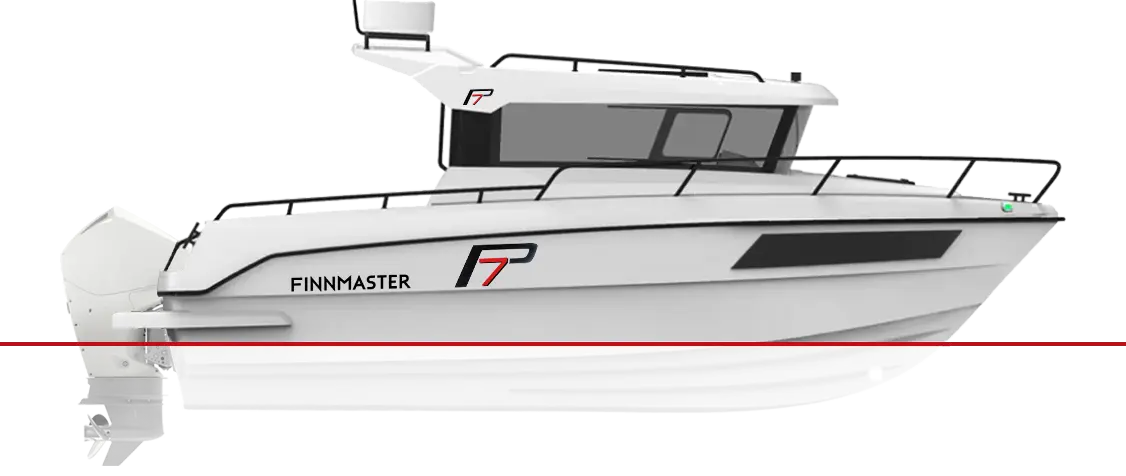
The Pilot 8 update focuses on control and access
Finnmaster has concentrated the latest Pilot 8 changes on practical areas that owners encounter during everyday operation. The cabin-boat concept remains intact, while the stern and helm systems have been revised to make boarding, manoeuvring and higher-speed running easier to manage.
That makes the update relevant to family cruisers, anglers and users who operate in mixed weather rather than only on calm summer days. An enclosed helm and useful stern access can matter as much as outright speed when a boat is used regularly across a longer season.
A larger swim platform adds more usable stern space
The renewed Pilot 8 receives a larger swim platform, giving passengers more room for boarding, swimming and moving around the stern. Finnmaster presents the change as an improvement to everyday accessibility rather than a purely visual redesign.
Buyers should still look at how the platform works with the outboard tilted and with normal cruising equipment aboard. Ladder position, handholds and access from a pontoon are practical details that can determine whether the extra area is genuinely useful.
Mercury joystick control targets easier docking
Finnmaster offers Mercury's single-engine joystick system as an option when the Pilot 8 is paired with a Mercury 400 V10 outboard. The system is intended to make low-speed manoeuvring more intuitive by translating joystick movements into steering and thrust commands.
Joystick assistance can reduce workload in tight marinas, but owners should still learn how the boat handles with conventional throttle and steering. Practising without electronic assistance gives the skipper a useful fallback if a sensor, control or network component becomes unavailable.
Seakeeper RIDE manages running attitude automatically
The updated model also integrates Seakeeper RIDE trim tabs, which automatically adjust to help control pitch and roll while the boat is moving. Finnmaster says the system is intended to improve stability and make the ride more comfortable across changing conditions.
Automatic trim systems work best when the boat is correctly loaded and the skipper understands what the system is doing. Passengers, fuel, cruising gear and sea state all influence running attitude, so owners should still monitor how the hull responds rather than treating automation as a set-and-forget feature.
Official sources: finnmaster.fi.