Facnor's TackFurl manual headsail furling system has won the Deck Equipment category of the 2026 DAME Design Awards at METSTRADE in Amsterdam. The honour was confirmed by the National Marine Manufacturers Association on 18 November, following the awards ceremony held on 17 November. TackFurl is a different approach to a familiar sailing-boat system: its design uses an integrated halyard lock at the upper end and an adjustable lower drum operated by a cunningham arrangement. For owners of sailing boats under twelve metres, the development is relevant because a reliable furler can simplify headsail handling, but only if it suits the rig and is installed correctly. The award recognises product design; it does not establish that TackFurl is appropriate for every mast and sail.
The importance of the headsail furler
A furling system allows a crew to roll a headsail around a supporting structure for storage or to reduce exposed sail area. On many cruising boats, it makes a demanding task more manageable because the crew can control the sail from a relatively sheltered position rather than going forward to handle fabric in difficult conditions. A furler can also become a source of problems when lines are crossed, the upper swivel jams or sail tension is inadequate. The way the halyard and drum are arranged is therefore not a minor detail. Facnor has concentrated on these components in TackFurl, presenting a system that challenges some assumptions about the layout of a traditional headsail furler.
The new award is separate from a product launch
The METSTRADE exhibitor listing for TackFurl dates from May 2026, and a Facnor exhibitor news entry followed in September. The November news is the jury's recognition of the existing product, not the first announcement that the system exists. This distinction matters because boat owners may already have seen TackFurl discussed at sailing events or in catalogues. The DAME programme received 153 entries in 2026, with 74 products nominated, and the jury selected winners across several product categories. Facnor was awarded the Deck Equipment prize. It did not receive one of the three joint overall awards, which went to Garmin, Scanstrut and Teignbridge. Accurate reporting helps a buyer understand the significance of the recognition.
A locking device at the upper end
The product description identifies a locking mechanism positioned at the top of the foil sections. This is a central feature of TackFurl because it changes how the sail is supported and tensioned. The manufacturer says the arrangement removes the need for the usual upper swivel and changes the role of the halyard that might otherwise be led through a masthead sheave and towards the cockpit. Its claimed benefit includes reducing the possibility of halyard wrap. The details of the mechanism still require understanding before installation. A skipper should not assume that an unfamiliar locking arrangement is operated in the same way as a conventional swivel-based furler. Correct engagement and release procedures are essential.
Why halyard wrap can be troublesome
Halyard wrap occurs when a halyard becomes entangled around a rotating furler component, preventing normal operation and potentially damaging rigging. It can be caused by an unsuitable halyard lead, poorly adjusted equipment or other installation issues. On a small cruising boat, clearing a wrap can be inconvenient and sometimes dangerous, particularly if it occurs while the crew is trying to reduce sail in freshening wind. Facnor's design aims to address that problem by changing the relationship between the halyard and the rotating assembly. Yet no furling system removes every possible failure mode. Correct sail luff dimensions, rig alignment and line handling remain important regardless of the brand or mechanism chosen.
Lower-drum adjustment brings another control
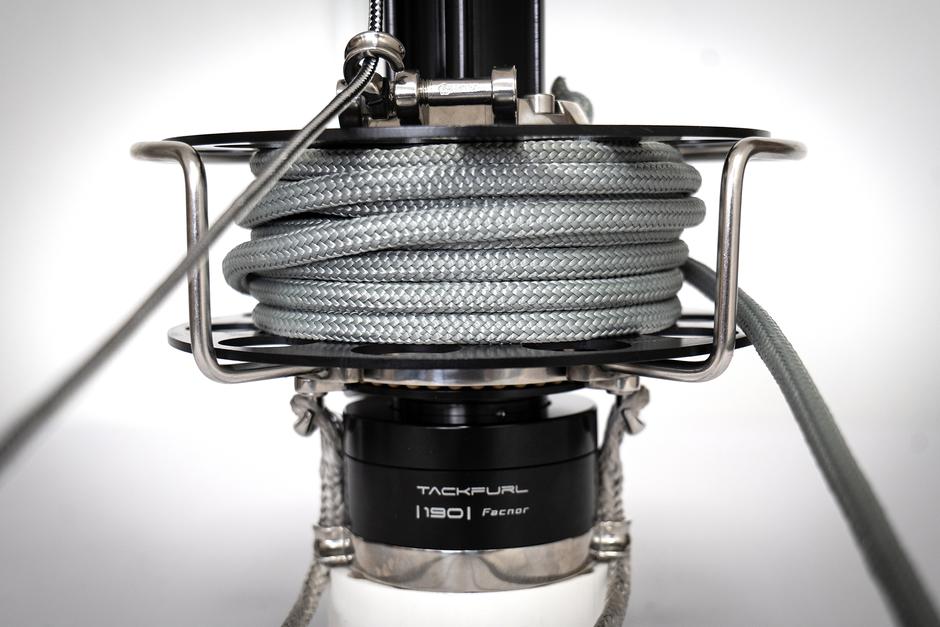
Facnor describes an adjustable compact lower drum linked to a cunningham control. The manufacturer says pulling the cunningham lowers the drum, using low-friction Torlon balls in the assembly. This is intended to help the sailor adjust the sail's tension and support smooth rotation. The feature must be understood as part of a coordinated rigging system rather than an isolated gadget. Increasing or reducing tension affects how the sail sets and how the furling unit behaves. An inexperienced owner should request a demonstration of the complete sequence rather than assuming the control is operated exactly like an ordinary mainsail cunningham. The manufacturer's terminology describes its mechanical arrangement; real-world adjustments depend on the rig.
The complete kit is part of the offer
The official METSTRADE product listing describes TackFurl as a ready-to-install kit including the furling system, trigger or hoisting line, furling line and cunningham rope. A packaged approach may help a rigger understand which principal elements have been designed to work together. It does not follow that every additional component required for an individual boat is included. Fittings, sail modifications, masthead arrangements and deck leads may still need assessment. Owners should request a detailed list of supplied parts and identify which components need to be adapted or purchased separately. The cost of a furler is best compared as a complete installed arrangement, not simply as the price of one drum or set of foils.
Rig compatibility is the decisive question
A small yacht may have a mast and forestay arrangement developed around the equipment originally installed by the builder. The diameter and condition of the forestay, sail dimensions and available space at the bow all influence whether a new system is suitable. A change to the way the halyard is secured can make the specification especially important. The TackFurl introduction does not establish universal retrofit compatibility. An owner should ask a qualified rigger to inspect the actual boat and establish which product size and configuration is permitted. A furler that works well on one design may be difficult to fit on another without making changes that require professional engineering assessment.
Sail shape remains part of performance
A good furling arrangement can support reliable handling, but the headsail itself also needs to be appropriately cut and maintained. A worn or stretched sail may not roll evenly, and insufficient luff tension can affect both shape and operation. The TackFurl concept offers a different method of managing tension, which can be attractive to sailors who pay attention to headsail trim. However, the award does not supply comparative sail-performance figures or demonstrate that every boat will sail faster. Performance depends on wind, crew technique, sail design and the complete rig. The advantage most clearly described by the manufacturer is mechanical arrangement and operation rather than a guaranteed increase in boat speed.
Furling lines require suitable deck leads
Even a well-designed drum can be difficult to use if the line is led through poor angles or high-friction blocks. On compact boats, the route from the bow to the cockpit may pass stanchions, lifelines and other fittings. The installer must keep the furling line clear of snagging points and make sure it can be handled without exposing the crew to unnecessary risk. Rope diameter and material also affect grip and wear. Facnor lists a furling line within the complete kit, but the final lead needs to be arranged around the individual boat. A professional should check that the proposed path will not interfere with anchor equipment, mooring lines or other critical deck systems.
A lower drum can matter at the bow
Bow space is limited on many leisure sailing boats. The forestay fitting, anchor roller, pulpit, mooring cleats and navigation lights may already occupy the same small area. Facnor describes TackFurl's drum as compact and low-profile, a feature that could influence how the sail is carried and how the crew reaches nearby fittings. Yet a compact drum is not proof that there will be no clearance problem. The furler must still avoid chafe against sailcloth and fittings, and the installation must preserve the structural integrity of the forestay attachment. The position of the sail tack relative to the deck can also affect sail geometry. Those questions are best resolved during a rig survey.
New systems need a different operating routine
A crew moving from a familiar furler to an unfamiliar mechanism should receive specific instruction. The TackFurl arrangement involves a locking function and tension controls that may be unlike those aboard the previous boat. Before an offshore passage, the crew should practise hoisting, locking, furling and lowering the sail in controlled conditions. Everyone who may operate the system should know what signs indicate that a lock has not engaged or that the line has become obstructed. Forcing a jammed assembly can damage equipment or create a dangerous sudden release. The value of a good design is increased when operating procedures are simple enough for the whole crew to remember.
Maintenance remains necessary
The product description highlights smoother rotation and low-friction elements, but moving marine equipment remains exposed to salt, vibration and wear. Foil sections, bearings, line attachments and locking components should be inspected as required by the manufacturer's instructions. Owners should also examine the furling line and the sail attachment for chafe. A new technical concept does not remove the need for periodic rig inspections or professional help where structural components are involved. Replacement parts and service support are worth asking about when purchasing the unit, particularly for boats that cruise beyond the area served by the installing rigger. A repairable system is often easier to live with than one that can only be returned to a distant factory.
The DAME jury recognised several types of innovation
The 2026 DAME results also recognised advances in communication, lighting, personal equipment and propulsion. The Deck Equipment category's selection of TackFurl reflects the importance of practical mechanical design alongside digital technology. A safer, simpler method of handling a headsail may be just as meaningful to a sailor as another electronic screen. Nevertheless, awards judge design qualities under defined conditions; they cannot reproduce every long-term sailing situation. Owners should use the prize as a reason to investigate how the furler works, then compare its actual operating sequence with existing options. The best equipment is the equipment that suits the boat's rig, crew and intended passages.
A possible option for new builds and refits
Boatbuilders may be interested in an integrated furling kit because component selection can be planned during construction. Owners of existing boats face a more complicated calculation: they need to consider how the forestay, sail and current halyard arrangement will accommodate the change. A refit can be worthwhile if the old system is worn or difficult to operate, but the fact that TackFurl has won an award does not make replacement automatically necessary. The existing equipment may remain safe and suitable when properly maintained. A considered decision should compare total costs, rigging work, parts availability and the clarity of the new operating routine rather than relying on a single advertised advantage.
Pricing and model availability need confirmation
The official product listing explains the design and contents of the kit, while the November award statement confirms its recognition. Neither provides a reliable price for every boat and installation in every country. Actual supply may depend on the appropriate forestay size and local distribution. An owner considering TackFurl should obtain the current technical manual, compatible model list and a quotation from an authorised rigger. It is also important to ask whether a sailmaker will need to modify the headsail and what warranty covers the locking mechanism. Those questions are particularly relevant when converting an older boat whose standing rigging may already be due for renewal.
A design prize brings attention to sail handling
Facnor's Deck Equipment category win at METSTRADE 2026 gives its TackFurl system greater visibility in an industry that continues to seek practical ways to make small-crew sailing easier. The integrated upper lock and adjustable lower drum are distinctive enough to merit examination, especially for owners concerned about halyard wrap or the complexity of traditional arrangements. The technology should still be considered alongside basic rig safety, sail compatibility and proper training. For a leisure sailing boat under twelve metres, successful innovation is measured not by the novelty of the mechanism alone but by how confidently and reliably its crew can use the equipment through many seasons on the water.
Official sources and photography
Reporting independently based on Official primary issuer announcement, Official manufacturer product catalogue/gallery.
Official source product photograph: Facnor TackFurl compact furling drum and line system, original Facnor manufacturer-submitted photograph in official METSTRADE product media catalogue. Original image rights remain with the source publisher and photographer. Official press-image source.