
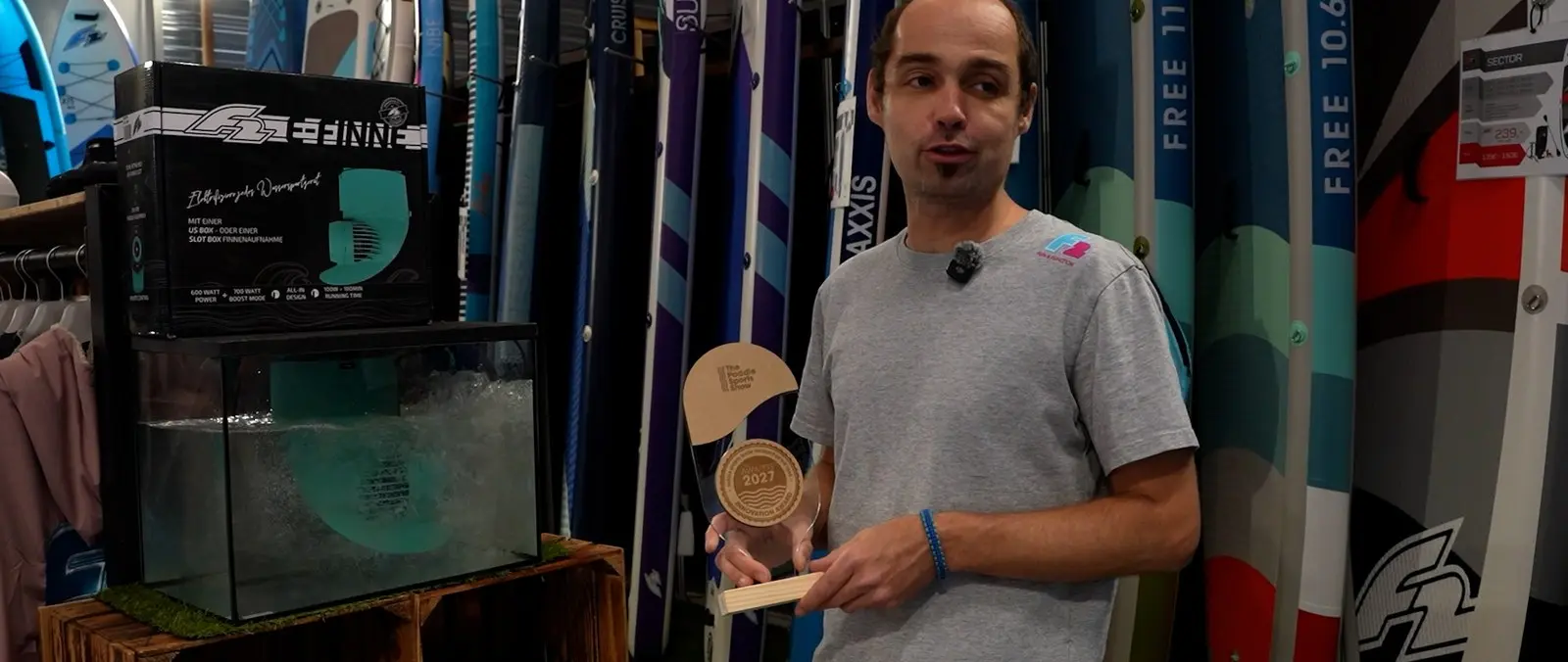
An award for electric-assisted paddling
The Electric Fin Pro from F2 has won the 2027 Innovation award at the Paddle Sports Show in Strasbourg. The organiser highlights the device's combination of electric propulsion, relatively straightforward installation and flexible controls, identifying automatic paddling assistance and adjustable continuous thrust as its defining functions. The award arrives as recreational paddling brands increasingly explore ways of supplementing human power without turning every board into a conventional motorboat.
For paddleboarders, a powered fin may be useful when wind or fatigue makes a return journey demanding, although no device should be treated as a substitute for planning a route within personal ability. The F2 announcement establishes an award result and broad features, not independent range or endurance figures for every possible board and user.
Two types of assistance change how a board behaves
F2 describes automatic assistance that responds to the paddling experience, alongside a manually adjustable continuous-thrust mode. These functions suggest two different approaches: supporting a rider's normal movement and providing a more sustained propulsive contribution. Their usefulness will depend on the particular setting and how smoothly the system responds to control inputs.
The experience of a powered board differs from that of a traditional SUP, especially when the rider stops paddling or needs to make a tight turn. Users should become familiar with the device in open, sheltered water before approaching busy areas or narrow channels. Any sudden movement near other people needs to be anticipated and controlled rather than treated as a surprising feature.
Installation deserves closer inspection
A fin-mounted system can offer a less intrusive propulsion option than attaching a separate outboard or propulsion pod. Yet fin-box designs vary among paddleboards, and buyers must verify mechanical compatibility rather than assume an accessory fits every board. Security of attachment is essential, because a fin works below the board where debris, grounding and changes in water depth may affect it.
Owners should also consider how the battery and controls are protected from water and damage. Electrical equipment designed for use around water requires appropriate sealing and maintenance, while charging instructions must be followed precisely. Before travelling, a rider should understand how to operate or disable the system if it malfunctions.
Environmental considerations beyond the marketing
A small electric motor avoids local exhaust emissions during operation, which can be attractive on quiet inland water. That does not eliminate considerations about batteries, charging energy or eventual disposal. The environmental value of assisted paddling depends partly on how long the product lasts and whether components can be repaired or replaced.
Access rules are another important issue. Some lakes allow human-powered craft but restrict motorised vessels, and even a small electric fin could change how a board is classified. Prospective buyers should check local regulations before relying on an assisted board in a protected area or waterbody with a motor ban.
What the award means for recreational users
The Paddle Sports Show uses its Innovation category to recognise products that introduce a different technical approach, and the Electric Fin Pro offers an example of paddling equipment moving beyond purely manual propulsion. It may interest people who enjoy longer outings or need additional assistance, but the device will not be equally useful to every paddler.
The organiser has confirmed the 2027 award, while full technical specifications, price and warranty should be obtained from F2 or an authorised seller. The sensible purchasing test remains straightforward: does the equipment genuinely improve the experience on the water where the board will be used? The answer requires a real demonstration and attention to safety, not simply enthusiasm for a prize.