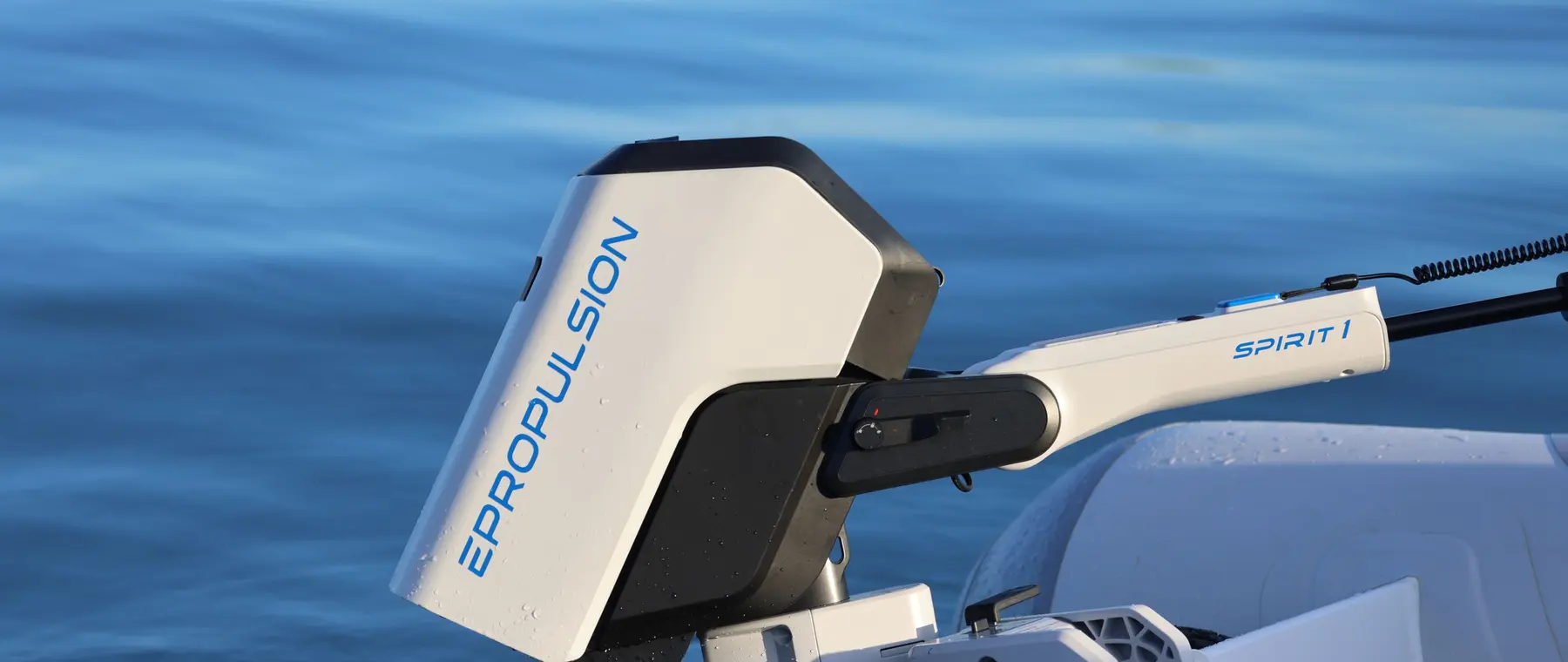
ePropulsion has introduced a new Spirit 1 portable electric outboard at METSTRADE 2026, combining a 1 kW nominal motor, an additional 1.5 kW Boost Mode and a removable 1,539 Wh battery. The launch was announced on 17 November in Amsterdam, where the product also received a Special Mention in the DAME Design Awards' Propulsion and Dynamics category. Designed for tenders, dinghies, fishing craft and smaller sailing boats, the engine is intended to offer straightforward handling and quiet electric propulsion without the weight and maintenance routines associated with a small petrol outboard. The award recognises a particular design, not a claim that the motor can replace every conventional engine. Its usefulness will depend on the size, load and operating conditions of the boat.
A new Spirit rather than a renamed old motor
The Spirit product family has been available in different forms for several years, including the earlier Spirit 1.0 Plus and Evo variants. The November 2026 announcement refers to a newly developed Spirit 1 model with its own battery capacity, styling and operating features. That distinction is important when comparing specifications or looking at second-hand equipment. A listing for an older Spirit 1.0 model may not include the same display, battery or boost capability. Owners should verify the exact model name and generation rather than infer that any reference to Spirit means the newest system. The manufacturer has also been developing the more powerful Spirit 2, which is a separate product intended for different applications.
One kilowatt is the normal power rating
The new Spirit 1 is described as a 1 kW electric outboard, roughly comparable in intended use to the smaller auxiliary engines found on many dinghies and tenders. That does not mean it will deliver a fixed speed on every hull. The relationship between electrical power and boat movement depends on hull form, propeller performance, load, wind and current. A tender that moves comfortably through sheltered water may struggle against a strong headwind or tidal stream. The manufacturer provides example performance figures for controlled test conditions, but these are not universal cruising guarantees. Buyers should assess their actual route and the reserve power needed to return safely.
Boost Mode can provide extra power briefly
ePropulsion says the Spirit 1 offers a new Boost Mode that increases output to 1.5 kW. This may be useful for manoeuvring or dealing with a short period of extra resistance, but the higher output is not intended for unlimited continuous use. The company's published product information describes a boost period of up to one minute under defined battery and temperature conditions, including a minimum state of charge. Boaters should understand how the mode is activated and what happens when its permitted duration ends. Treating short-term boost output as the permanent motor rating could lead to unrealistic expectations about top speed, towing capability or the ability to make headway against conditions.
The battery is removable from the motor
The integrated battery has a stated energy capacity of 1,539 Wh and can be disconnected from the motor for carrying and charging. This is one of the attractions of the portable design. Owners may be able to transport the components separately instead of lifting the complete unit at once. The company quotes a battery weight of approximately 10.4 kilograms and motor weights between 9.2 and 10.6 kilograms depending on configuration. Those figures should be considered by anyone lifting equipment from a pontoon, dinghy or storage locker. The combined system is not weightless, and awkward lifting over a rail can be hazardous even when each component is relatively compact.
A detachable clamp helps with storage
The manufacturer identifies a detachable clamp, folding tiller and quick-connect battery arrangement among the changes intended to make Spirit 1 portable. Those features may help when the motor is removed from a tender at the end of a trip or carried between a boat and its storage area. The actual benefit depends on the configuration of the dinghy's transom and the available storage space. Owners should practise removing and refitting the motor under controlled conditions rather than improvising while the boat is moving. A secure lifting grip and a suitable storage position can prevent damage to the propeller, electronic connectors and mounting hardware. Portability should not be confused with permission to leave equipment unsecured aboard.
Choose the correct shaft length
Electric outboards are available in different lengths and configurations because transom height varies between boats. The manufacturer lists several Spirit 1 configurations, and the choice should be based on the boatbuilder's recommendations and the expected operating conditions. A shaft that is too short may allow the propeller to ventilate or the cooling arrangement to operate incorrectly, while an unnecessarily long setup may be awkward or vulnerable in shallow water. The mounting clamp must also fit the transom safely. Buyers should check the dimensions of the actual boat before ordering, especially if they are replacing a petrol outboard whose mounting arrangement has been modified during the vessel's life.
Charging is part of the voyage plan
A removable battery can make charging more convenient, but it still requires an appropriate electrical supply and safe procedures. Owners should follow the instructions for the battery and charger and avoid using unapproved accessories. Charging time depends on the charger, available power and the battery's initial state, so it should not be assumed from capacity alone. Someone using a tender several times a day may need a different routine from a sailor who uses a small auxiliary engine briefly to leave a harbour. A sensible voyage plan includes a reserve for unexpected conditions. The availability of shore power at a marina does not guarantee that charging arrangements will be suitable without the right equipment.
External batteries offer a different arrangement
ePropulsion says the new Spirit 1 can be used with compatible external E Series batteries, offering an alternative for owners who require more stored energy than the removable pack alone provides. That flexibility is valuable only when the complete electrical system has been specified correctly. Battery capacity, cabling, protective devices, mounting and the manufacturer's approved connections all matter. A spare battery is not simply a generic power bank that can be connected to any motor. Owners should establish the supported configurations and weight implications before making changes. More energy can extend operating opportunities, but it also increases the equipment that must be secured and maintained aboard a small craft.
The USB-C port is a useful secondary feature
The removable battery includes a USB-C output that can provide power to compatible personal devices. This may be convenient during a day on the water when a phone or other small device needs charging. However, the motor battery should remain primarily a propulsion energy source. A skipper should avoid using so much stored energy for accessories that the boat is left without a sensible reserve for returning to shore. The presence of USB-C does not turn the propulsion battery into an unrestricted electrical supply for every onboard device. Owners should check the output's rating and protection features and follow the manufacturer's guidance about connecting equipment in wet conditions.
Hydrogeneration is of particular interest to sailors
The Spirit 1 includes ePropulsion's hydrogeneration technology, intended to recover electrical energy through water movement when a sailing boat is travelling under sail. The manufacturer describes operation over a range of approximately 3 to 16 knots, with quoted generation figures around 380 W at 10 knots and up to 1.5 kW at 16 knots under suitable conditions. Those are manufacturer figures, not guaranteed output on every yacht. In practice, propeller immersion, drag, boat speed, system settings and battery conditions affect what can be recovered. A sailor should consider any hydrogeneration benefit alongside its effect on sailing performance and should not treat the system as an unlimited energy source.
Electric propulsion changes the maintenance routine
One attraction of an electric outboard is the absence of a conventional petrol engine's fuel, oil and combustion components. This can reduce certain routine tasks and avoid exhaust gases at the point of use. Yet an electric system still requires inspection of the propeller, mounting components, electrical contacts, seals and battery. Owners should clean and store the equipment according to the manufacturer's guidance. Saltwater exposure remains a concern, and corrosion or impact damage can create faults even when the motor has fewer moving parts than a combustion engine. The phrase low maintenance should be understood as a difference in maintenance requirements rather than a promise that the equipment never needs attention.
Battery range must be treated realistically
The Spirit 1's 1,539 Wh battery is larger than the packs supplied with some earlier portable electric outboards, but battery energy alone does not define how far a boat can travel. A displacement dinghy moving gently through still water may use much less power than a heavily loaded craft trying to maintain speed against wind and tide. Increasing motor output generally reduces how long the battery can deliver energy. The product's published performance examples are helpful for comparison when their test conditions are understood. A prudent owner should measure actual consumption on familiar routes and keep a reserve rather than planning every journey around the maximum range shown in a brochure.
Quiet operation brings both benefits and responsibilities
Electric propulsion can be noticeably quieter than a small petrol outboard, improving the experience aboard a tender or compact sailing boat. Less engine noise may make conversation easier and reduce disturbance in certain settings. It also means that other water users may receive less audible warning of an approaching boat. A skipper must continue to keep a proper lookout, observe appropriate speed limits and communicate when necessary. Quiet operation does not remove the need to avoid swimmers, paddleboards and wildlife. The absence of exhaust at the vessel should also not be presented as proof of zero environmental impact across battery production, charging and eventual disposal.
What the DAME Special Mention means
The 2026 DAME jury awarded ePropulsion's Spirit 1 a Special Mention in the Propulsion and Dynamics category. This is an important distinction from a category win or joint Overall Winner designation. The competition recognised numerous entries across different types of equipment, with a small number receiving additional mentions. The manufacturer says the recognition followed the motor's debut at the Amsterdam exhibition. Such an award indicates that the judges found the design noteworthy, but it does not provide independent long-term reliability measurements or establish the product's full market performance. Owners should regard the honour as a prompt for closer examination, not as a substitute for demonstrations, warranty checks or suitable installation.
A small tender presents particular requirements
A yacht tender or recreational dinghy may spend long periods stored ashore or aboard a larger vessel, then be launched for short transfers. Portability, reliable starting, safe lifting and controlled manoeuvring can matter more than maximum speed. An electric outboard may be attractive for such use if its operating range is sufficient. However, boats used as the sole transport between an anchored vessel and shore need extra attention to reserve power, wind and weather. An owner should also assess the risk of dropping a removable battery during handling and the practicality of charging it in the boat's usual location. The suitability of the Spirit 1 depends on a complete understanding of these routines.
An announcement aimed squarely at small boats
ePropulsion's official November statement identifies tenders, dinghies, fishing craft and small sailing boats as the main intended users. It describes the new model's nominal output, short-term boost, larger removable battery and features intended to ease handling. These are relevant design changes for people who do not need a large outboard but want a portable propulsion option. The announcement does not provide one fixed retail price for every region or confirm availability through every dealer. Buyers should check the exact model and shaft configuration, supported batteries, warranty terms and local service before ordering. A specification sheet becomes useful only when it can be matched to an individual boat.
A new option with clear operating limits
The launch of the new Spirit 1 at METSTRADE 2026 adds another choice for owners who value quiet and portable propulsion. Its DAME Special Mention draws attention to the combination of a 1 kW motor, limited 1.5 kW Boost Mode, 1,539 Wh removable battery and optional hydrogeneration. The strongest case for the product will come from how reliably it performs on suitable small craft and how clearly its controls communicate energy use. Electric propulsion offers meaningful advantages in certain boating circumstances, but those advantages should be weighed against charging access, realistic range and the strength of the conditions in which the boat will operate. In small-boat ownership, an honest understanding of limits is part of good seamanship.
Official sources and photography
Reporting independently based on Official ePropulsion manufacturer original 17 November 2026 launch and DAME award announcement.
Official source product photograph: ePropulsion new Spirit 1 portable electric outboard in a real small-boat setting, original 2026 company press lifestyle photograph. Original image rights remain with the source publisher and photographer. Official press-image source.