
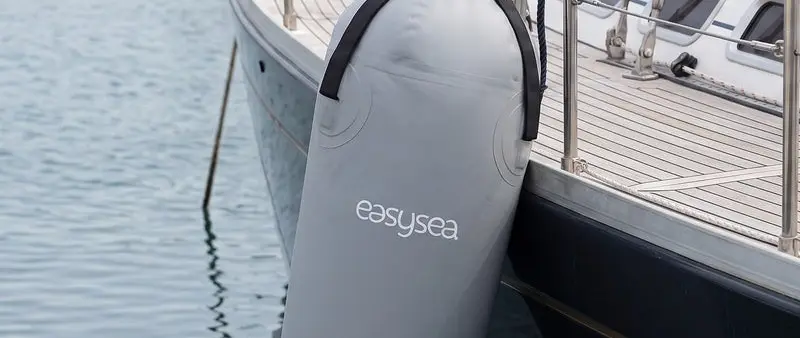
Italian marine-accessories developer Easysea has received a 2026 DAME Design Award Special Mention for its Ballast Fender, an inflatable boat fender that uses water held in a separate lower chamber to help it remain upright alongside a hull. The device was featured at METSTRADE in Amsterdam in November, with the company positioning it as a practical answer to fenders that blow upward or land on a deck during gusts and passing wash. For owners of small leisure boats, the problem is familiar: a fender that is not protecting the intended point of contact can be nearly as unhelpful as having no fender at all. The product is scheduled as a 2027 addition, rather than being evidence of routine in-service performance today.
The problem the design tries to solve
Conventional cylindrical inflatable fenders depend on their hanging position and the way the boat moves against the pontoon or another vessel. Wind can blow a lightweight fender away from the hull, while waves and wash may shift it toward the deck or out of the required position. Owners sometimes respond by adding weight, doubling lines or choosing a larger fender, none of which is necessarily a reliable answer in every situation. Easysea's stated innovation is to place ballast inside the fender itself, encouraging the lower end to stay down without requiring a separate loose weight. Its claims should be tested in real berthing conditions rather than taken as proof that displacement is impossible.
How the two-chamber system works
According to the manufacturer's METSTRADE product entry, the Ballast Fender has an air-filled upper chamber and a sealed compartment at the base that can hold up to five litres of water. The water provides weight at the bottom, while the air-filled volume maintains the fender's buoyancy. That combination aims to help the device remain vertical while still floating, even when the ballast compartment is full. The exact behaviour will vary with the amount of ballast, line length, wind, waves and contact with a hull. A buyer should not assume that a full five litres is always necessary or that the arrangement will remain correctly positioned during every alongside movement.
Two advertised lengths and one diameter
Easysea lists a 30-centimetre diameter and two lengths: 74 and 106 centimetres, designated FDW-101 and FDW-102. Those figures give potential buyers a starting point for judging where the fender might fit, but the correct size for a boat is not determined by length alone. Freeboard, hull shape, topside curvature, berthing height and nearby rubbing strakes all matter. A deep-sided cruiser and a low-sided runabout may need very different contact positions even if both are below twelve metres. The practical test is whether the fender covers the vulnerable part of the hull while hanging clear of fittings or protrusions.
Five litres of water is meaningful weight
If the lower chamber is filled to its advertised capacity, the water alone contributes approximately five kilograms before the mass of the fender and line is counted. That is a simple physical estimate, not a manufacturer-specified complete product weight. Handling the device when full may therefore be more demanding than dealing with an ordinary empty inflatable fender, especially for a smaller or older crew member. Owners should establish how the chamber is filled, drained and secured, and whether it can be managed safely at the pontoon. The design may trade some handling convenience for improved position control, and that trade-off deserves a hands-on demonstration.
What happens when the fender is stored
The manufacturer says the Ballast Fender can be deflated and rolled up when empty. That may be attractive on smaller boats where cockpit lockers are already occupied by lines, safety equipment and tools. But the difference between carrying an empty inflatable fender and stowing one that has just been used with seawater in its ballast chamber deserves attention. The owner should have a method of draining and rinsing the product without spilling water where it might damage electrical equipment or stored belongings. Instructions about drying, valves and material care will be useful for avoiding odours, mould or wear between trips.
DAME recognition should be described precisely
The 2026 DAME Design Awards gave the Ballast Fender a Special Mention. That is a real distinction from an overall award or a category-winning result, and the manufacturer's own METSTRADE description uses the Special Mention wording. The recognition indicates that the jury considered the design noteworthy, but it is not the same as independent certification of every performance claim or a long-term marine durability test. Buyers should treat the award as a reason to investigate the product, not as a replacement for comparing fender size, construction, support and cost. A newer design may be clever while still needing careful handling in some situations.
Hanging height remains essential
Adding ballast does not remove the need to position a fender at the right point on a hull. The line must be adjusted so the protection is where a boat and pontoon are likely to touch, and the hanging arrangement should be checked when the tide or water level changes. A low fender can slip beneath a pontoon edge while one hung too high can fail to protect the topsides or become trapped near a rail. The useful question is whether the water-weighted base improves its tendency to remain vertical after the skipper has placed it correctly. It cannot compensate for poor initial positioning or unsuitable mooring arrangements.
Use alongside another vessel
Boats rafted together may move independently in wash or wind, placing different demands on their fenders than boats tied to a fixed pontoon. A stable hanging position could be helpful where the hulls have similar freeboard, but the dynamic contact loads may still be significant. Owners should choose the number and size of fenders for the vessels involved and establish a secure attachment point. The presence of ballast should not be used as a reason to reduce ordinary precautions or rely on one device to protect a long section of hull. Any special limits for rafting should come from the final manufacturer instructions.
Wind and wake are different forces
Wind can displace a lightweight fender before contact, whereas passing wake may push a vessel bodily toward or away from a dock. The water ballast is intended to improve orientation against the first type of problem, but it cannot make a boat or a pontoon stationary. Wave-induced movement still creates forces that must be absorbed by the fender's inflatable body and restrained by correctly arranged mooring lines. A successful design therefore needs both position stability and adequate compression behaviour. The METSTRADE product note establishes a concept but does not publish independent impact absorption or endurance figures for repeated contact at different speeds.
New material and durability questions
A two-chamber inflatable introduces an internal division and additional connections or valves compared with some simpler fenders. Those features may be useful, but each also needs to remain reliable under folding, ultraviolet exposure, heat and abrasion. Owners should ask whether the materials tolerate the type of pontoon surfaces commonly encountered in their cruising grounds and whether valve parts can be replaced. It is also sensible to know what happens if one compartment loses pressure or the water seal becomes compromised. The manufacturer's claim that the product floats with ballast inside does not remove the need to understand its failure modes.
A potential role for small crews
A skipper operating a small boat with only one other person aboard may need to handle lines and fenders while simultaneously watching the boat's approach. Equipment that stays in place once correctly deployed could reduce one source of distraction, provided filling and lifting the ballast do not create new difficulties. The design might be particularly relevant to berths exposed to crosswinds, but local dock shape and tidal range remain important. Crew should practise the approach and use a safe plan for mooring rather than count on any fender technology to solve a poorly controlled manoeuvre. The fender is protective equipment, not a steering or braking device.
Comparing price and value will require launch details
Easysea identifies the product as new for 2027 and describes its patent status as pending, but the METSTRADE listing does not provide a confirmed retail price or a complete warranty statement. Owners should avoid assuming it will cost the same as a conventional cylindrical fender of similar dimensions. Value will depend on purchase price, lifespan, spare parts, storage needs and how often the existing problem occurs at a specific berth. A skipper whose fenders rarely move may see little advantage, while another repeatedly dealing with crosswind may place greater value on stability. Only a real comparison can determine whether the added complexity is worthwhile.
What a useful demonstration should show
A persuasive test would compare conventional and ballasted fenders of appropriate size on the same hull, under changing wind and wash conditions. It would show how the Ballast Fender behaves both fully and partially filled, how quickly the water can be removed, and whether it floats in the advertised way after a compartment is affected. Owners would also benefit from observing wear at the attachment point and the way the body compresses against an ordinary marina pontoon. These are suggested evaluation criteria rather than tests that Leisure Boat Guide has conducted. The company has published a product image and specifications, not a full independent field-test dossier.
A design that addresses an everyday nuisance
The Ballast Fender stands out because it tackles a small but persistent problem that can result in costly scratches or bruised topsides. Its water-filled lower chamber and inflatable upper body make the design easy to understand, while the two lengths and compact empty storage may suit a range of recreational craft. The DAME Special Mention adds visibility to the idea, but owners should wait for confirmed product instructions, pricing and real-world evidence before treating it as an automatic improvement. For boats under twelve metres, dependable fender placement comes from a combination of the right equipment, proper lines and competent crew habits.
Official source: https://www.metstrade.com/exhibitors/easysea/products/ballast-fender