
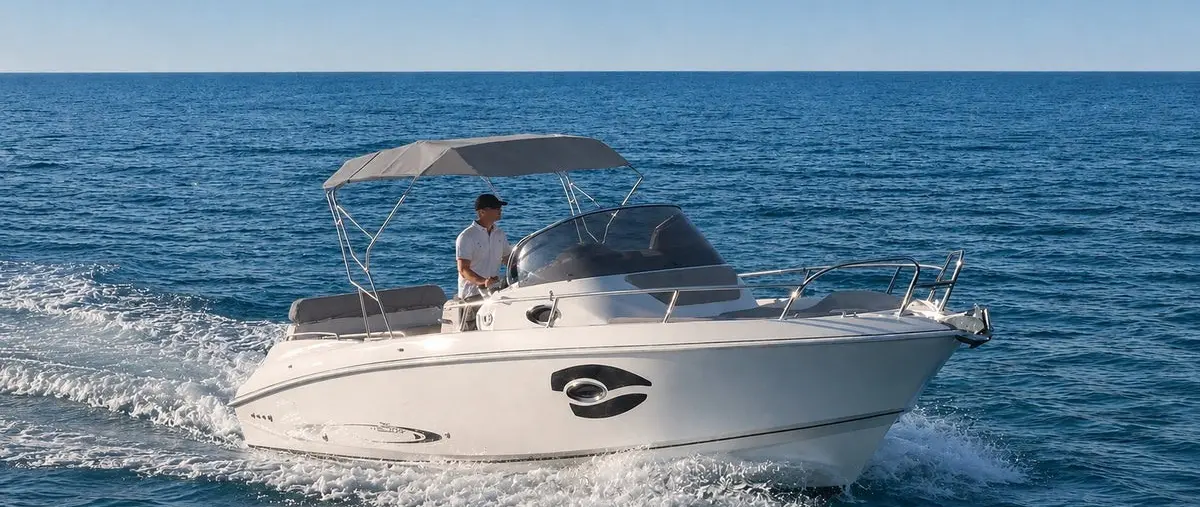
Easysea is developing Fold, a self-standing bimini top intended to open and close in a single movement without the deck-level supporting stays found on many conventional sunshades. The Italian company's design appeared in the METSTRADE 2026 catalogue as a DAME Design Award nominee, with availability indicated from February 2027. A bimini may seem a minor accessory beside a new engine or navigation system, yet it can significantly change how comfortable a small boat is on a hot day and how much space remains available on deck. The Fold proposal addresses both the time needed to deploy shade and the clutter of lines and supports around the cockpit.
What Easysea has shown
The official METSTRADE product listing describes a self-standing structure with hinged arms that extend the cover and hold its fabric taut. The manufacturer says one person can open or close the bimini quickly, without attaching additional guy lines or stays to the deck. That is the central design claim and should be distinguished from verified operating performance on every boat. The catalogue includes product visuals and identifies the concept as a nominee for the 2026 DAME Design Awards. Nomination recognises the design's interest, but it does not establish that the canopy has passed independent long-term tests on all combinations of hull, speed and weather.
Why shade is an important small-boat feature
Owners of runabouts, RIBs and small day cruisers often spend long periods outdoors where sun exposure and heat can make an otherwise enjoyable passage uncomfortable. A canopy gives the helm and passenger area some protection, but it also affects sightlines, headroom and access around the boat. Smaller craft have little spare deck area for frames and lines, and many owners struggle with fittings that must be removed before the boat can be trailered or stored. The appeal of an easier bimini is therefore not merely cosmetic. It may make shade practical during shorter stops when the crew would otherwise decide not to deploy a complicated cover.
A mechanism inspired by folding structures
Easysea describes a design inspired by origami, with arms that move together to open or stow the fabric. The aim is a single organised motion rather than separately tensioning multiple lines. The engineering challenge is to keep the frame stable and the fabric supported through repeated cycles without creating pinch points or undue stress at the hinges. A buyer should ask how the mechanism locks when open and closed and whether the motion is manageable by an operator who is standing in a moving boat. There is no reason to assume a demonstration in a show hall proves that the operation will be just as straightforward in a gusty anchorage.
Materials and the published dimensions
The METSTRADE listing specifies 25-millimetre AISI 316 stainless-steel tubing, UV-resistant acrylic fabric and widths from 200 to 270 centimetres. It also refers to grey, blue, beige and red finishes, with variants designed with or without a roll bar. Those details help identify the intended market, but they are not a complete installation drawing. A boat's beam does not directly determine the clear width available for a bimini; console shape, railings and seating may narrow the workable space. Owners should measure the fixing points and the whole swept area of the frame rather than order from the hull's nominal width.
Fitting the canopy around a console
Small motorboats can have awkward combinations of windscreen, arch, seatbacks and handrails. A bimini may need to pass over the driver's head without obstructing the view forward or interfering with the steering wheel. Easysea's photograph of Fold on a small motorboat suggests the intended context, but a potential buyer should not assume the exact pictured mounting geometry will fit a different craft. It is essential to check how the arms move near glass, antennas and other fittings. The supplier should provide information about clearance both when the top is fully deployed and when it is folded away for cruising or storage.
What self-standing actually implies
A self-standing canopy is designed to remain supported by its own frame and mounting arrangement without relying on additional tie-downs to the deck in normal use. That can reduce clutter around a cockpit and remove lines that otherwise catch on passengers' clothing or equipment. It does not mean the frame is unaffected by wind or suitable for use at any boat speed. Wind load on a large fabric surface can be substantial, particularly if the boat changes direction quickly or travels into a headwind. Owners need the manufacturer's approved operating limits and should never infer them merely from the presence of stainless tubing.
One-person handling still needs a safe technique
Easysea promotes opening and closing Fold in one movement, apparently reducing the need for two crew members to tension a conventional canopy. That could help a lone skipper or a family with children, especially when the boat is stopped at an anchorage. The operator should nevertheless be able to keep hands clear of moving joints, remain balanced and secure the mechanism properly. A demonstration should show what happens if the movement is interrupted and how to confirm the frame is fully locked. It should also establish whether a crew member can operate the top safely without climbing onto seats or leaning over the gunwale.
Fabric tension and weather protection
A taut canopy is less likely to flap annoyingly than loose material, but fabric performance depends on cut, frame geometry, stitching and installation. UV resistance is a useful property for a top exposed to strong sunlight, yet the manufacturer's brief listing does not quantify expected life or cleaning intervals. Nor should a sunshade automatically be treated as a heavy-rain roof or wind shelter. Boat owners should ask whether Fold is intended for light showers, how water drains and whether prolonged wet storage is acceptable. Correctly caring for the acrylic fabric can help avoid mildew and damage regardless of the opening mechanism.
The question of trailering and storage
One of the challenges for owners of smaller leisure boats is lowering the overall height before moving under a bridge, entering a shed or loading onto a trailer. A folding bimini might make that easier if its stowed position is compact and suitably secured, but the specific dimensions and clearances must be checked. The product image is not a guarantee that a given boat will fit beneath its existing garage door or canvas cover. A safe storage arrangement should also prevent the frame from moving while the boat is transported. Any road-trailer instructions should come from the manufacturer rather than be assumed from on-water operation.
What the roll-bar option may change
The catalogue identifies versions with and without a roll bar, a distinction that could matter on sports boats with existing arches or structures behind the cockpit. But the presence of a bar on a particular boat may alter the attachment geometry or the space through which the canopy arms swing. Buyers should clarify the actual configuration required rather than treating the options as universal accessories. A roll bar may also carry lights, antennas or other equipment that must remain unobstructed. Working from manufacturer templates and photographs of the actual boat is more reliable than guessing whether a support structure can be accommodated.
Retrofit and new-build decisions differ
A boatbuilder can choose appropriate fixing positions and reinforce structural areas during initial construction. That may make a self-standing system easier to integrate cleanly. A retrofit must work with the structure and fittings already present, including access beneath the deck and the condition of the laminate around mounting points. The load carried by each bracket should be assessed rather than relying on a thin, unreinforced surface. A successful retrofit quote should include the necessary backing, sealing and finish work, not merely the price of the canopy assembly. Easysea's statement about made-to-measure shipyard supply makes clear that some installations may require a tailored approach.
Comparing Fold with simpler bimini tops
A conventional folding frame with straps can be inexpensive and easy to repair, even if its deployment takes more time. A more intricate self-standing design may reduce routine fuss but add hinges and moving connections that need inspection. Owners should compare purchase cost, service access, fabric replacement arrangements and the likelihood of damage during ordinary handling. It is also worth asking whether the mechanism can be locked securely in the stowed position and whether it can be removed if necessary. The best solution is the one that matches how often shade is needed and how much complexity the owner is comfortable maintaining.
DAME nomination and planned availability
Easysea's Fold design received a DAME Design Award 2026 nomination, not the Special Mention awarded to the company's separate Ballast Fender. These distinctions should not be confused. The METSTRADE catalogue states that Fold is expected to become available from February 2027, so buyers should regard product pricing and delivery commitments as matters for direct confirmation. A planned launch date does not prove that every size and colour will be stocked in every market immediately. Owners considering a winter refit may wish to have measurements and mounting options checked early while avoiding assumptions about the final production hardware.
A good demonstration will be decisive
The strongest evidence of Fold's practical appeal would be a full cycle on a representative small boat, showing the person operating it and the clearances around the cockpit. The test should include opening, locking, stowing and securing the frame, as well as an examination of how the fabric behaves under ordinary low-speed wind. Prospective buyers should ask about approved maximum operating speed and whether the canopy must be folded during towing or rough weather. A hands-on demonstration may reveal whether one-motion operation genuinely reduces effort for a particular crew. No review should treat an attractive promotional video as a substitute for the instructions and real fitting requirements.
Shade that is easier to use is likely to be used more
The central attraction of Fold is a straightforward ownership proposition: a bimini that is simpler to deploy may be used more often, improving comfort on short leisure trips. Its self-standing frame could also help free up deck space and reduce the number of fittings that passengers must navigate. The manufacturer has provided useful material and width specifications, but structural suitability and safe operating limits still require a boat-specific decision. For small leisure vessels, the design is a promising item to inspect when the 2027 range arrives, especially where a cumbersome conventional top has discouraged owners from putting up shade at all.
Official source: https://www.metstrade.com/products-and-services/easysea/products/fold-self-standing-bimini