
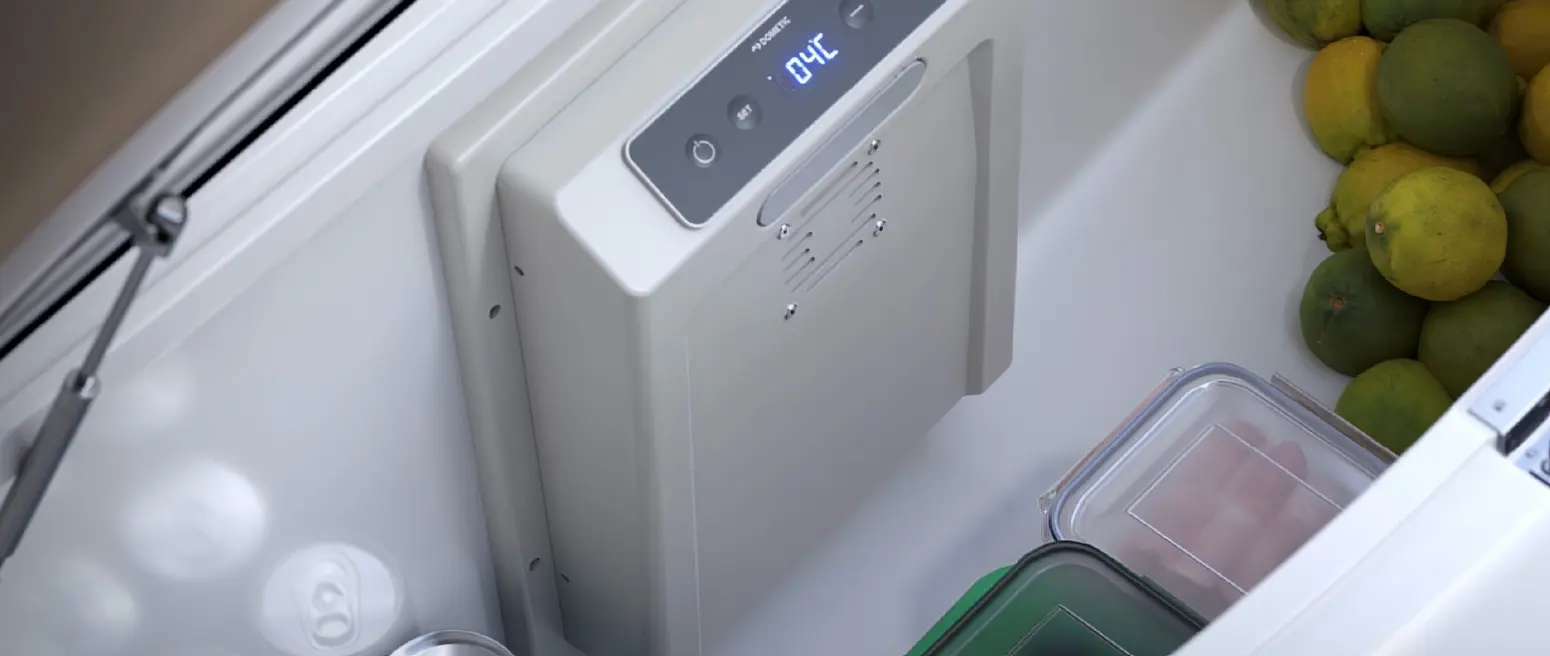
Dometic has introduced the CX600 marine refrigeration condensing unit in its METSTRADE 2026 product catalogue, targeting custom fishboxes with a stated volume of up to 0.6 cubic metres, or 20 cubic feet. The company describes it as the largest air-cooled 12/24-volt direct-current condensing unit in its Cold Machine 2.0 family, using the lower-global-warming-potential refrigerant R1234yf. For specialised recreational fishing boats, especially those with sizeable insulated catches or storage compartments, a dedicated cooling installation can be important to how the boat is used. The announcement is about a component for building such a system, however, not a complete plug-in refrigerator that can be fitted into any existing locker without design work.
What has actually been launched
The official METSTRADE listing, dated 18 November 2026, identifies the CX600 as a DC-driven condensing unit intended to cool custom fishboxes of up to 0.6 cubic metres. It places the product beyond earlier Cold Machine configurations described as handling around 0.3 to 0.35 cubic metres, or roughly ten to twelve cubic feet. Those figures refer to the stated target volume, not a guarantee that every box of a particular size will reach the same temperature under all conditions. An installation also requires insulation, appropriate evaporator components, controls and suitable power wiring. Owners should request a complete system specification rather than order the condensing unit in isolation.
Why fishboxes are a demanding application
A fishbox may be opened repeatedly during a day on the water, exposed to warm weather and loaded with catches whose temperature needs to be reduced or maintained safely. Its performance depends on insulation, the amount of warm material introduced, drainage and how long the lid remains open. A large internal volume can be useful for recreational fishing, but only if the system can manage the actual cooling duty. A manufacturer rating is typically based on specified assumptions about box construction and ambient conditions. Owners should not infer that maximum nominal volume alone indicates how quickly a catch will cool or the final holding temperature in tropical or high-summer conditions.
The significance of direct-current power
Dometic presents the CX600 as a 12/24-volt direct-current system, which is relevant because many smaller leisure boats use one of those electrical architectures. Using DC can simplify certain installation choices compared with equipment that requires a separate AC inverter, though the total power demand still needs careful management. A large-capacity cooling system can draw significant current over extended periods, and its suitability depends on the boat's alternator, house batteries, cabling and charging arrangements. There is no reason to assume that a nominal 12-volt system is adequately supplied just because the battery voltage matches the product label. A marine electrician should calculate the complete load and voltage drop.
Electricity use depends on the box and operating conditions
A condensing unit's electrical demand is not a fixed number that can be calculated from fishbox volume alone. Ambient temperature, insulation thickness, lid sealing, desired set point and how much warm material enters the compartment all influence the compressor's operating cycle. The METSTRADE listing does not provide a complete consumption profile across varying operating conditions. Owners should ask for expected average and peak power demand on their particular box and then consider the duration of a typical fishing trip. Long periods at anchor or slow-speed trolling may provide less alternator output than passages at higher engine speed, making battery reserves particularly important.
What low-GWP refrigerant means
The CX600 uses R1234yf, a refrigerant the manufacturer describes as lower in global-warming potential than some conventional alternatives. That is relevant to environmental decisions, but it should not be mistaken for a claim that the entire refrigeration system has no environmental effect. Energy use, materials, servicing and refrigerant containment all matter over the equipment's lifetime. Refrigerants also require correct handling and compliant servicing procedures even when their global-warming potential is lower. Owners should ask who is authorised to repair or replace refrigerant-containing components locally and how the system is to be maintained. The refrigerant choice is one part of a broader engineering and lifecycle assessment.
Factory precharging and quick connections
Dometic says the CX600 is factory pre-charged and uses quick-connect fittings, advertising a tool-free installation that may take under one hour for the refrigeration connections. That is a specific manufacturer claim about a streamlined procedure, not a guarantee that a complete fishbox retrofit can be designed, wired, mounted and commissioned in sixty minutes. The insulation, evaporator location, electrical supply and safe physical installation may require substantial additional work. Quick connectors can reduce one part of the process if they are used exactly as intended, but routing and supporting the lines correctly remains important. Buyers should ask the installer what is included in any quoted fitting time.
Ignition protection is a serious requirement
The METSTRADE entry refers to ISO 8846 and ABYC C-1500 ignition-protection provisions. Those claims are important for marine electrical equipment, particularly where fuel vapours might be present, but their exact application needs to be checked against the finished product and the installation location. A marking or standard cited in a catalogue should not be interpreted as approval for every enclosed space on a boat. Owners and boatyards should consult the full installation manual and any certification documentation. Electrical equipment must be fitted according to the conditions under which it was tested. Safe routing, fusing and avoidance of unsuitable compartments remain vital regardless of a headline conformity statement.
The space problem on boats under twelve metres
A fishbox with a nominal volume of 600 litres is substantial on a compact boat, and the extra refrigeration equipment competes with batteries, plumbing, lockers and access to mechanical services. The volume specified for the CX600 does not imply that such a box is suitable for every small craft. A naval architect or experienced boatbuilder may need to consider weight distribution, structural support and drainage before any new box is constructed. A higher-capacity system is most likely to interest dedicated sport-fishing or commercial-style recreational applications rather than a small family dayboat with modest chilled storage needs. The design should follow the boat's actual mission rather than its maximum available locker space.
Fishbox insulation can matter as much as compressor size
Poorly insulated surfaces allow heat to enter faster, increasing compressor runtime and reducing the value of a more powerful condensing unit. A custom fishbox should be assessed for thermal bridges, lid seals, exposure to direct sun and insulation around corners and penetrations. In some cases, improving an existing box may be a more effective investment than increasing refrigeration capacity alone. The manufacturer’s volume rating is useful only when paired with realistic thermal assumptions. A professional installer should be able to explain the expected temperature performance and identify which parts of the boat require modification before a larger cooling system can deliver its intended benefit.
Serviceability is part of the sales pitch
Dometic says the CX600 has a field-replaceable, serviceable design for builders and dealers. Access to parts and the ability to diagnose problems without replacing a complete assembly can improve long-term ownership economics. That matters on boats used heavily during a short fishing season, when a refrigeration fault can disrupt trips. Nevertheless, the published product summary does not provide a detailed spare-parts list, specific service interval or local repair coverage. Buyers should ask how warranty claims will be handled, whether a trained service partner is available near their home port and what diagnostic equipment may be required. Ease of replacement is valuable only if components are actually obtainable.
Choosing cooling for fishing rather than convenience
A fishing boat's refrigeration needs can differ from those of a cruiser seeking cold drinks or a galley refrigerator for occasional weekend use. Fish handling introduces practical questions about hygiene, cleaning, drainage and maintaining appropriate temperatures after a catch. A large custom cooling box may make sense for long trips or particular fisheries, but other owners may be better served by insulated ice boxes or smaller standard refrigeration units. The choice should reflect the local climate, trip duration, catches, battery capacity and space available aboard. A technology that is excellent for one pattern of use can be unnecessarily costly and complex for another.
How to compare the CX600 with earlier options
The company describes the new capacity as a step beyond legacy 10- to 12-cubic-foot cooling units. That is a comparison of intended box volume, not proof of higher efficiency or lower energy consumption per litre. A meaningful evaluation should consider rated cooling performance, electrical demand, compressor cycling, noise, heat rejection, service access and the evaporator configuration. The cooler also needs somewhere to release the heat removed from the box, so ventilation around the condensing unit is essential. Owners should resist comparing systems purely by their maximum advertised compartment size. A smaller well-designed system may outperform a larger poorly installed one for the intended duty.
Questions to settle with a boatbuilder
Before commissioning a custom fishbox, ask for the calculated heat load, insulation details, approved condensing and evaporator components, electrical requirements and the installation layout. Clarify whether the proposed temperature range is for refrigeration, freezing or another specialist use. The written quotation should include wiring, protection, mounting, drainage, commissioning and any expected future service costs. A designer should also consider whether access to the compressor will remain practical when the boat is fully loaded. These steps are more useful than choosing equipment from a catalogue image alone, particularly where the finished installation is built into a fibreglass structure.
An environmentally improved refrigerant is not the whole story
Selecting a lower-GWP refrigerant may help reduce one component of a cooling system's environmental burden, but energy efficiency and correct maintenance also influence its footprint. A system that is oversized, poorly insulated or badly ventilated could consume more electrical energy than a properly matched installation, regardless of refrigerant type. This is especially relevant to battery-powered vessels where electricity may be generated by an engine or obtained from a shore charger. Buyers should compare expected energy use over an ordinary season and ask whether service access will help keep the equipment operating efficiently. The company's specific environmental claim should be treated accurately and not inflated into a zero-emissions label.
A useful specialist launch from METSTRADE
The CX600 addresses a clear niche in the marine market: larger custom fishboxes served by a direct-current refrigeration system with serviceable components. The published specifications make it relevant to some serious small-boat fishing applications, while leaving many installation questions open. What will determine its value is how the complete system performs in a real insulated box during typical boating conditions. Owners contemplating a new-build or substantial retrofit should discuss it with a qualified refrigeration specialist, obtain verified technical documentation and compare alternatives on practical capacity, energy use and support. The announcement expands the menu of options; it does not make a tailored design unnecessary.
Official source: https://www.metstrade.com/exhibitors/dometic-group-ab/products/dometic-cx600-1