
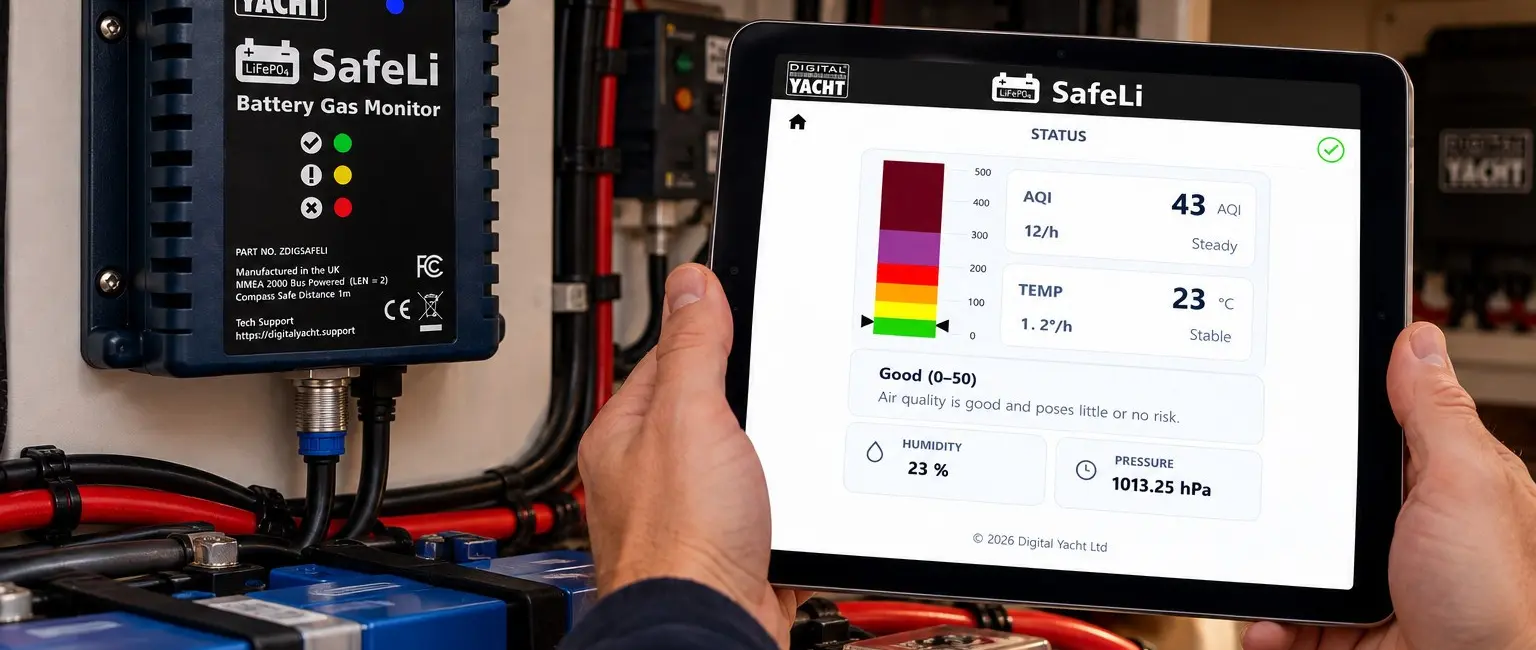
New monitoring technology for lithium battery installations
Lithium house batteries are used in many small cruising boats, but safe charging and monitoring depend on the entire electrical installation rather than battery technology alone. The latest product announcement describes the available features, but suitability depends on the boat, its existing equipment and a correctly planned installation.
Many modern recreational cruisers use lithium technology for house energy storage because it can deliver substantial usable capacity in a relatively compact system. Battery chemistry and the equipment around it still require careful engineering, however, with charging arrangements, thermal management and protection systems all contributing to safe operation.
SafeLi is intended as another layer of detection rather than a replacement for the protection already built into a properly specified battery system. It is important to distinguish a warning sensor from the battery management system that controls charging and protects individual cells.
Dual sensing for gas and abnormal temperature
The device uses gas sensors designed to detect hydrogen and certain volatile organic compounds that may be released if a battery develops a problem. It also incorporates a temperature sensor intended to identify potentially abnormal heating close to the installation.
LiFePO4 cells are generally considered more thermally stable than some other lithium battery chemistries, but incorrect operation, physical damage or equipment faults can still create hazardous conditions. Detection of unusual gases or temperature should be treated as a prompt for appropriate safety procedures rather than proof of one particular failure mode.
The location of any sensor matters because ventilation, enclosure design and the arrangement of the battery bank can influence what it detects. Owners should therefore rely on competent installers and the manufacturer’s final guidance rather than assuming a single sensor can adequately protect every battery compartment.
Warnings at the helm and elsewhere aboard
SafeLi connects to a compatible NMEA 2000 network and receives its power from that connection, according to Digital Yacht. The company says a connected installation can raise alerts through supported navigation displays, allowing the helmsman or crew to see a warning during normal operations.
The device also provides a local audible alarm and wireless access to monitored readings from a phone or tablet. Where a vessel uses the company’s NjordCloud service, selected notifications can also be relayed to shoreside users or managers through configured remote messaging.
Remote warning facilities depend on both equipment compatibility and communications availability. Owners should still establish what alarms remain operational if onboard Wi-Fi, internet access or a display is unavailable, and should not rely on remote messaging as the only means of detecting a developing hazard.
A useful addition to a complete safety design
SafeLi is being promoted for continuous battery-compartment monitoring, with the company highlighting relatively straightforward integration on a suitable network. The announcement does not establish that the sensor independently prevents a fire, manages charging or provides a substitute for the vessel’s approved fire detection arrangements.
For a cruising yacht with a larger lithium house bank, the product could prompt a discussion between owner, yard and electrical engineer about how battery information is monitored and how abnormal conditions are handled. That includes power isolation, ventilation strategy and the availability of trained assistance.
The Annapolis preview provides an opportunity to ask about final specifications and compatibility before the METSTRADE launch. As with any safety-related system, the appropriate approach is to assess the full installation, not to judge protection by the presence of a single device.
What a small-boat owner should check
Before fitting the system to a recreational boat, owners should confirm the exact model, supported hardware and any extra parts needed for their installation. It is also worth asking which functions remain available if the vessel loses internet service or a component fails.
The technical benefits must be balanced against installation expense, maintenance and crew familiarisation. A practical demonstration with the actual electronics or machinery configuration is more useful than assuming every capability described by the manufacturer will work on every boat.