
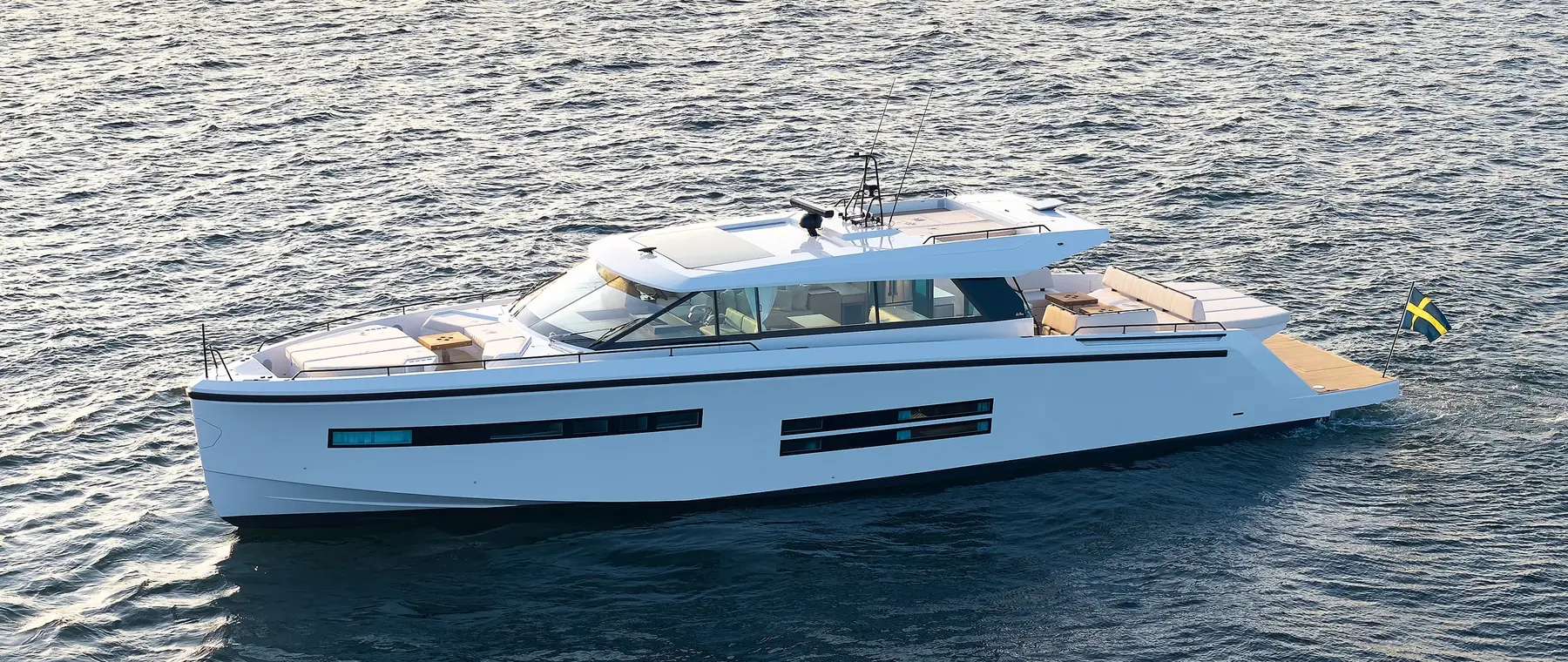
Delta Powerboats' 72 Coupé is among the notable motor yachts expected at the Fort Lauderdale International Boat Show, running from 28 October to 1 November 2026. At 21.75 metres overall, the Swedish-designed performance cruiser is distinguished by carbon-fibre construction and an unusually broad choice of propulsion arrangements. Buyers can investigate a twin Volvo Penta IPS installation or an alternative with four large Mercury V12 outboards, depending on the configuration offered for their build.
The show organiser lists the Delta 72 among the 2026 debut boats, but the model itself is not a brand-new concept being launched for the first time. Delta's official European information states that the first yacht was commissioned by a returning customer and launched in summer 2025. The Fort Lauderdale appearance is therefore most usefully seen as an opportunity for buyers in the American market to examine a developed design and discuss how its specification may be adapted for their preferred cruising style.
Why carbon fibre matters on a boat this size
Delta and its design partner Mannerfelt Design have used advanced composite construction to limit weight while creating a substantial enclosed cruising yacht. The builder places a strong emphasis on Scandinavian simplicity, with a comparatively restrained profile and generous outdoor seating rather than decorative complexity for its own sake. The premise is that lighter structures can help deliver the speed and efficiency expected of a performance yacht without requiring owners to give up practical accommodation.
Construction material alone does not establish a fuel-saving percentage, however. Actual consumption depends on displacement as fitted, hull condition, the propulsion system, speed and loading, as well as sea conditions. Delta's European and North American published specifications include some different figures for displacement and fuel arrangements, which makes a hull-specific equipment list essential before comparing the boat with a heavier competitor.
The published principal dimensions are more straightforward. The Delta 72 measures 21.75 metres overall, with a 19.70-metre hull length, 5.60-metre beam and a stated draft of about 1.60 metres. Those proportions place it in a substantial coastal and offshore cruising category, large enough to support separate crew accommodation while remaining smaller than many traditional long-range motoryachts.
Two propulsion approaches and different priorities
Delta describes two distinct routes for power. One uses twin Volvo Penta D13-IPS1350 inboard installations, combining diesel engines with pod drives. The alternative is a four-engine Mercury V12-600 outboard arrangement, placing the main propulsion units outside the hull. Both are high-power options, but they carry different implications for machinery access, underwater running gear, weight distribution and service arrangements.
The choice should be guided by actual operating habits. A couple planning regular longer passages may evaluate continuous cruising efficiency, noise and storage space more closely than a buyer whose main interest is rapid day trips with a large group. Outboards and IPS pods also lead to different maintenance conversations, and availability of qualified service support in the owner's usual cruising grounds may be as important as the advertised top-speed band.
Delta's North American promotional material gives a broad 42-to-52-knot maximum-speed range across proposed configurations, whereas its European model page separately lists a 40-knot maximum for the D13 inboard version. These figures should not be combined into a single guaranteed result or represented as independent test measurements of every hull. They describe different source specifications; buyers should request speed-and-fuel tables for the precise power package, loading and build version they intend to order.
The same caution applies to range and tank volume. The Swedish builder's website reports a 3,100-litre fuel capacity and approximately 400 nautical miles of cruising range for a D13 configuration, while the North American sales page displays alternative capacities and range figures. Until the two parties clarify how the versions differ, a prospective owner should get the detailed approved specification in writing instead of assuming figures from separate markets refer to one identical boat.
Social space for a large party
Accommodation for owners and overnight guests is balanced by generous exterior zones. Delta says the main deck and upper surfaces provide seating for more than twenty people, with three separate sun-lounging areas. That is a day-use seating claim, not an overnight guest accommodation count, and the number of people legally allowed aboard must be confirmed against the particular vessel's certification.
The boat incorporates a transformer-style bathing platform, a tender garage and storage intended for watersports equipment. These features are attractive on a cruise that alternates between ports, anchorages and shore visits, because deploying a tender or allowing swimmers back aboard should not require guests to cross the entire interior. They also add mechanical systems that will need inspection and maintenance, and owners should ask to see the platform operated during a demonstration.
The deck layout is intended to suit both a family passage and a larger gathering at anchor. That versatility matters because the best seating arrangement for a fast open-water run is not always the same as the one wanted for lunch or an evening with guests. Prospective buyers should examine shade, wind exposure and handholds for each deck zone, particularly at the speeds discussed in the model's promotional material.
Four guest suites plus crew accommodation
Below deck, Delta specifies space for eight guests across four en-suite cabins, including a full-beam master suite. A separate crew cabin is intended to accommodate two staff members. That makes the boat plausible for trips where an owner wants a professional skipper or support aboard without surrendering one of the main guest cabins to crew use.
The arrangement also demonstrates how the yacht tries to combine sport-cruiser performance with some features associated with larger luxury vessels. Four bathrooms consume meaningful volume in a hull of this length, so the practicality of each cabin, storage locker and passageway is worth testing in person. An impressive cabin count is useful only if occupants can live comfortably during the length of voyage for which the boat is intended.
Owners considering extended travel should also clarify electrical generation, air-conditioning capacity, fresh-water storage, waste systems and the consequences of running additional hospitality loads in warm climates. Delta lists 1,000 litres of freshwater on its European specification, but day-to-day endurance depends heavily on passenger use and any water-making equipment. Those details deserve the same attention as the propulsion headline.
What to inspect at Fort Lauderdale
The 2026 show presents a useful moment to discuss the 72 Coupé with the builder's North American representatives and examine the model's design philosophy firsthand. The official brand information identifies Swedish design and construction undertaken in Estonia, making engineering documentation and importer after-sales support relevant questions for an owner based in the United States or Caribbean. A visit should resolve how warranty work, replacement parts and seasonal maintenance are handled in practice.
It is especially important to identify whether the displayed boat has IPS or outboard propulsion before drawing conclusions from its machinery spaces and aft-deck arrangement. An owner interested in the alternative should request drawings and photographs for that exact configuration. The hull design may be shared, but the day-to-day ownership experience and onboard storage can vary with the power package.
The Delta 72's relevance to the wider leisure-boat market is not simply its headline performance. Carbon-fibre construction, a highly social deck and four-cabin accommodation in one design force trade-offs that are familiar to boatbuilders at much smaller sizes. Fort Lauderdale should let buyers judge whether Delta has balanced those compromises effectively, while the outstanding specification differences remain questions to settle with the manufacturer before placing an order.