
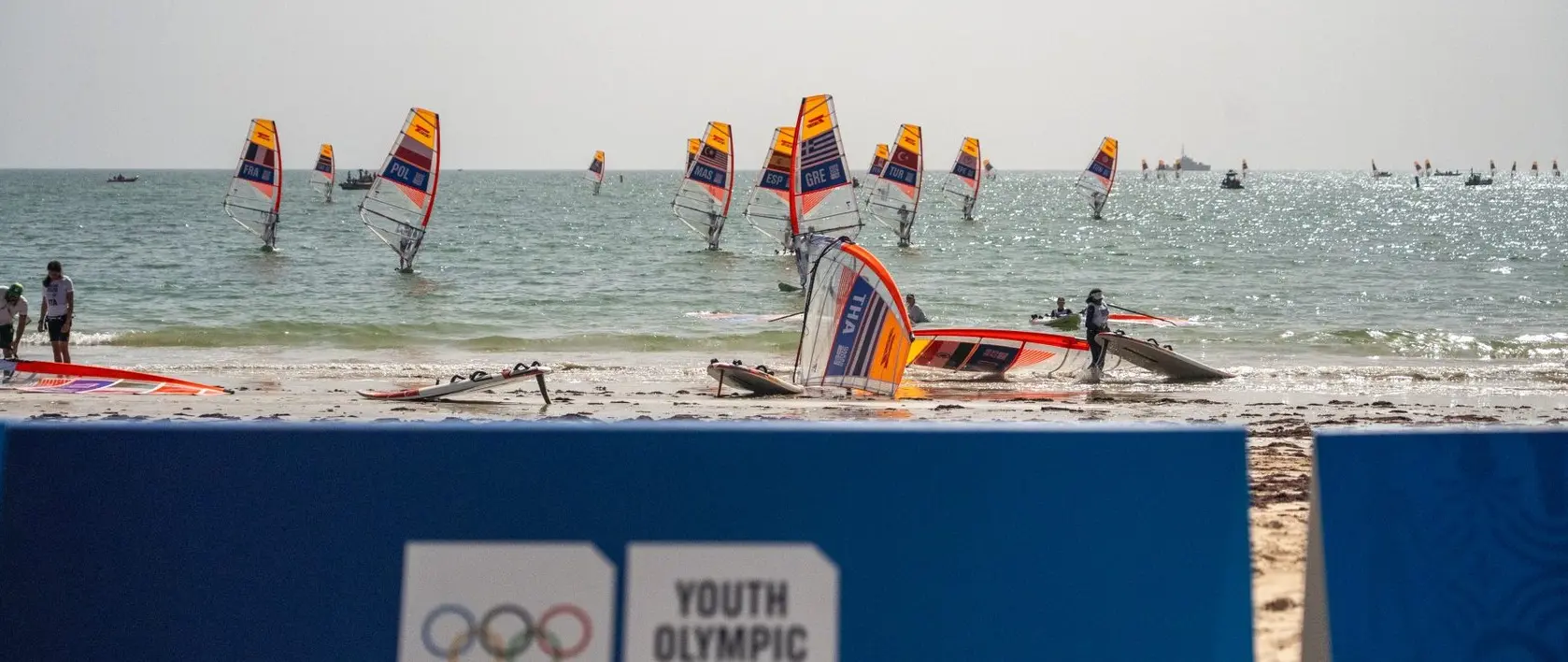
Youth Olympic windsurfing moves into its second phase
Six races into the Dakar 2026 Youth Olympic Games Techno 293 windsurfing programme, Greece's Evangelos Kyriazakos heads the men's standings while Italy's Laura Grasso Castagnetta leads the women's fleet. The provisional rankings on the official World Sailing event site follow two days of competition at Saly Beach West, where forty-seven windsurfers from thirty-eight nations are contesting fifteen scheduled races. The series is far from decided, and the changing order shows why an opening-day winning streak does not settle a multi-race championship.
China's Wu Ziyan made the strongest possible start to the women's event by winning all three opening races on Sunday 8 November, but the published six-race table now puts her third on sixteen net points. Grasso Castagnetta leads with ten net points, while Spain's Olivia Sanchez is second on twelve. Those numbers are a snapshot from the event's official results after race six, not final medals. They demonstrate how quickly the overall picture changes once more results are counted.
A historic venue and a fleet of young sailors
The sailing competition is part of the first Olympic event held in Africa. World Sailing's event report described drums, Senegalese colours and traditional Kumpo performers welcoming athletes and spectators as racing opened. The ceremony added a local cultural setting to a sport that can otherwise appear remote from its host community. On the water, the practical challenge was still familiar to dinghy and board sailors everywhere: find clean wind, choose a sound course and complete each race with as few errors as possible.
The organisers reported light winds and intense heat at the start, with a short postponement before the first racing. That matters because windsurfing performance depends on both physical effort and subtle changes in the wind field. A board sailor cannot simply call on an engine when the breeze fades; maintaining speed requires technique, movement and careful decisions about when to change direction. The official timing and conditions help put the opening results in context without treating every position as a permanent prediction.
Kyriazakos has made consistency count
After six races, Greece's Evangelos Kyriazakos is first in the men's standings on seven net points. His published sequence includes first places in races one, four and six, and a second in races two and five. Hong Kong's Ng Hoi Tik is second on eleven net points, having won races two and five but also recorded a tenth that is currently discarded. The contrast illustrates the value of a low-scoring series in which consistent results can matter more than one isolated performance.
Jade Justin Justiniane of the Philippines is third with twenty-three net points, level on that measure with Hungary's Flórián Kátai, who is fourth in the official order. These are the event site's provisional positions, and the difference between tied net scores can involve the racing rules' tie-break procedure. Readers should use the current official results rather than reconstructing standings from a handful of finishing places. The fifteen-race programme means more opportunities remain for rankings to move.
Grasso Castagnetta takes over the women's lead
The women's table tells an equally instructive story. Laura Grasso Castagnetta finished second in each of the first three races, then recorded a third, an eleventh that is currently discarded and a victory in race six. Her sequence is enough for ten net points and the lead after six races. Spain's Olivia Sanchez has been close behind with a string of high finishes, placing her second with twelve net points. Neither sailor had to win all of Sunday's races to be at the front now.
Wu Ziyan's opening three victories established her as a clear early contender, but subsequent sixth, seventh and did-not-come-to-starting-area results have changed her net score. She remains third after race six on sixteen net points. The official table presents the unstarted result and discards according to the scoring rules, so a reader should not assume that a single missed race necessarily ends a campaign. The remaining race programme creates room for recovery and further movement at the top.
How a fifteen-race series changes tactics
A single race rewards a good start, sound route and sustained speed over one course. A fifteen-race championship also requires management of fatigue, changing conditions and cumulative risk. The results pages show total points as well as net points, with a result in brackets identifying a discarded score at the current stage. This means a sailor's worst race may not count in the same way as all the others, but additional poor scores can still become costly.
Competitors therefore balance attacking for a race victory against avoiding avoidable mistakes. A risky start may offer an immediate advantage but can bring penalties or a poor finish. When a championship remains open, predictable starts, clean manoeuvres and the ability to recover from a weak first leg are valuable. A spectator following the series should watch net scores, the number of races completed and published decisions rather than relying on headlines about who won the latest heat.
The African programme and local participation
World Sailing has highlighted the significance of African participation in Dakar. Its opening report named Egypt's Essam Elwy, Tunisia's Rayen Briki and Algeria's Youcef Guebli as participants in a year-long training programme supported by Olympic Solidarity. It also noted Tunisia's Frida Sethom and host-nation sailor Ousmane Thioune. This is more than a ceremonial presence: the athletes are racing against a broad international fleet in the same changing conditions.
After six races, the official men's table places Briki sixth and Elwy tenth, while Guebli is eleventh. Those results provide a useful indication of the competitiveness of the programme without making claims about future medals. In the women's fleet, Sethom is eighteenth in the published standings. Local participation and regional training pathways matter because they can create opportunities for sailors who have not always enjoyed the same equipment access or regatta calendar as established sailing nations.
Small craft, demanding technical choices
Techno 293 racing is windsurfing rather than the operation of a powered leisure boat, but it belongs firmly within small-craft sport. Competitors work with board trim, sail control and body position, responding to wind changes on equipment that is highly sensitive to technique. The format can serve as an accessible entry point for young people who enjoy the independence of a craft controlled directly by their own decisions and physical skills.
Observing elite youth competition is useful for recreational sailors too. It reveals how wind shadow, starting position and calm manoeuvres influence progress even when boats are small. However, equipment used for an Olympic series does not replace safe instruction or local club supervision for someone learning to windsurf. Beginners need appropriate water, weather and safety support. The news is about a competitive championship, not a suggestion that newcomers should attempt similar conditions without training.
Results need careful reading as racing continues
The organiser's current results show both fleets have completed six of their fifteen scheduled races, with twenty-three competitors in the youth female event and twenty-four in the youth male event. The figures are provided on live event pages, meaning they will become out of date as later races are posted. An article published during the regatta should distinguish a fixed fact—such as Wu winning Sunday's first three races—from a changing standing. Doing so helps readers follow a competition without mistaking a provisional lead for a final result.
Readers may also encounter scoring abbreviations. DNC indicates a competitor did not come to the starting area, DNF means did not finish, DNS means did not start and OCS identifies a competitor on the course side at the start under the rules. Those labels explain why one line of a results table can carry a much larger point number than an ordinary finishing place. The official legend should be consulted before interpreting what happened to an athlete.
What comes next in Senegal
World Sailing's opening report said the medals are due to be determined on Thursday 12 November. That schedule gives several days for further racing, although individual starts remain dependent on operational and weather decisions. Both classes share the Saly Beach West setting, and the organisers publish race schedules, results and notices through their championship website. Fans should verify the latest information there rather than relying on a timetable copied at the start of the week.
The emerging contests are intriguing for different reasons. Kyriazakos has built an early men's advantage through a sequence that includes three first places, while Grasso Castagnetta's steady women's score has overtaken Wu's spectacular initial sweep. Conditions may change the tactical balance again. A fair account of the championship allows for that uncertainty and gives credit to the whole fleet rather than declaring a winner before the last races are sailed.
A clear result, but not a finished championship
The significant news after the first two days is both the historic opening of Olympic sailing in Senegal and the transformation of the standings across six races. The level of international participation, a three-win opening by Wu and subsequent lead changes make this an event worth following. Its interest lies in the sailors' ability to adapt rather than in one simple score. The championship will reach its proper conclusion only when the organisers have completed and confirmed the racing.
Sources: World Sailing's official opening report, the women's live table and men's live table. Standings above are expressly after six of fifteen races, as published for 9 November 2026. Photograph: Dakar windsurfers from World Sailing's official editorial media coverage; World Sailing states that Dakar 2026 imagery is available for free editorial use, with attribution to the organiser.
The wider importance of Dakar extends beyond the podium. Young sailors from different regions are sharing a competition at a historic African Olympic venue, demonstrating what small-craft racing can offer in skill, discipline and international exchange. The next race results will settle more of the sporting questions. For now, the fact that early certainty has already been challenged is part of the appeal.